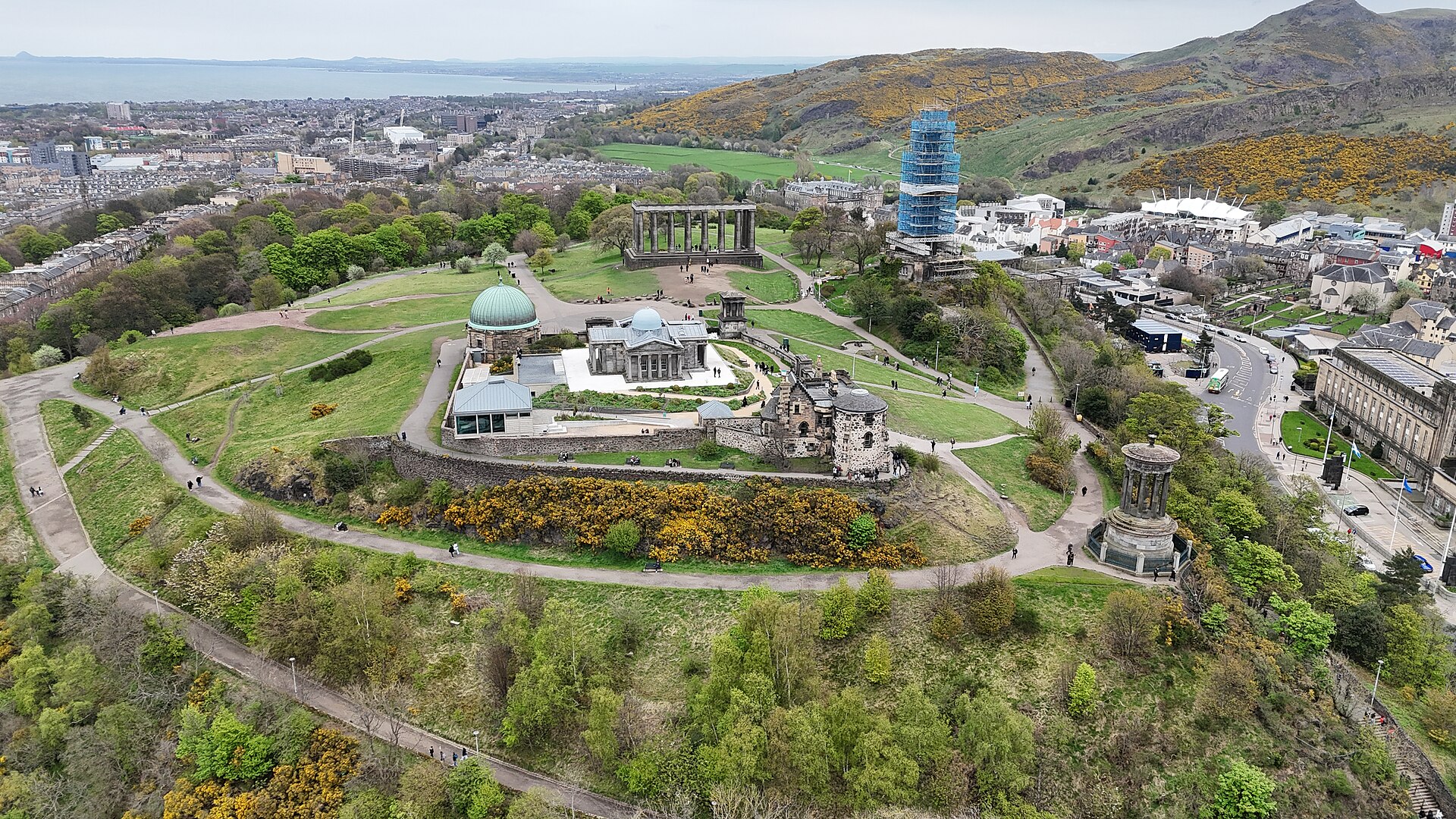
Edinburgh has places that don’t announce themselves. Calton Hill is one of them. It’s smaller than Arthur’s Seat, less imposing than Castle Rock, and that’s why it stays with you. Between the Old and New Towns, its slopes rise just enough to make you slow down. From the top, the city spreads out: gothic spires, modern rooftops, the sea in the distance, the Pentland Hills blurred on the horizon. But the real view isn’t the panorama—it’s how close everything feels. The streets shrink, the buildings tilt toward you, as if the city has leaned in to be seen.
In the 1700s, as the city outgrew its medieval walls, Calton Hill became a threshold. For years, it was common land—cattle grazed, laundry dried on the wind, locals cut through on their way somewhere else. By the 1800s, it was turned into one of Scotland’s first public parks, with paths, benches, and a pond that’s now gone. Today, it’s still a place without rules. Students read on the grass, families let their kids run ahead, visitors step off the Royal Mile to catch their breath.
The buildings around the hill show how Edinburgh grew. To the north, the neat Georgian facades of the New Town, designed by James Craig. To the south, the Old Town’s alleys, where every cobblestone feels old. The hill looks natural, but it isn’t—the slopes were shaped, the summit raised to make the climb easier. At the top, a neoclassical pavilion from the 1820s stands unfinished. It was meant to be a Parthenon for those lost in the Napoleonic Wars, but money ran out after twelve columns. Now it’s a ruin, a place for photos and quiet thoughts.
There’s nothing here you *have* to see. No museums, no attractions, no lists. What Calton Hill gives you instead is space. The gulls circle quietly. The air smells of cut grass, or on cold days, woodsmoke from chimneys far away. In the morning, mist hides the city, leaving only the tops of spires and trees. Spring brings daffodils; summer bleaches the grass pale; autumn turns the maples red. Winter makes the climb feel like a small adventure, the ground crunching underfoot.
For locals, the hill holds memories. Childhood bike rides downhill, picnics on checkered blankets, first dates under the unfinished monument. Students still gather here at the end of term. The hill has been in poems, songs, and 19th-century celebrations with fireworks and brass bands. Those big events are gone, but the feeling remains—especially on summer evenings, when people sit on the slopes with guitars and wine.
You can climb from any direction. From St Andrew Square, past townhouses and hidden gardens. Toward the Royal Mile, through narrow closes where cafés sell shortbread. Near Waverley Station, the city’s noise fades quickly into leaves. The shortest way starts at Princes Street, where the trees frame the castle on its crag.
Calton Hill isn’t just a place to walk. It’s where you watch the city change. Dawn over the Firth of Forth, the streets empty at night, the midday crowds flowing and ebbing. By evening, the wet pavements glow under streetlamps, shadows stretch long. The hill feels like the city’s quiet center.
No crowds, no queues. You can come anytime, sit on a bench, and let time pass. Sometimes a busker plays near the top. Sometimes an artist sets up an easel. On weekends, picnickers fill the slopes; in winter, children sled down the gentle hills. Calton Hill isn’t preserved—it’s lived in. That’s why it matters. It’s a reminder that Edinburgh isn’t just history. It’s still happening.