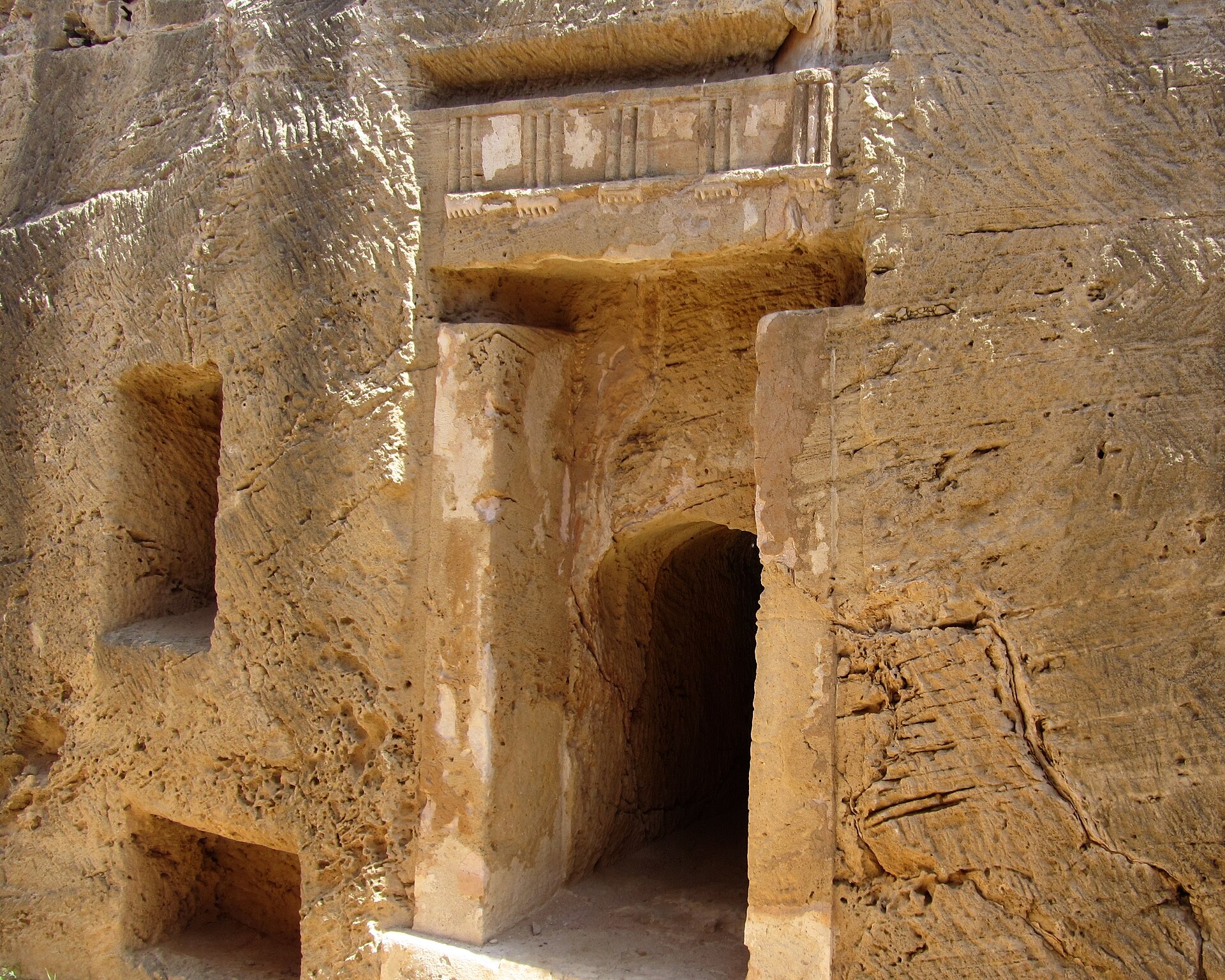
The Tombs of the Kings is one of those places where history feels almost tangible, as if the past hasn’t quite faded into the background but lingers in the stone and the sea breeze. Carved into the soft limestone rock near Paphos, this vast necropolis dates back to the 4th century BC, though its use continued well into the Roman period. Despite its name, the tombs were not actually built for royalty—at least, not in the way most people imagine. Instead, they served as the final resting place for high-ranking officials, wealthy merchants, and prominent citizens of ancient Paphos, which was then a thriving coastal city and a key center of Hellenistic culture in Cyprus.
Walking through the site, you can’t help but notice how the tombs mimic the architecture of the living. The underground chambers and colonnaded courtyards were designed to resemble the grand houses of the time, a reflection of the belief that the afterlife was an extension of earthly existence. Some tombs even feature Doric columns, their fluted shafts still standing after centuries of erosion, while others have intricate carvings that hint at the craftsmanship of the era. The largest tombs are arranged around sunken atriums, open to the sky, where families might have gathered for rituals or offerings. It’s easy to imagine the quiet solemnity of these spaces, the flicker of oil lamps casting shadows on the walls, the scent of incense mingling with the salt air.
The necropolis wasn’t just a burial ground; it was a statement. In the Hellenistic world, status was everything, and the grandeur of these tombs was a way for the elite to assert their importance even in death. Some of the tombs were reused over generations, their chambers expanded or repurposed as the city’s fortunes shifted. By the Roman period, Paphos had become the island’s capital, and the necropolis grew alongside it, absorbing new influences. You can see this evolution in the details—the later tombs sometimes blend Greek and Roman styles, with arched doorways or more elaborate facades. It’s a reminder that history isn’t static; it layers itself over time, each era leaving its mark.
What makes the Tombs of the Kings so striking is their setting. The site sits just a short distance from the Mediterranean, and the sea is always present, its rhythmic waves a counterpoint to the stillness of the stone. The tombs were originally closer to the water, but centuries of coastal erosion have shifted the shoreline, leaving them slightly inland. On a clear day, the light here is almost crystalline, sharpening the edges of the rock and turning the limestone a pale gold. In the early morning or late afternoon, when the sun is low, the shadows stretch long and dramatic, accentuating the depth of the tombs. It’s a place that rewards slow exploration—there’s no rush, no crowds in the way, just the quiet and the wind.
The tombs were largely forgotten after antiquity, buried under layers of sand and earth until their rediscovery in the 20th century. Excavations revealed not just the tombs themselves but also artifacts that offered clues about the lives of those buried here—coins, pottery, jewelry, and even fragments of frescoes. Some of these finds are now displayed in local museums, but the site itself remains the most evocative testament to Paphos’s past. Unlike the polished ruins of more famous ancient cities, the Tombs of the Kings feel raw and unmediated, as if they’ve only just been uncovered. There’s a sense of discovery here, even for visitors who know what to expect.
One of the most interesting things about the site is how it challenges expectations. The name "Tombs of the Kings" conjures images of pharaohs and pyramids, but this is something entirely different—a necropolis shaped by Greek and Roman traditions, where the dead were honored with the same architectural language as the living. There are no mummies or golden sarcophagi here, no grand narratives of divine rulers. Instead, there’s a quieter kind of history, one that speaks to the everyday rituals of grief and remembrance. The tombs were meant to be visited, to be seen, and in that way, they connect the past to the present. Even now, people come to walk among them, to touch the stone, to wonder about the lives that once filled these spaces.
The site is also a reminder of how deeply Cyprus is tied to the Mediterranean world. Paphos was a crossroads of cultures, a place where Greek, Roman, and later Byzantine influences intersected. The Tombs of the Kings are just one piece of that larger story, but they’re a particularly vivid one. They show how ideas traveled—how the concept of a grand tomb, borrowed from the Egyptians, was adapted by the Greeks, then reinterpreted by the Romans. The result is something uniquely Cypriot, a blend of styles and traditions that feels both familiar and strange. It’s this layering of history that makes the site so compelling, not just as an archaeological wonder but as a place that invites reflection.
Visiting the Tombs of the Kings isn’t like stepping into a museum. There are no glass cases or explanatory plaques cluttering the view, just the tombs themselves, open to the elements. The site is managed with a light touch, allowing visitors to wander freely, to sit on the steps of a tomb, to listen to the sound of the sea. It’s a place that encourages you to slow down, to look closely at the details—the way the stone has been worn smooth by time, the faint traces of carvings that have almost disappeared. There’s a certain melancholy here, but also a sense of continuity. The tombs were built to endure, and in their own way, they have. They’ve outlasted empires, survived earthquakes, and now stand as silent witnesses to the passage of time.
If you’re in Paphos, the Tombs of the Kings are worth visiting not just for their historical significance but for the atmosphere they create. It’s a place where the past feels close, where you can almost hear the echoes of ancient voices. The site isn’t vast—you can explore it in an hour or two—but it’s dense with meaning. Whether you’re interested in history, architecture, or simply the quiet beauty of a place shaped by time, the tombs offer something unexpected. They remind you that history isn’t just about grand events or famous names; sometimes, it’s about the small, human details—the way a family might have gathered here centuries ago, the way the light falls on the stone, the way the sea breeze carries the scent of salt and thyme. It’s these moments that make the Tombs of the Kings more than just a tourist attraction; they make it a place worth remembering.