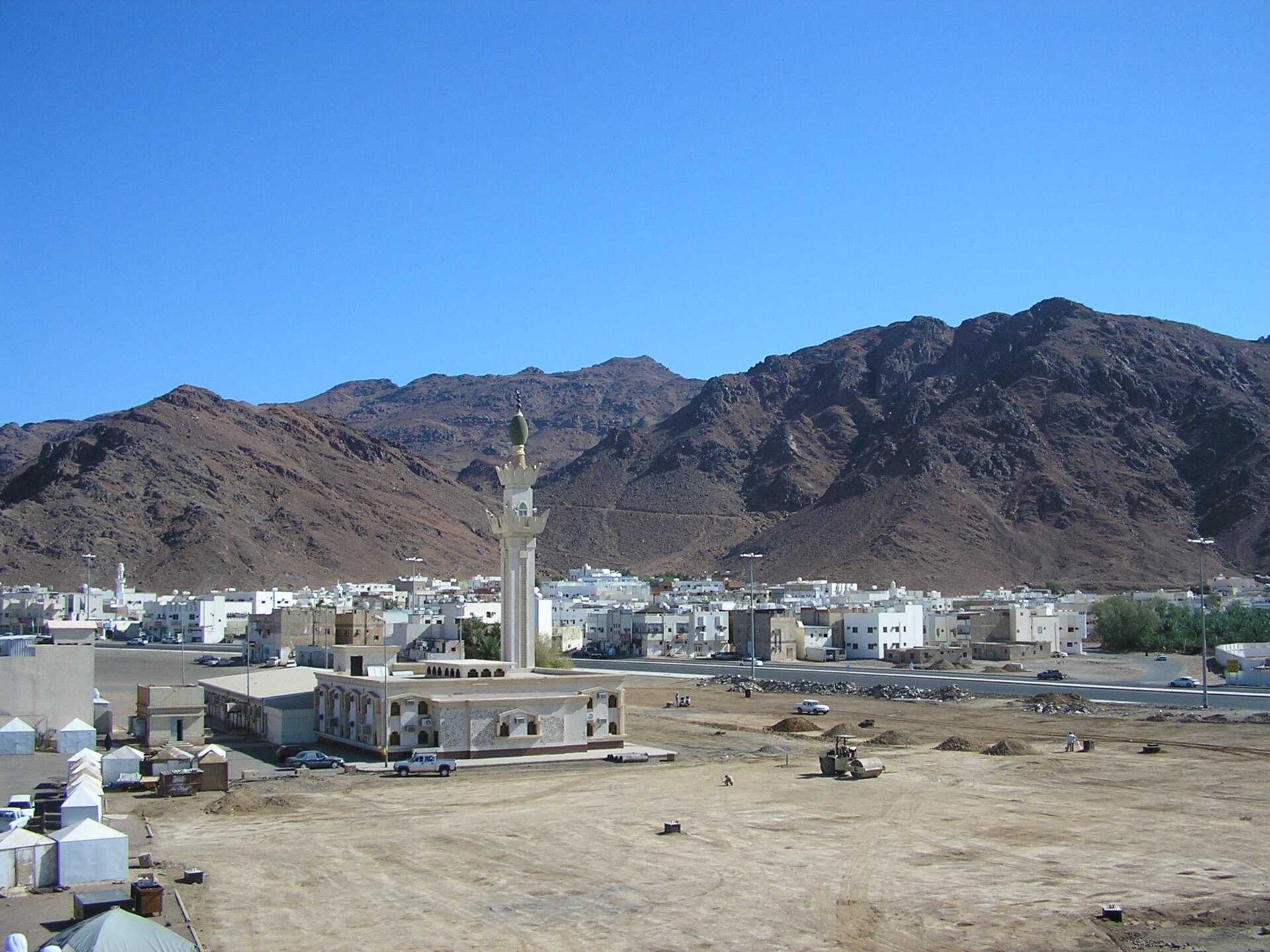
Mount Uhud rises just north of Medina, a silent witness to events that shaped the course of Islamic history. Its slopes, sparse with vegetation, climb to a modest height of around a hundred and ten meters, yet the significance of this place cannot be measured in mere elevation. Here, in the valley at its base, the Battle of Uhud unfolded in 625 AD—one of the defining conflicts of early Islam, when a small Muslim community led by the Prophet Muhammad faced the far larger forces of the Meccans. Today, the mountain remains a place of pilgrimage and reflection, drawing not only the faithful but also those who seek to connect with history and feel the weight of the past.
The ascent to the summit is gentle, winding between rocks and boulders along a well-trodden path. From the top, the view stretches across Medina: the minarets of its mosques, the white rooftops of homes, and the endless desert beyond the city. On clear days, the horizon seems boundless, the air filled with a quiet broken only by the occasional voices of pilgrims or the whisper of wind through the stones. Scattered along the slopes are small caves, said to have sheltered warriors during the battle. One, closer to the peak, is believed to be where the Prophet Muhammad prayed before the fighting began.
The Battle of Uhud was a trial for the fledgling Muslim community. After their victory at Badr, confidence ran high, but this time fortune turned against them. The Meccans, seeking revenge, marched on Medina with a force of three thousand. The Muslims, numbering around seven hundred, took position near the mountain, using its natural terrain as a barrier. Yet divisions among the defenders and a sudden maneuver by Meccan cavalry led to their defeat. Among the fallen was the Prophet’s uncle, Hamza ibn Abd al-Muttalib, who became one of the most revered martyrs in Islam.
Today, the slopes of Uhud hold a cemetery where the martyrs of that battle are buried. The graves are simple, marked only by unadorned stones, but for the faithful, this place is sacred. There are no grand memorials or ornate tombs—just silence and memory. Nearby stands a small mosque, built in honor of the fallen. Its light-colored stone walls blend seamlessly with the landscape, while its minaret rises above the valley, a quiet reminder of events long past.
Uhud is more than a battlefield; it is a symbol of resilience and faith. In Islamic tradition, it is remembered as the place where the Prophet received revelations about the importance of patience and unity. Though defeated, the Muslims did not falter. Instead, they rallied around their leader, a turning point that helped them endure future trials. Today, pilgrims climbing the mountain often pause to pray and reflect, drawing parallels between those ancient struggles and their own lives.
The area around Uhud also bears traces of the past. In the valley below, remnants of ancient fortifications still stand—rough stone walls that once defended Medina. These structures evoke a time when the city was a small oasis surrounded by adversaries. Now, the land is quiet, but if you listen closely, you can almost hear the echoes of the past: the shouts of warriors, the neighing of horses, the clash of swords.
Visiting Mount Uhud is not just a sightseeing trip; it is an immersion in history. There are no crowds of tourists or bustling souvenir stalls, only an atmosphere of tranquility and contemplation. Many come at sunset, when the rocks glow golden and shadows stretch long and mysterious. In these moments, past and present seem to merge, and Uhud reveals itself not just as a point on a map, but as a living witness to centuries gone by.
For the people of Medina, the mountain is woven into daily life. Locals often visit to escape the city’s hustle, breathing in the fresh air and taking in the views. Children play at its base while elders sit on the rocks, reminiscing. Here, history and modernity coexist, and anyone who climbs Uhud becomes part of that unbroken thread of time.
Mount Uhud is a place where history comes alive. It offers a chance to feel the breath of the past, to understand how events from over a thousand years ago shaped the culture and faith of millions. Whether you come as a pilgrim or a curious traveler, Uhud leaves its mark. Perhaps because it is one of those rare places where the past isn’t just recorded in books—it lives in the stones, the wind, and the silence.