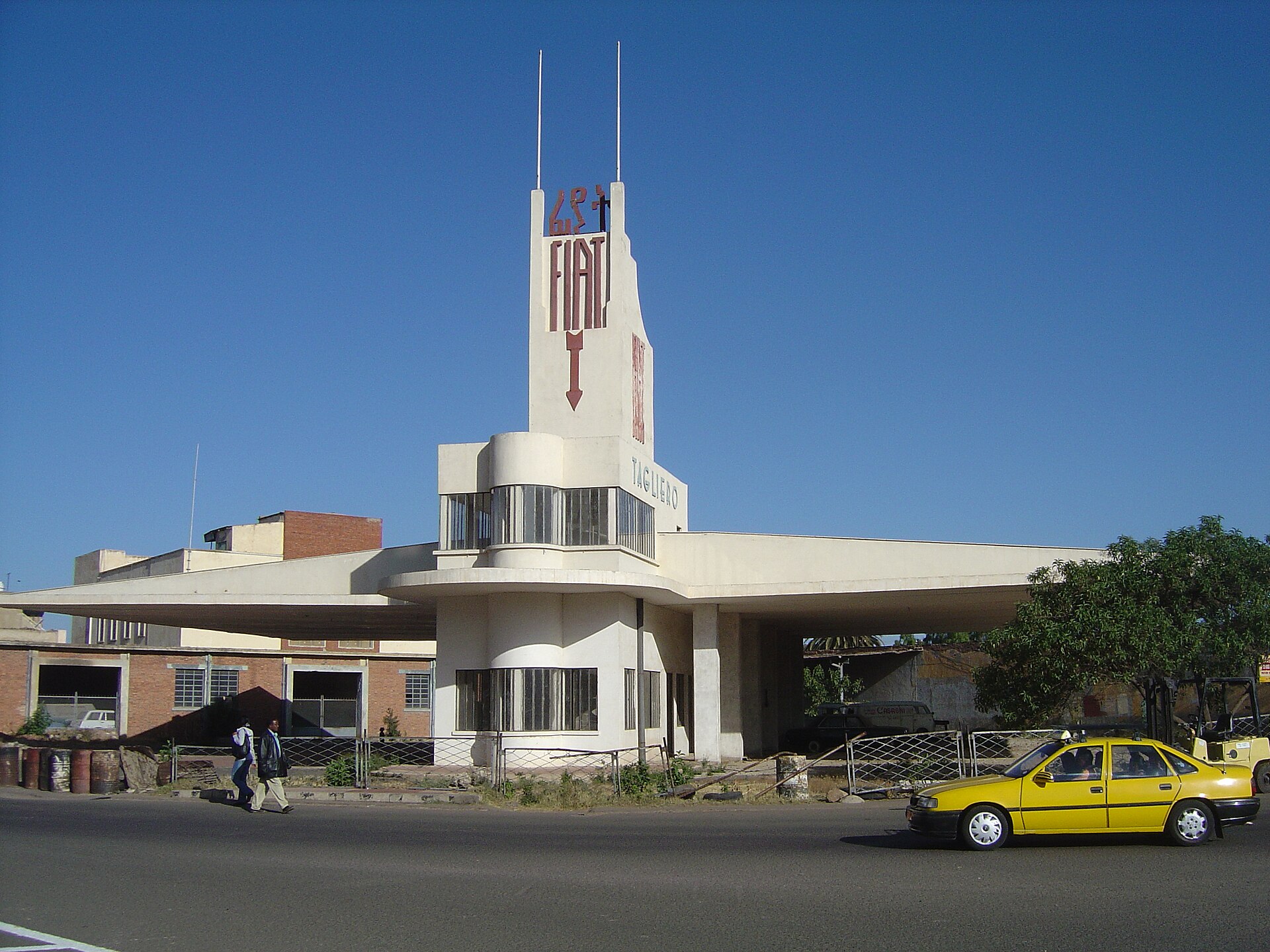
Asmara’s Fiat Tagliero is one of those rare buildings that seems to defy both time and gravity. Perched on a busy intersection just off the city’s main thoroughfare, this futuristic structure looks like something plucked from a 1930s science fiction magazine and dropped into the heart of Eritrea’s capital. Built in 1938, it was originally a filling station for Fiat, designed by the Italian engineer Giuseppe Pettazzi. But what makes it remarkable isn’t just its function—it’s the way it looks, as if it might at any moment lift off into the sky.
The building is shaped like an airplane, complete with a central tower that resembles a fuselage and two sweeping wings that stretch out on either side. The wings, each supported by a single slender column, appear to hover above the ground, giving the whole structure an almost weightless quality. At the time of its construction, this was no small feat. Reinforced concrete was still a relatively new material, and the engineering required to make those wings cantilever out without additional supports was cutting-edge. Pettazzi’s design was so bold that local authorities reportedly insisted on temporary supports being added during construction, fearing the wings would collapse. The supports were removed once the concrete had fully set, and the building has stood firm ever since.
The Fiat Tagliero wasn’t just an architectural experiment—it was a statement. Asmara in the 1930s was a city in the midst of transformation. Under Italian colonial rule, it was being reshaped into a modernist showcase, a place where fascist Italy could demonstrate its technological and cultural ambitions. The filling station was part of a broader wave of construction that included cinemas, cafés, and government buildings, all designed in styles that ranged from Art Deco to Rationalism. The Fiat Tagliero, with its streamlined form and aerodynamic lines, embodied the era’s fascination with speed, progress, and the machine age. It was a symbol of Italy’s vision for Asmara—a city that was meant to be both a colonial outpost and a laboratory for modernist ideas.
Today, the building stands as a relic of that era, though its original purpose has long since faded. The filling station closed decades ago, and the structure has been repurposed over the years, serving as everything from a bus stop to a small shop. The paint is chipped in places, and the once-gleaming concrete shows signs of wear, but the building’s bold silhouette remains unmistakable. It’s a reminder of how Asmara became known as "Africa’s Little Rome," a city where Italian architectural influences are still visible at every turn. The Fiat Tagliero isn’t just a curiosity—it’s a piece of living history, a snapshot of a moment when Asmara was being reinvented as a modern metropolis.
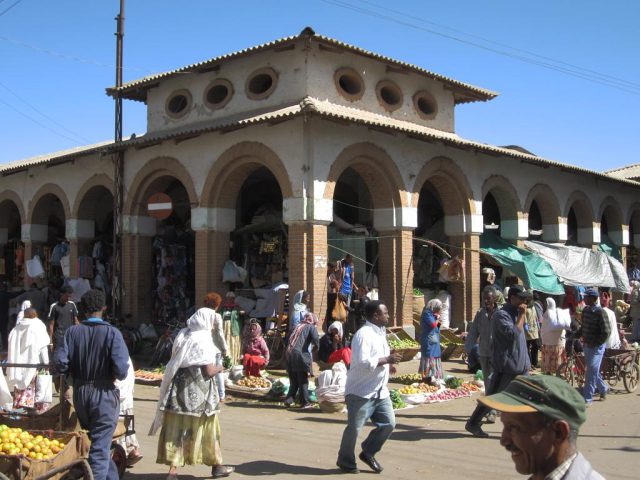
What’s striking about the Fiat Tagliero is how it fits into the city’s rhythm today. Asmara is a place where the past and present coexist in unexpected ways. The building sits on a corner where vendors sell fruit and spices, where taxis idle in the shade, and where the hum of daily life continues around it. It’s not a museum piece, roped off and preserved behind glass—it’s part of the city’s fabric, a landmark that locals pass by without a second thought, even if they recognize its oddity. Tourists, on the other hand, often stop to stare, snapping photos of its improbable design. The contrast between the building’s futuristic aesthetic and the everyday life unfolding around it is part of what makes it so compelling.
The story of the Fiat Tagliero is also a story about Asmara itself. The city’s modernist architecture has gained international recognition in recent years, with UNESCO designating its historic center as a World Heritage Site in 2017. The listing was a long time coming, and it acknowledged not just the individual buildings but the way they collectively tell a story about colonialism, modernity, and urban planning. The Fiat Tagliero is one of the standout examples of this legacy, a building that captures the optimism and ambition of its time. It’s a reminder that architecture isn’t just about function—it’s about ideas, about the dreams of the people who built it and the society it was meant to serve.
Visiting the Fiat Tagliero is a low-key experience. There’s no grand entrance, no guided tour, no plaque explaining its significance in great detail. You simply walk up to it, stand beneath its wings, and look up. The building’s scale is more intimate than you might expect from photos—it’s not a towering monument, but something human-sized, almost playful in its proportions. The central tower is narrow, with small windows that hint at the offices or storage spaces inside. The wings, meanwhile, are thin and delicate, their undersides curved like the hull of a ship. It’s easy to imagine how radical this design must have seemed in the 1930s, when most filling stations were little more than functional sheds.
The building’s location adds to its charm. It sits at the edge of Asmara’s commercial district, where the streets are lined with shops selling everything from textiles to electronics. The area is lively but not overwhelming, a place where you can wander without feeling rushed. Nearby, you’ll find other remnants of Asmara’s modernist past—the Cinema Impero with its Art Deco façade, the Bar Zilli with its vintage signage, the former Casa del Fascio with its stark, geometric lines. Together, these buildings create a sense of walking through a different era, one where the future was imagined in concrete and steel.
The Fiat Tagliero isn’t just a relic—it’s a conversation starter. It raises questions about what gets preserved and why, about the legacy of colonialism, and about how cities evolve. Asmara’s modernist buildings were built for a specific purpose, serving a colonial administration that is now long gone. Yet they endure, not just as historical artifacts but as part of the city’s identity. The Fiat Tagliero, with its bold design and improbable engineering, is a testament to the fact that architecture can outlast the ideologies that created it. It’s a building that invites you to look up, to wonder, and to see the city in a new light.