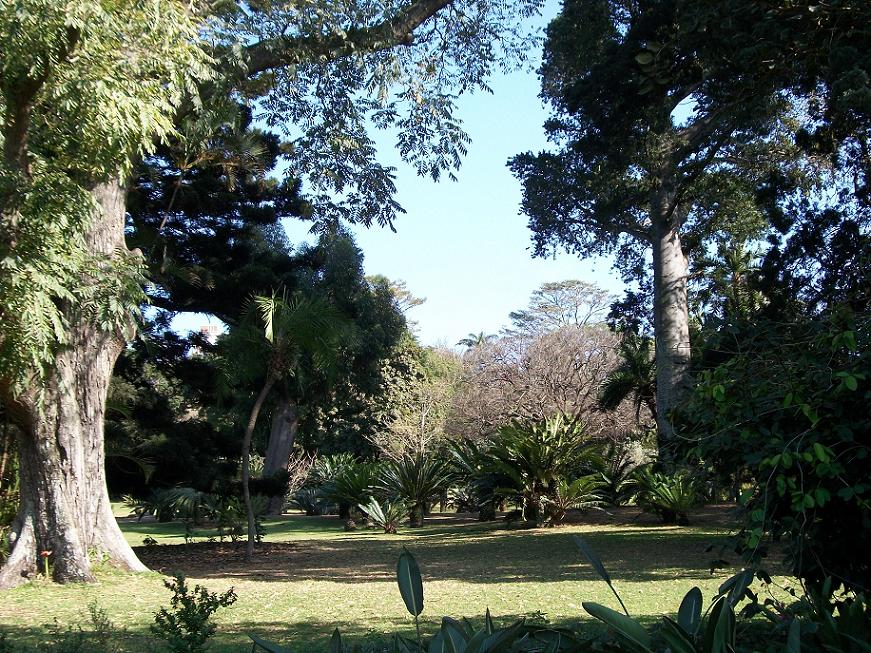
Durban Botanic Gardens feels like a quiet pause in the middle of a city that never stops moving. Tucked between the hum of traffic and the distant murmur of the Indian Ocean, it’s one of those rare places where the past and present coexist without effort. Established in the late 1800s, it was South Africa’s first botanic garden, created not just as a scientific hub but as a refuge for a growing colonial port town. Back then, Durban was a place of new beginnings—where ships arrived with exotic seeds and settlers dreamed of taming a wild landscape. Today, the gardens still carry that sense of discovery, though now it’s less about conquest and more about understanding.
The twenty hectares of land unfold like a carefully written story, each section revealing something different. The entrance is shaded by towering trees, some planted over a century ago, their branches forming a natural canopy that softens the African sun. Among them, the giant figs and ancient araucarias stand out, their gnarled roots and thick trunks hinting at the decades they’ve witnessed. The palm avenue is perhaps the most striking feature—a long, straight path lined with species from across the globe. There’s the regal queen palm from South America, the sturdy date palm from North Africa, and the rare raffia palm from Madagascar, its leaves so large they could shelter a person. Walking here feels like flipping through an atlas of the world, each tree a marker of some distant place and time.
One of the garden’s quiet treasures is its orchid collection, housed in a greenhouse where humidity clings to the air. Hundreds of species bloom here, some so delicate they flower for only a few weeks a year. Many are native to South Africa, their intricate shapes and vibrant colors a testament to the country’s biodiversity. Nearby, the water gardens offer a different kind of beauty—ponds dotted with giant water lilies, their pads broad enough to hold a small child. Dragonflies dart above the surface, and if you’re lucky, you might spot a malachite kingfisher perched on a reed, its feathers a flash of emerald and blue. The gardens attract all kinds of wildlife, from sunbirds sipping nectar to the occasional monitor lizard basking in the sun, reminding visitors that this is still very much a living ecosystem.
The history of the gardens is woven into Durban’s own story. In the late 19th century, the city was a bustling outpost of the British Empire, a place where trade routes converged and fortunes were made. The botanic gardens became a symbol of progress, a place where the latest scientific ideas met colonial ambition. Botanists experimented with plants brought from across the empire, testing which could thrive in the subtropical climate. The gardens were also a social hub—ladies in long dresses sipped tea under the trees, while gentlemen debated the merits of new agricultural crops. Some of that old-world charm lingers in the wooden pavilions and stone bridges, their weathered surfaces now softened by creeping vines and moss.
Beyond the exotic, the gardens also celebrate the plants native to KwaZulu-Natal. Here, you’ll find proteas, their striking blooms a national symbol, as well as an array of succulents that have adapted to the region’s dry spells. Some look almost sculptural, like the thick-leaved jade plants or the towering aloes, their flower spikes glowing like torches in the sunlight. A separate section is dedicated to medicinal plants, many of which have been used for generations by the Zulu people. Visitors can learn about traditional remedies—how a particular root was brewed into tea for fever or how leaves were crushed to treat wounds. It’s a reminder that this land has always been a source of knowledge, long before botanists arrived with their notebooks and labels.
The gardens aren’t stuck in the past, though. They’re a place where new ideas take root, quite literally. Throughout the year, there are workshops on sustainable gardening, talks on conservation, and even art exhibitions that draw inspiration from the natural world. Children’s programs teach young visitors about pollinators, seed dispersal, and why biodiversity matters. On weekends, the gardens come alive with music—local bands playing under the trees, families spreading out picnic blankets, and couples strolling hand in hand. In summer, the air is thick with the scent of frangipani, and the lawns are dotted with people escaping the heat, their laughter blending with the rustle of leaves.
What makes the Durban Botanic Gardens special is how seamlessly it fits into the rhythm of the city. It’s not a museum piece, cordoned off and untouchable. Instead, it’s a place where life happens—where students cram for exams on benches, where joggers weave through the paths at dawn, and where elderly couples sit on the same bench every afternoon, watching the world go by. The gardens have become a part of Durban’s identity, a green lung in the middle of urban sprawl. There’s no pressure to rush, no scripted tourist experience. Just the quiet pleasure of wandering, of stumbling upon a hidden grove or a particularly fragrant flower, and feeling, for a moment, like you’ve stepped outside of time.
In recent years, the gardens have also become a space for conversations about the environment. There are tree-planting initiatives, clean-up drives, and efforts to protect endangered species. Some plants here are the last of their kind in the wild, preserved by the care of horticulturists who understand their value. It’s a small but important reminder that conservation isn’t just the work of scientists—it’s something everyone can be a part of. Walking through the gardens, it’s hard not to feel a sense of responsibility, to wonder what will happen to these plants, these birds, these trees if we don’t pay attention.
At its heart, the Durban Botanic Gardens is a place of contradictions. It’s both cultivated and wild, historic and ever-changing, a slice of the British Empire and a celebration of African nature. There’s something comforting in its order—the neatly labeled plants, the manicured lawns, the winding paths that always lead somewhere—but also something unpredictable. A sudden downpour might send visitors scurrying for cover, or a troop of vervet monkeys could swing through the trees, their antics drawing laughter from onlookers. It’s this balance that makes the gardens feel alive, like a story that’s still being written.
Whether you spend an hour or a whole day here, the gardens have a way of lingering in your memory. Maybe it’s the sight of a rare orchid in bloom, or the sound of water trickling over rocks in the Japanese garden, or simply the feeling of shade on a hot day. It’s a place that invites you to slow down, to notice the small things—a butterfly landing on a flower, the way sunlight filters through the leaves, the quiet hum of bees at work. In a world that moves too fast, the Durban Botanic Gardens offers a reminder that some things are worth savoring.