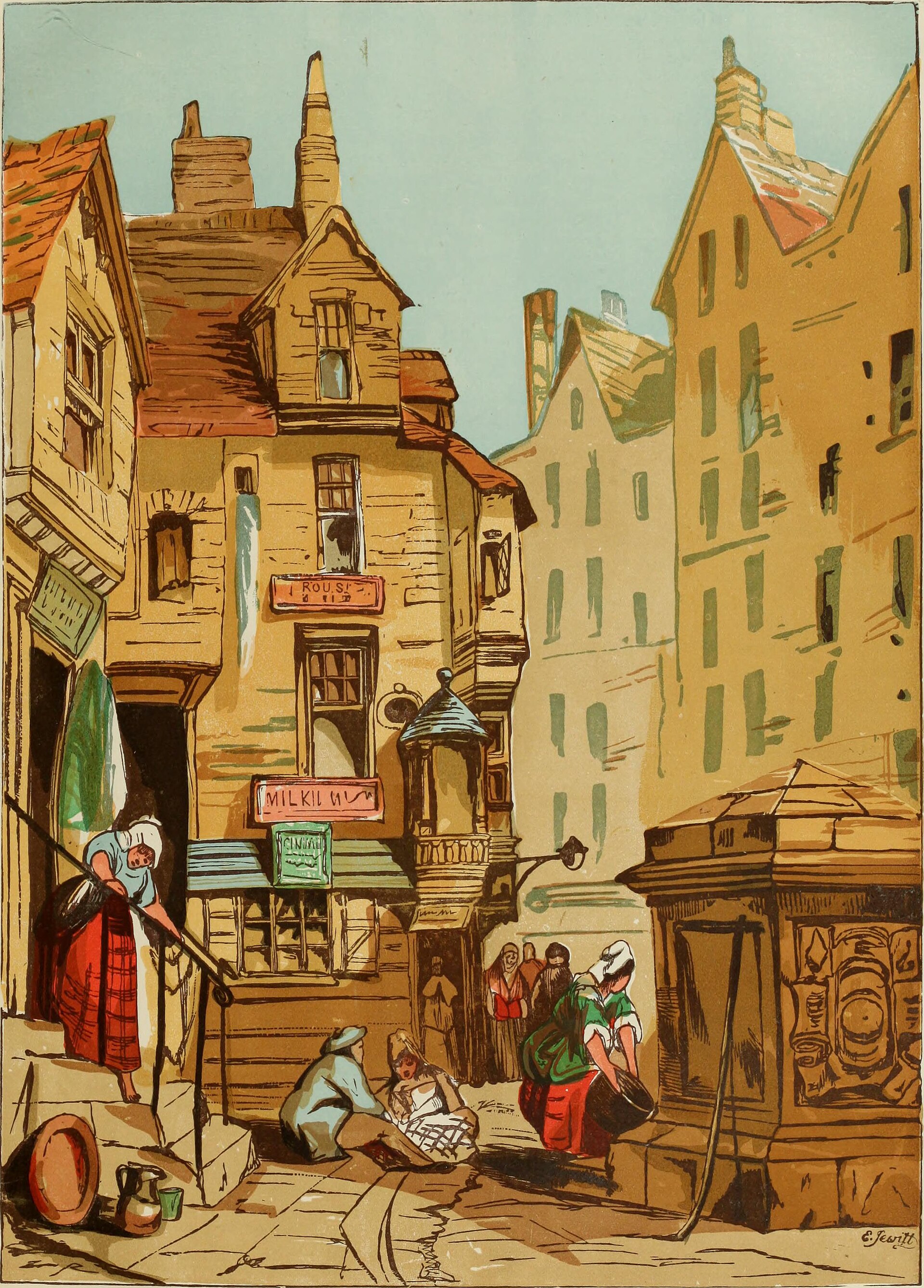
John Knox House stands quietly on Edinburgh’s Royal Mile, a narrow stone building that has witnessed some of the most turbulent moments in Scotland’s history. It’s one of the few surviving medieval houses in the city, and though its exterior appears unassuming—low ceilings, thick walls, small windows—it carries the weight of a nation’s transformation. This was the home of John Knox during the final years of his life, a man whose fiery sermons and uncompromising beliefs reshaped Scotland’s religious and political landscape. Walking through its rooms, you don’t just learn about the past; you feel it in the creak of the floorboards and the faint scent of aged wood.
The house itself is a relic of 16th-century Edinburgh, a time when the city was a maze of narrow closes and towering tenements, where the wealthy lived cheek by jowl with the poor. Its architecture reflects the practical needs of the era: small windows to keep out the cold, thick walls for defense, and a layout designed for both privacy and communal living. The building has been restored with care, preserving its original character without turning it into a stage set. There are no grand halls or ornate decorations here—just the simple, sturdy craftsmanship of a time when survival often depended on resilience rather than luxury.
Inside, the rooms are arranged to evoke the daily life of Knox and his contemporaries. The furniture, though not all original, is of the period, and the displays include personal items that once belonged to the reformer. His study, where he wrote *The History of the Reformation in Scotland*, is particularly striking. The desk is cluttered with books and papers, as if he had just stepped away. It’s easy to imagine him here, pen in hand, drafting sermons that would ignite passions across the country. The house doesn’t romanticize its subject; instead, it presents Knox as he was—a complex figure whose influence was as divisive as it was profound.
Knox’s legacy is impossible to separate from the religious upheavals of his time. A former Catholic priest, he became one of the most vocal leaders of the Protestant Reformation in Scotland, challenging the authority of the Catholic Church and the monarchy. His confrontations with Mary, Queen of Scots, were particularly explosive, as his sermons often directly opposed her policies and personal faith. The museum doesn’t shy away from these controversies. Through letters, pamphlets, and contemporary accounts, it shows how Knox’s ideas polarized society—some saw him as a champion of religious freedom, while others viewed him as a dangerous radical. His role in establishing the Presbyterian Church, which became the dominant faith in Scotland, is explored in detail, revealing how deeply his beliefs shaped the nation’s identity.
Beyond religion, Knox’s influence extended into politics. The Reformation he helped lead wasn’t just about theology; it was about power, governance, and the relationship between church and state. Scotland’s shift toward Protestantism under his guidance had lasting consequences, from the way laws were written to how education was structured. The museum touches on these broader themes, illustrating how the changes Knox set in motion rippled through society. For ordinary Scots, this meant everything from the abolition of Catholic rituals to the introduction of new forms of worship—and, in some cases, persecution for those who resisted.
What makes John Knox House special is its intimacy. Unlike larger museums, where exhibits are often roped off behind glass, here you can move freely through the rooms, examining objects up close. You can sit on a wooden bench in the kitchen, run your fingers over the pages of a centuries-old Bible, or stand in the same spot where Knox once preached to his followers. The house doesn’t overwhelm with grandeur; instead, it invites reflection. It’s a place where history feels personal, where the past isn’t just something you read about but something you experience.
The surrounding Old Town adds to the atmosphere. The Royal Mile, with its cobbled streets and medieval buildings, is the perfect setting for a house like this. Just steps away, St. Giles’ Cathedral—where Knox delivered many of his sermons—stands as a reminder of the religious battles that once raged here. The contrast between the quiet of the museum and the bustle of the city outside makes the visit even more striking. It’s a reminder that history isn’t confined to books; it’s embedded in the very stones of the city.
John Knox House isn’t for those looking for spectacle. There are no flashy displays or interactive exhibits, and the crowds that flock to Edinburgh Castle or the National Museum are noticeably absent. Instead, it offers something rarer: a chance to step back in time without distraction. The house is small enough to explore in an hour, but its impact lingers. It’s a place that encourages you to slow down, to think about the people who lived here and the ideas they fought for. In a city filled with grand monuments, this modest building stands as a testament to the power of conviction—and the quiet spaces where history is made.