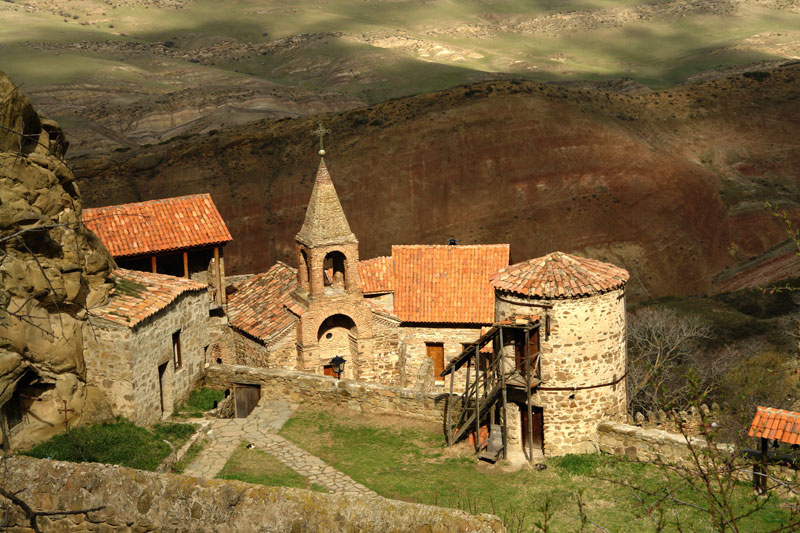
Perched on the edge of Georgia’s arid highlands, where the wind carves patterns into the dust and the sun bleaches the rocks to a pale gold, David Gareja feels less like a monastery and more like a natural extension of the land itself. The complex clings to the slopes of the Iori Plateau, about sixty kilometers from Tbilisi, its stone walls and cave chapels blending seamlessly into the rugged terrain. It’s a place where history isn’t just remembered—it’s still alive in the worn steps of pilgrims, the flicker of candlelight in dimly lit sanctuaries, and the quiet persistence of a community that has endured for over fifteen centuries.
The story of David Gareja begins in the sixth century with a Syrian monk named David, one of thirteen ascetics who traveled to Georgia to spread Christianity. He chose this harsh, unforgiving landscape not for its comfort, but for its isolation—a place where the silence could be filled only with prayer. Over time, his followers expanded the monastery, carving cells, churches, and refectories directly into the rock. The most famous of these is David’s Lavra, where twelfth- and thirteenth-century frescoes still glow with surprising vibrancy. The faces of saints, biblical scenes, and intricate Georgian inscriptions cover the walls, a testament to both religious devotion and artistic mastery. Nearby, other caves reveal traces of daily life: storage rooms, wine cellars, and even remnants of irrigation systems, proof that the monks didn’t just pray here—they worked the land, cultivated vineyards, and adapted to the land’s demands.
The landscape itself is part of the monastery’s identity. The buildings don’t dominate the terrain; they emerge from it, as if the rock had simply been coaxed into shape by human hands. This harmony between architecture and nature makes David Gareja unique. The most striking example is Udabno Monastery, perched on a cliffside with sweeping views of the semi-desert stretching toward the horizon. The climb is steep, but the reward is a sense of timelessness, amplified by the vivid frescoes inside the cave church. These paintings, considered some of Georgia’s finest medieval art, depict saints and biblical figures with a dynamism that feels almost modern. The colors—deep blues, rich reds, and golds—have survived centuries of wind, dust, and neglect, a quiet defiance against the passage of time.
Life here has always been difficult. Water is scarce, and the monks dug deep wells to tap into underground sources. Summers bring scorching heat, while winters are bitterly cold, the wind cutting through even the thickest layers of clothing. Yet the monastery never truly emptied. During invasions—Mongols in the thirteenth century, Persians and Turks in later years—it was looted and damaged, but it always recovered. Even during the Soviet era, when the site was turned into a military training ground, locals risked punishment to visit in secret. The resilience of David Gareja mirrors that of Georgia itself, a place that has repeatedly risen from destruction.
Today, the monastery is a place of pilgrimage, though not in the crowded, commercialized sense of the word. There are no tour buses or souvenir stalls, just a rough dirt road leading from Tbilisi through rolling hills and sparse vegetation. The journey takes about two hours, but the landscape shifts dramatically along the way—from the lush outskirts of the capital to the stark, almost lunar beauty of the plateau. When you arrive, the silence is immediate. The only sounds are the wind, the occasional call of a bird, and the distant murmur of prayers. It’s a place where you can wander for hours, moving from one cave to the next, each with its own story.
The monks who live here now are few, but they keep the traditions alive. They maintain the churches, preserve the frescoes, and welcome visitors with quiet hospitality. In recent years, David Gareja has drawn more attention from historians, archaeologists, and artists, all drawn to its unique blend of spirituality and history. Yet despite the growing interest, the monastery retains its sense of remoteness. There’s no rush here, no agenda—just the slow rhythm of days shaped by prayer, work, and the land itself.
For Georgians, David Gareja is more than a historical site; it’s a symbol of endurance. During centuries of foreign rule and conflict, the monastery stood as a reminder of what mattered most—faith, culture, and the unbroken thread of identity. Today, it continues to serve that role, though in a different way. Visitors come not just to see the frescoes or explore the caves, but to feel the weight of history in the air. It’s a place where the past isn’t distant or abstract; it’s tangible, almost breathing, in the cool shade of the rock-cut chapels and the echoes of ancient hymns.
The journey to David Gareja is as much a part of the experience as the destination itself. The road winds through landscapes that shift from green valleys to barren hills, a reminder of Georgia’s geographical diversity. Along the way, you might pass shepherds guiding their flocks or farmers working small plots of land, their lives still shaped by the rhythms of the seasons. When you finally reach the monastery, the contrast is striking—the quiet intensity of the place, the way the light plays on the stone, the sense of stepping into a world that has remained largely unchanged for centuries.
There’s something humbling about standing in a place where people have prayed, worked, and endured for over a thousand years. David Gareja doesn’t offer grand cathedrals or dramatic vistas; its power lies in its simplicity. It’s a place where the boundaries between nature, history, and faith blur, where the land itself seems to hold the memory of those who came before. Whether you’re drawn by religion, history, or simply the desire to step away from the noise of modern life, the monastery offers a rare kind of stillness—one that lingers long after you’ve left.