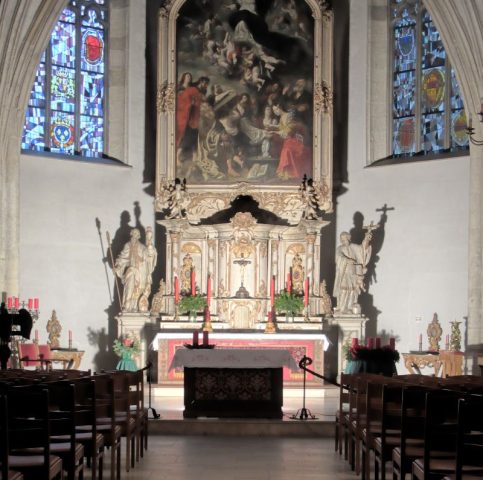
The Church of Saints Peter and Paul sits quietly in the heart of Luxembourg City, just off Place Guillaume II, where the rhythm of daily life moves at an unhurried pace. It’s the kind of place you might walk past without noticing—its facade lacks the grandeur or vivid colors that draw the eye, yet its understated architecture holds a story deeply woven into the city’s past. Built in the early 20th century, the church feels as though it has always belonged here, though in the grand timeline of Luxembourg, it arrived relatively recently.
The building was designed in the Neo-Byzantine style, a choice that reflected a broader European trend at the time, particularly in places with strong Orthodox traditions. Luxembourg, a country more commonly associated with Catholicism, might seem an unlikely home for such a church, but its position at the crossroads of cultures made the style a fitting one. Inside, the space isn’t lavish, but every detail has been carefully considered. Mosaics, icons, and frescoes create a sense of calm, a quiet contrast to the bustle of the square just beyond its walls. The iconostasis, intricately carved and gilded, stands out most of all—its presence feels almost alive, as if it has absorbed the prayers of generations.
The church’s history is closely tied to Luxembourg’s Russian community. In the early 1900s, the city became a refuge for émigrés fleeing the upheavals of the Russian Revolution. For them, this church was more than a place of worship; it was a piece of home in an unfamiliar land. Here, they heard the hymns of their childhood, preserved traditions that were disappearing in their homeland, and found a sense of continuity amid displacement. Over time, the community dwindled, but the church remained, a tangible reminder of an era when Luxembourg unexpectedly became a haven for people from the far reaches of Europe.
Today, the Church of Saints Peter and Paul serves as both an active Orthodox parish and a point of interest for visitors curious about the city’s layered history. Inside, you’ll find icons brought from Russia, along with a few relics connected to the lives of the Russian diaspora in Luxembourg. Services are held in Church Slavonic, and while congregations are smaller than they once were, the atmosphere remains warm and welcoming. For many of its parishioners, the church is more than a place of worship—it’s a living fragment of history, carefully preserved.
From the outside, the church appears modest, but its significance extends beyond religion. It stands as a reminder of how Luxembourg has long been a refuge for different peoples—Spaniards, French, Russians, Portuguese—each wave of migration leaving its mark. The Church of Saints Peter and Paul is one such mark, visible and enduring. It doesn’t compete with the city’s other churches in scale or grandeur, and that’s precisely what makes it special. It doesn’t demand attention, yet it has become an inseparable part of Luxembourg’s urban fabric, a quiet witness to its past.
You can visit the church whenever services aren’t being held. Inside, the noise of the square fades to a murmur, as if the city itself steps back to make room for reflection. For those interested in the history of Orthodoxy in Western Europe—or simply looking to see Luxembourg from an unexpected angle—this place offers a quiet revelation. There are no crowds, no rush, just the chance to step into a space where time seems to move differently.
The Church of Saints Peter and Paul is more than an architectural landmark; it’s a living entity, sustained by the people who value it. On feast days, the congregation gathers, choirs sing, and for a moment, it feels as though the past has returned. On ordinary days, the church stands silent, a patient keeper of stories, ready to share them with anyone who takes the time to listen. It doesn’t shout its history, but for those who pause, it speaks volumes.