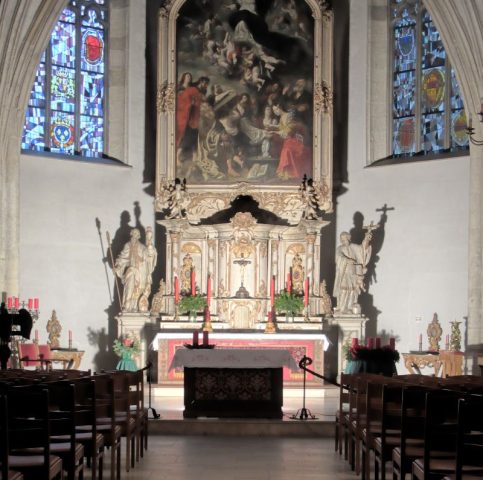
Notre-Dame Cathedral in Luxembourg City is one of those places that reveals itself slowly. At first glance, it might seem like just another Gothic church in the heart of the city, but spend a little time with it, and you begin to sense something deeper. This isn’t a monument frozen in time—it’s a building that has grown alongside the country itself, absorbing its history and reflecting its changes. Unlike the grand medieval cathedrals of France or Germany, Notre-Dame was built in an era when Gothic architecture was already fading, which gives it a unique character. It doesn’t try to compete with the past; instead, it carries the past forward in its own way.
The cathedral’s origins trace back to the early 17th century, when it was founded by the Jesuits during the Counter-Reformation. Back then, it was a modest church, small in scale but significant for the Catholic community in Luxembourg. The city was under Spanish rule at the time, and the Jesuits played a key role in shaping its religious and cultural life. It wasn’t until the 19th century, when Luxembourg gained full independence, that the church was elevated to cathedral status. This transformation wasn’t just symbolic—it marked the moment when the building became a national landmark, a place where the country’s identity could take root.
Architecturally, Notre-Dame Cathedral is a conversation between different eras. The original structure was built in late Gothic style, with its pointed arches, ribbed vaults, and intricate stonework—elements that still define its character today. But over the centuries, the building has been expanded and refined, particularly in the 19th century, when Neo-Gothic touches were added. The result is a harmonious blend rather than a clash of styles. Inside, the high ceilings and slender columns create a sense of openness, while the stained glass, though not as ancient as that of Chartres or Reims, bathes the space in a soft, diffused light. The effect is less about grandeur and more about quiet dignity.
One of the most striking features inside is the main altar, a Baroque masterpiece that stands in contrast to the Gothic lines of the rest of the interior. Nearby, the statue of Our Lady of Luxembourg draws the eye—she’s not just a religious figure but a national symbol, her image appearing on the country’s coat of arms and in local folklore. The cathedral also houses a crypt where members of the grand ducal family are buried. It’s a solemn space, one that feels removed from the bustle of the city above. Walking through it, you can almost hear the echoes of centuries of visitors who came to pay their respects.
Beyond its religious role, the cathedral is a living part of Luxembourg City’s cultural life. It hosts organ concerts that attract music lovers from across the country, and its instrument is considered one of the finest in Luxembourg. The sound of the organ filling the vaulted space is something you don’t easily forget. In the summer, the cathedral’s doors stay open to visitors, and it’s not uncommon to see tourists mingling with locals, all drawn by the same sense of quiet curiosity. Even in the busiest moments, there’s always a corner where you can sit undisturbed, letting the atmosphere settle over you.
From the outside, Notre-Dame Cathedral might not impress with sheer size, but that’s part of its charm. It doesn’t overwhelm; it invites. The façade is adorned with statues of saints and delicate stone carvings, but it’s not overly ornate. Instead, it feels balanced, as if every detail has its place. The best time to see it is in the evening, when the streetlights cast long shadows across the pavement, softening the stone and making the arches seem even more graceful.
The cathedral sits in the heart of Luxembourg City, surrounded by government buildings, cafés, and shops. This juxtaposition of the sacred and the everyday is what makes it feel so alive. You might see a tourist snapping photos of the façade, a local hurrying in for mass, or a child pointing at the stained glass, trying to make out the stories in the colored light. The cathedral doesn’t exist in isolation—it’s woven into the fabric of the city, a reminder that history isn’t just something that happened long ago. It’s happening now, in the way people move through the space, in the way the building itself has adapted over time.
For Luxembourg, Notre-Dame Cathedral is more than just a place of worship. It’s a symbol of continuity, a thread connecting the country’s past to its present. The building has witnessed Luxembourg’s evolution from a small territory within the Holy Roman Empire to one of Europe’s most stable and prosperous nations. That history isn’t locked away in a museum—it’s alive in the stones, in the rituals, in the way the light filters through the windows. Even if you’re not religious, there’s something about the cathedral that makes you pause. It’s the quiet, the sense of time slowing down, the feeling that here, for a moment, you can step outside the rush of modern life.
What makes Notre-Dame special is that it doesn’t demand reverence—it earns it. You don’t need to know its history to feel its presence. The building has a way of making itself felt, whether through the coolness of its stone walls, the echo of footsteps in the nave, or the way the light shifts as the day goes on. It’s a place where the past isn’t just remembered; it’s still being written, one visitor at a time.