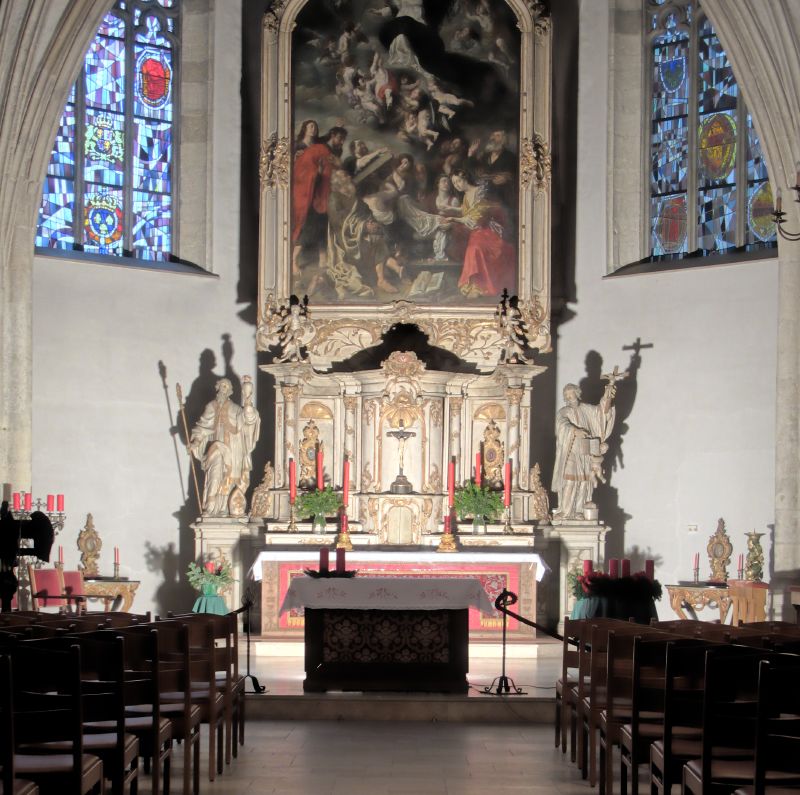
Saint Michael’s Church stands quietly in the heart of Luxembourg City, where the cobblestone lanes of the old quarter meet the rhythm of modern life. Its presence is unassuming yet enduring, a testament to the city’s layered history. The church first appeared in records in 987, built as a chapel for the counts of Luxembourg, and though it has been rebuilt and reshaped over the centuries, it remains one of the country’s oldest places of worship. Each reconstruction left its mark, turning the building into a patchwork of styles that tell the story of Luxembourg’s past—from medieval conflicts to periods of peace and renewal.
The architecture is a conversation between eras. The heavy, rounded arches of the Romanesque period contrast with the pointed elegance of Gothic vaults, while the Baroque flourishes on the façade add a touch of lightness. The main portal is particularly striking, adorned with reliefs depicting scenes from the life of Saint Michael, the archangel who lends the church its name. Inside, the space feels intimate yet grand, with sunlight filtering through stained-glass windows to cast colored patterns on the stone walls. The wooden altar, intricately carved, draws the eye with its craftsmanship, a quiet reminder of the skill and devotion that went into its creation.
Unlike many historic sites, Saint Michael’s Church is not just a relic of the past. It remains an active place of worship, where services are held regularly and the local community gathers. The atmosphere inside is one of stillness, a rare calm in a city that otherwise hums with activity. On Sundays, the sound of the organ fills the nave, and the scent of incense lingers in the air. Even outside of service times, visitors can sit on the wooden pews, listening to the occasional echo of footsteps or the distant murmur of the city beyond the walls.
The church has witnessed much of Luxembourg’s history firsthand. In the Middle Ages, it was part of the city’s fortifications, a place of refuge during sieges. Later, under French occupation, it was repurposed as a storage space, its sacred function temporarily forgotten. By the 19th century, there were even plans to demolish it to make way for new development—a fate that, fortunately, never came to pass. Today, it stands as a symbol of resilience, a building that has outlasted wars, occupations, and the relentless march of time.
For those exploring Luxembourg, Saint Michael’s offers a different kind of experience. While the city’s grand ducal palace and Notre-Dame Cathedral draw larger crowds, this church provides a moment of quiet reflection. There are no guided tours or audio guides here, just the chance to wander at your own pace, taking in the details that might otherwise go unnoticed. The surrounding streets add to the charm, with small cafés where locals linger over coffee and tiny shops selling handmade crafts. The area feels like a village within the city, where the past is never far from the surface.
The best times to visit are early morning or late afternoon, when the light is soft and the shadows long. The stone walls glow in the golden light, and the church seems to breathe with the city around it. It’s easy to imagine the generations of worshippers who have passed through its doors, each leaving their own mark on its history. Whether you come for the architecture, the atmosphere, or simply a moment of peace, Saint Michael’s Church offers a glimpse into the soul of Luxembourg—a place where history is not just remembered, but lived.