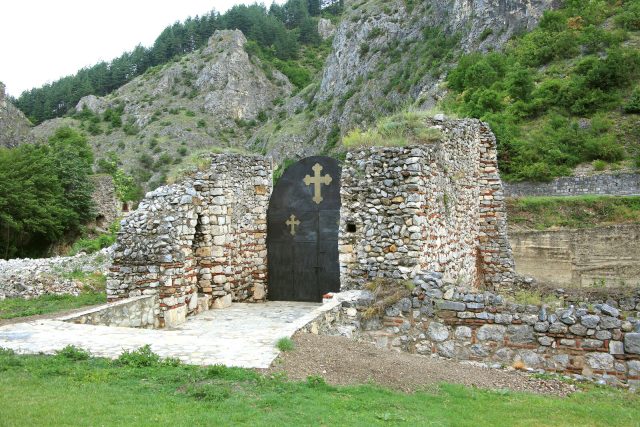
Perched on a gentle slope above Prizren’s old town, the Church of Saint Saviour feels like a quiet witness to centuries of change. It doesn’t command attention the way grander monuments do, but that’s part of its charm—small, unassuming, yet deeply rooted in the city’s layered past. Built in the 14th century, when Prizren was a thriving cultural and religious hub of the Serbian Empire, the church reflects an era when faith and art were inseparable. The city was known for its workshops, where frescoes and icons were crafted with care, and this modest structure stands as a testament to that tradition.
The architecture is classic Byzantine, a style that defined the Balkans during the Middle Ages. The church is compact, with a single dome and sturdy stone-and-brick walls that balance strength and elegance. Inside, fragments of frescoes remain, their colors faded but still carrying the warmth of the artists who painted them. The apse, in particular, holds traces of traditional Orthodox iconography—soft, muted scenes that hint at the devotion poured into every brushstroke. Time has worn away much of the detail, yet the church endures, a silent record of resilience through upheaval.
Prizren has always been a crossroads of cultures, and the Church of Saint Saviour has seen its share of transformations. During the Ottoman period, it was converted into a mosque, only to revert to its original purpose later. Such shifts were common across the Balkans, where borders and beliefs ebbed and flowed over centuries, but few places wear these changes as visibly as this church. Its walls bear the marks of different eras, each layer telling a story of adaptation and survival. Today, it stands as a reminder that history isn’t just a sequence of events—it’s a living fabric woven from countless human experiences.
The church sits near the old bridge over the Prizren Bistrica River, surrounded by narrow streets lined with Ottoman-era houses. This part of the city feels suspended in time, where the past lingers in the cobblestones and the quiet rhythm of daily life. Centuries ago, merchants haggled in the bazaar, craftsmen worked in their shops, and worshippers gathered here for services. Now, the area is quieter, but the atmosphere remains. In the late afternoon, when the sun casts a golden glow over the stone walls, the church seems to exist outside of time, as if the centuries between then and now have softened into something almost tangible.
Unlike many historic sites, the Church of Saint Saviour isn’t a museum, nor is it an active place of worship. It occupies a space somewhere in between—a quiet keeper of memory, open to those who seek it out. There are no crowds here, no rushed tours, just the chance to linger over the details: the uneven texture of the walls, the faint outlines of frescoes, the subtle signs of restoration. Occasionally, small exhibitions or cultural events take place inside, but more often, the church simply stands in stillness, a silent presence that invites reflection.
For anyone curious about the Balkans, this church offers more than just architectural beauty. It’s a key to understanding how identity was shaped in a region where cultures collided and coexisted. There are no grand legends or epic battles tied to this place, but that’s precisely what makes it meaningful. The real story lies in the quiet persistence of the building itself—each stone, each crack a fragment of a history that isn’t written in textbooks but can be felt if you listen closely. Prizren is a city of layers, where every neighborhood holds its own past, and the Church of Saint Saviour is one of its most understated yet evocative chapters.
Visiting the church doesn’t require planning or effort. It’s a short walk from the city center, down winding streets past carved wooden balconies and small shops selling sweets. There are no parking lots or tourist signs, just the sense of stepping into a place that hasn’t been polished for visitors. You can come without an agenda, sit on the low wall outside, and let your thoughts wander. How many people have crossed this threshold over the centuries? What prayers were whispered under these arches? What hopes and sorrows were carried within these walls?
The Church of Saint Saviour isn’t the kind of place that dazzles with grandeur or opulence. It doesn’t try to impress—it simply exists, much like an ancient tree or a mountain path that has seen more than it can say. In a world where everything competes for attention, such places feel increasingly rare. They remind us that history isn’t always loud, and beauty often hides in the details that go unnoticed. Prizren has many such corners, but this church is one where time seems to pause, allowing the quiet voice of the past to be heard.