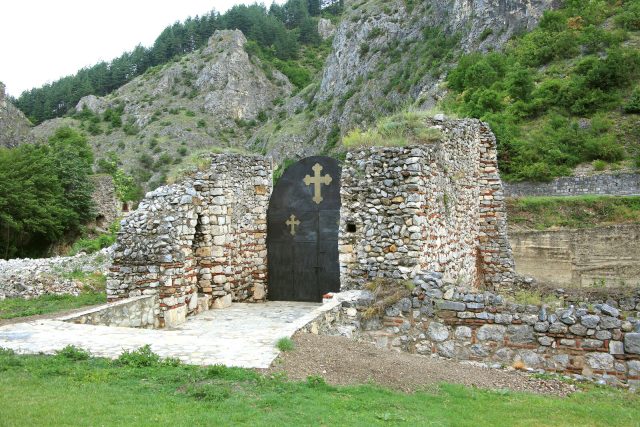
Nestled in the heart of Prizren’s old town, the Church of Saint Nicholas feels like a quiet witness to centuries of change. The narrow street it stands on is lined with tightly packed houses, their stone facades worn smooth by time, and the cobblestones underfoot carry the weight of countless footsteps. The church itself is modest in size, its white walls and simple dome blending into the surroundings yet standing out as a reminder of the city’s layered past. Prizren has always been a crossroads of cultures, and this small church is one of the many places where that history lingers.
The church dates back to the 14th century, when Prizren was part of the Serbian Empire and a thriving center of trade, politics, and faith. Back then, the city drew merchants, pilgrims, and craftsmen from across the region, and Saint Nicholas—patron saint of travelers—was a fitting namesake for a place meant to offer solace before or after long journeys. Originally part of a larger monastery complex, the church today is all that remains of that era, though even in its reduced state, it hints at the bustling life that once surrounded it.
Architecturally, the church follows the Byzantine style common in the Balkans during the Middle Ages. Its small rectangular structure, topped with a dome resting on a low drum, is a classic example of the period’s religious buildings. Inside, the walls were once covered in frescoes, though time and neglect have faded many of them. What remains are fragments of saints’ faces, biblical scenes, and intricate patterns, all testaments to the skill of medieval artists. The most striking surviving image is that of Saint Nicholas himself, a figure that would have held deep significance for the church’s original visitors.
Like Prizren itself, the church has seen its share of upheaval. Over the centuries, the city changed hands multiple times—ruled by Serbs, Ottomans, Austrians, and later Yugoslavia. Each era left its mark, and the Church of Saint Nicholas was no exception. During Ottoman rule, it was converted into a mosque, its frescoes whitewashed, its altar dismantled, and a minaret added to signal its new purpose. It wasn’t until the 19th century, when Ottoman power waned, that the church was returned to the Orthodox community and restoration efforts began.
Today, the church is more than just an architectural relic. It stands as a symbol of the coexistence of different faiths and cultures in Prizren. Services are still held here, though not as frequently as in the past, and the congregation is mostly local Serbs for whom the church is a vital part of their heritage. Visitors might find elderly women lighting candles or tourists peering inside, drawn by curiosity. The atmosphere is quiet, almost intimate, as if the outside world moves at a different pace here.
Prizren is a city where history feels tangible at every turn. The winding streets lead to the fortress of Kalaja, ancient mosques stand alongside churches, and stone bridges arch over the Prizrenska River. The Church of Saint Nicholas fits seamlessly into this tapestry, a small but meaningful thread in the city’s story. It serves as a reminder that Prizren was once a center of Orthodox culture, even as it remains a place where different traditions continue to exist side by side.
A visit to the church isn’t just about admiring its architecture or faded frescoes. It’s about stepping into the rhythm of old Prizren, the city that has inspired artists and writers for generations. On a lucky day, sunlight might stream through the narrow windows, casting golden patterns on the stone floor and illuminating the icons. Or the sound of the church bell might echo through the streets, mingling with the call to prayer from a nearby mosque. These moments—along with the scent of old stone and incense—are part of what makes Prizren feel alive with history.
The Church of Saint Nicholas isn’t the kind of place that demands attention. It’s unassuming, its beauty found in its simplicity rather than grand gestures. Yet that’s precisely what makes it special. It feels like a quiet companion, a place that has seen centuries pass without fanfare. For those interested in the Balkans’ complex history, it offers another piece of the puzzle, helping to explain how this region’s identity was shaped. For everyone else, it’s simply a peaceful corner where time slows down, a place to pause and reflect on the lives that have touched these walls over the years.