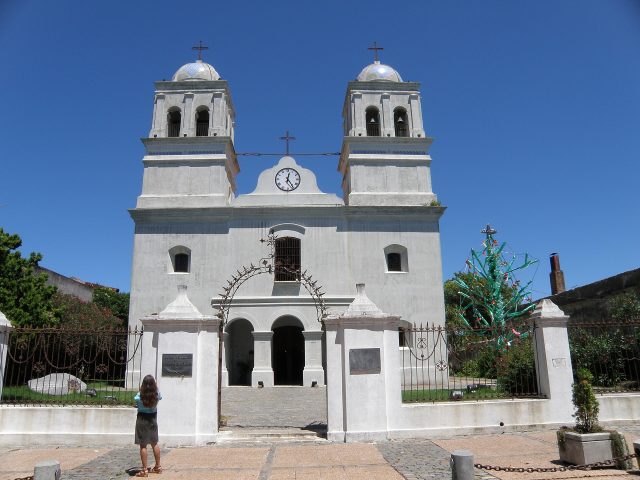
The Church of San Carlos Borromeo in Chuy is one of those quiet places that seem suspended in time, untouched by the noise of the modern world. It stands on the town’s main square, surrounded by low, weathered buildings and narrow streets where life moves at its own unhurried pace. Chuy itself is a border town, split between Uruguay and Brazil by an invisible line, yet here, within the walls of this church, the divide feels meaningless. It belongs as much to Uruguayans as it does to those who cross over from the Brazilian side, a shared space where history and faith transcend borders.
Built in the late 18th century, when this region was still under Spanish colonial rule, the church was more than just a place of worship. At the time, Chuy was a crucial stop on the route between Montevideo and southern Brazil, a frontier outpost where cultures, languages, and traditions constantly intertwined. The Spanish authorities ordered its construction to reinforce the Catholic Church’s presence in an area where loyalties were often divided. Over the centuries, the church has witnessed wars, political upheavals, and economic hardships, yet it remains remarkably unchanged, a silent witness to the passage of time.
The architecture is simple and unadorned, reflecting the practical needs of its original purpose. The whitewashed facade gleams under the sun, while the entrance is framed by a modest portico supported by two columns. Inside, wooden pews line the nave, the ceiling is left with exposed beams, and the altar is decorated with images of saints. The most revered piece is the statue of San Carlos Borromeo, the church’s patron saint, which has stood here since colonial times. Locals say it survived fires and floods unscathed, a detail that has only deepened the belief in its protective power.
Unlike the grand cathedrals of Europe or the lavish churches of Latin America, this one makes no attempt at opulence. There are no gilded altars, intricate frescoes, or marble columns—just the quiet hum of history, the scent of aged wood and candle wax, and the faint creak of floorboards underfoot. On Sundays, the congregation gathers for Mass, many of them descendants of the town’s earliest settlers. The services are held in Spanish, though you might occasionally hear Portuguese spoken by Brazilian visitors for whom this church has also become a familiar place of worship.
The square outside the church is where the rhythm of daily life unfolds. In the mornings, elderly locals gather to sip mate and share stories, while in the evenings, children play in the open space. During the summer, the square comes alive with local festivals, and the church becomes the heart of the celebrations. The most important day is the feast of San Carlos Borromeo, when the statue of the saint is carried through the streets, followed by a small festival of music and dancing. It’s not a tourist spectacle but a community event, where everyone knows each other by name.
Chuy moves at its own pace, and the Church of San Carlos Borromeo is very much a part of that slow, steady rhythm. It doesn’t try to impress or dazzle; its charm lies in its unassuming presence. Here, you can sense the way time flows in Uruguay’s interior—quietly, without hurry, without pretense. If you ever find yourself in this part of the country, step inside, sit on one of the wooden pews, and listen to the silence. It’s in these moments that the true spirit of the place reveals itself.