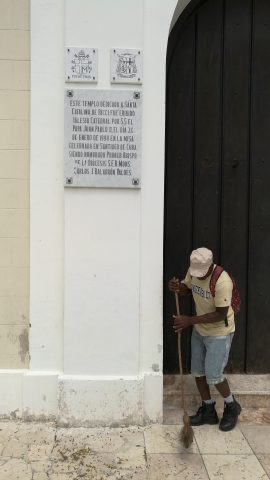
El Cobre is a quiet town in eastern Cuba, tucked away from the well-trodden paths of Havana or Varadero. It’s the kind of place where life moves at its own unhurried pace, where the past lingers in the warm air and the low-slung houses with their peeling pastel facades. Perched on a hill above the town stands the Church of Saint Charles Borromeo, a place that has quietly shaped the spiritual life of Cuba for centuries. For many, it’s more than just a church—it’s a symbol of faith, resilience, and the island’s complex history.
The story of this place begins in the early 1600s, when a small wooden statue of the Virgin Mary was discovered by enslaved workers in the nearby copper mines. According to local accounts, the figure was found floating in the water, unharmed despite the rough conditions. The statue, later known as the Virgin of Charity, became a beacon of hope for those who suffered under colonial rule. A modest chapel was built to house it in 1608, but as devotion grew, so did the need for a larger space. The current church, completed in the 19th century, stands as a testament to that enduring faith. Its neoclassical design is simple—whitewashed walls, clean lines, and an unassuming elegance that feels both timeless and deeply rooted in the Cuban landscape.
Inside, the church is a quiet sanctuary, its atmosphere one of reverence and quiet reflection. The main altar is dominated by the image of the Virgin of Charity, Cuba’s patron saint, her presence a constant reminder of the miracles attributed to her over the centuries. Around her, the walls are adorned with votive offerings—handwritten notes, small trinkets, pieces of jewelry, even crutches—left by those who believe their prayers were answered. Each object tells a story, a personal testament to faith in a place where the divine feels close enough to touch.
El Cobre’s significance extends beyond religion. The town and its church played a role in Cuba’s struggle for independence in the 19th century. Rebels sought refuge within its walls, and priests offered support to the movement, seeing in the fight for freedom a cause aligned with their own beliefs. The church also holds relics of José Martí, the national hero who revered the Virgin of Charity as a symbol of Cuban unity. For many, the church is a bridge between the spiritual and the political, a place where the ideals of faith and nationhood intertwine.
The most vivid expression of this connection comes every September, when thousands of pilgrims descend on El Cobre to celebrate the feast day of the Virgin of Charity. The town, usually sleepy and unassuming, transforms into a sea of color and sound. Streets fill with people, some walking for days to reach the church, their journey a physical act of devotion. Music drifts through the air—traditional Cuban rhythms mixed with hymns—while the scent of flowers and burning candles lingers. For those who come, it’s not just a religious observance but a deeply personal experience, a moment to seek solace, give thanks, or ask for protection.
Beyond the church, El Cobre feels like a place suspended in time. The streets are narrow and winding, lined with houses that have seen generations come and go. There are no grand hotels or tourist traps here, just the quiet rhythm of daily life. Locals go about their business with a warmth that’s distinctly Cuban—unhurried, open, and unpretentious. The town’s connection to the copper mines, which once defined its existence, is still present in the landscape, though the industry has long since faded. What remains is a sense of place, a feeling that here, more than anywhere else, you can glimpse the Cuba that exists beyond the postcards.
Visiting the Church of Saint Charles Borromeo is an opportunity to step away from the familiar narratives of Cuban tourism. There are no beaches or resorts here, no salsa clubs or vintage cars polished for show. Instead, there’s a different kind of richness—one of history, faith, and the quiet dignity of a place that has witnessed centuries of change. For some, it’s a pilgrimage. For others, it’s a chance to sit in the stillness of the church and listen to the echoes of the past. Either way, it’s a reminder that Cuba’s soul isn’t just found in its music or its revolutionary lore, but in the places where people have turned to something greater than themselves.