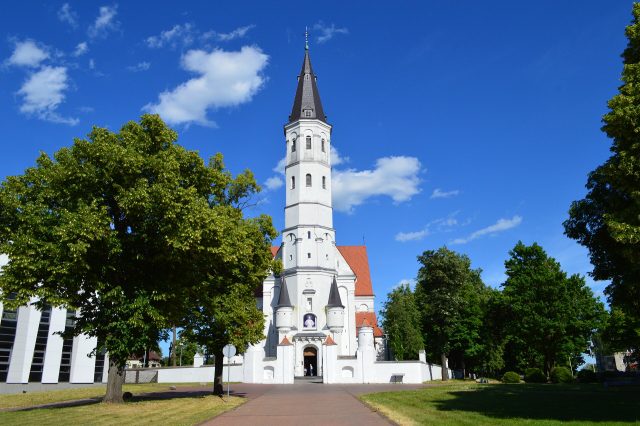
St. George’s Church in Šiauliai is the kind of place that doesn’t demand attention at first glance. Instead, it reveals itself slowly, layer by layer, like the quiet unfolding of a story. Built in the late nineteenth century, it stands at a crossroads of cultures and eras, blending architectural influences that tell as much about Lithuania’s past as they do about the people who shaped it. From the outside, the church appears unassuming—red brick, pointed towers, and arched windows hint at the Neo-Gothic style that was fashionable at the time. But look closer, and you’ll notice subtle details that set it apart: the unusual slope of the roof, the craftsmanship in the brickwork, the way local builders left their mark on a borrowed style.
Step inside, and the space feels unexpectedly airy. High vaulted ceilings, supported by slender columns, create a sense of openness, while the stained glass—softer and more muted than in Western European cathedrals—filters light in gentle hues. The altar, with its gilded accents and icons depicting the life of St. George, remains the focal point. Many of the interior elements have survived intact since the church’s construction, a quiet testament to resilience in a country that endured wars and upheavals throughout the twentieth century.
The church’s history is woven into the fabric of Šiauliai itself. The city, best known for its Hill of Crosses, has long been a place where faiths and traditions intersected. St. George’s was built during Lithuania’s time as part of the Russian Empire, a period when many churches were designed with Western influences but adapted to local tastes. Here, you can see traces of that duality—Orthodox touches in the iconostasis, subtle shifts in the decorative motifs—all softened by the hands of Lithuanian artisans who made the style their own.
Like much of Šiauliai, the church suffered damage during the Second World War, though it was never completely destroyed. The Soviet era brought a different kind of neglect; for decades, the building served as a warehouse, a workshop, and even a gymnasium. It wasn’t until the 1990s, after Lithuania regained independence, that the church was returned to its original purpose. Restoration took years, and while some details had to be recreated, the result is a space that feels remarkably close to its nineteenth-century origins.
For locals, St. George’s is more than just a historic building. It’s a place tied to personal and communal memories—baptisms, weddings, funerals. On feast days, the church fills with people, the sound of the organ echoing through the nave, drawing even those who don’t often attend services. On ordinary days, it’s quiet, the kind of quiet that invites reflection, broken only by the occasional footsteps or the rustle of a prayer book.
Šiauliai isn’t a city that most travelers seek out. It lacks the grandeur of Vilnius or the pilgrimage draw of the Hill of Crosses, but that’s part of its charm. Here, Lithuania feels unpolished, real. St. George’s Church fits into that atmosphere effortlessly. It doesn’t overwhelm with scale or spectacle, but there’s a sincerity to it, something unpretentious in the way it stands, as if it has always been exactly where it needed to be.
If you find yourself in Šiauliai, the church is worth visiting—not just for the sake of ticking off another sight, but for the chance to pause. To stand inside, listen to the silence, and imagine the generations of people who have walked through its doors. The streets around it are quiet, free of tourist crowds and souvenir stalls. Time moves differently here, at its own unhurried pace. That might be why St. George’s lingers in the memory—not as a vivid impression, but as a quiet, enduring presence.