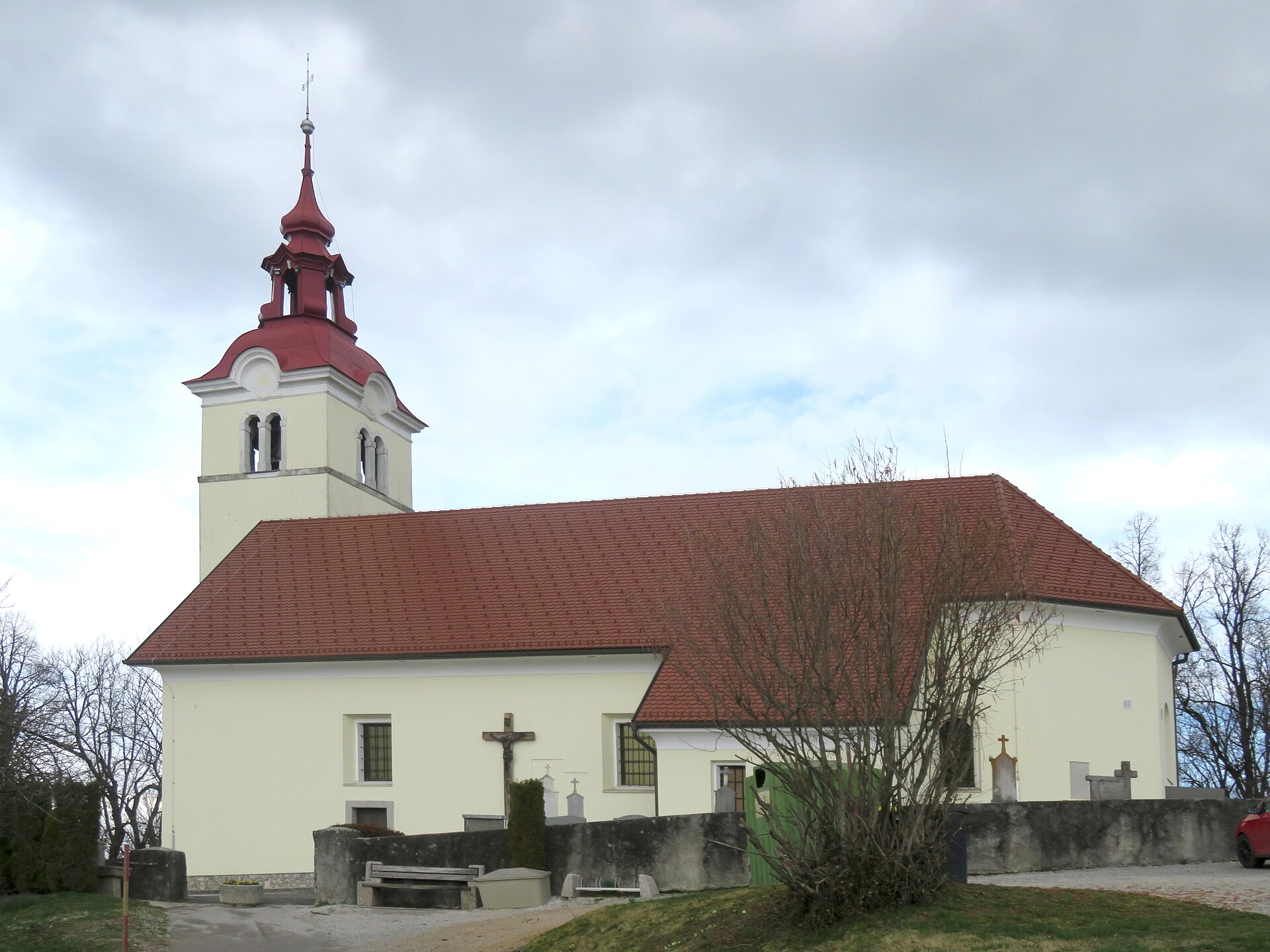
Perched on a gentle hill in the heart of Kranjska Gora, the Church of the Holy Spirit is one of those quiet places that doesn’t demand attention but lingers in your thoughts long after you’ve left. Its whitewashed walls and slender spire blend seamlessly into the town’s modest skyline, framed by the jagged peaks of the Julian Alps. There’s nothing grand about its appearance—just a simple wooden door, a few narrow windows, and a bell tower that seems to have weathered more winters than the rest of the building. Yet this very unassuming quality makes it feel authentic, as if it has always been here, untouched by the rush of modern life.
The church’s history is woven into the fabric of Kranjska Gora itself, a town that transformed from a remote alpine outpost into a hub for skiers and hikers. Records of its existence date back to the 17th century, when this corner of the Alps was little more than a scattering of farms and shepherds’ huts. Back then, the church was more than a place of worship—it was the heart of the community, where disputes were settled, festivals celebrated, and news exchanged. Under the rule of the Austro-Hungarian Empire, its architecture absorbed influences from both sides of the border. The steep, pointed spire echoes the churches of Tyrol, while the interior frescoes reflect the more restrained style typical of Slovenian religious art.
Inside, the church is just as understated as its exterior. The wooden pews, worn smooth by generations of worshippers, lead the eye toward a modest altar crowned with an image of the Holy Spirit. A handful of old icons hang on the walls, their colors faded but still vivid enough to tell their stories. The real treasure, though, is the ceiling. Painted in grisaille, a technique that mimics sculptural relief, it depicts biblical scenes with a quiet dignity. These frescoes have survived since the 18th century, enduring renovations and the passage of time, and they remain one of the few original elements left in the church. Most visitors glance at them briefly before moving on, but those who pause notice the small details—the way the light filters through the narrow windows, the scent of aged wood, the distant chime of the bell drifting in from outside.
Kranjska Gora is a small town, and the church sits at its center, just a short walk from the main square. In summer, the square buzzes with the chatter of artisans selling handmade goods; in winter, it fills with the laughter of skiers preparing for another run down the slopes. Behind the church, a park shaded by ancient linden trees offers a quiet retreat, where locals and visitors alike come to escape the midday sun. If you climb the small hill behind the building, you’ll find one of the best views in the area—a sweeping panorama of the Sava Dolinka Valley, its fields and forests stretching toward the mountains. The scene hasn’t changed much over the centuries, and it’s easy to imagine the lives of the people who once passed through here, when Kranjska Gora was nothing more than a sleepy village on the road to Austria.
Even today, the church remains a vital part of the town’s rhythm. Services are held regularly, and it’s not uncommon to see a wedding or baptism taking place on a weekend. In the summer, small classical music concerts draw crowds, offering a moment of reflection amid the bustle of tourism. For the locals, the church is neither a relic nor a spectacle—it’s simply part of their world, as familiar as the mountains or the river. That’s perhaps what makes it so special. It doesn’t try to impress or entertain; it just exists, a quiet witness to the passage of time.
If you find yourself in Kranjska Gora, take a moment to step inside. Sit on one of the wooden benches, listen to the silence, and let your eyes wander over the ceiling’s faded paintings. Then, when you’re ready, walk up the hill behind the church. From there, the valley unfolds in all its quiet beauty, a reminder of why so many people are drawn to this corner of Slovenia. The Church of the Holy Spirit won’t dazzle you with grandeur or spectacle, but it might just leave you with something more lasting—a sense of stillness, a connection to the past, and the feeling that, for a little while, time has slowed down.