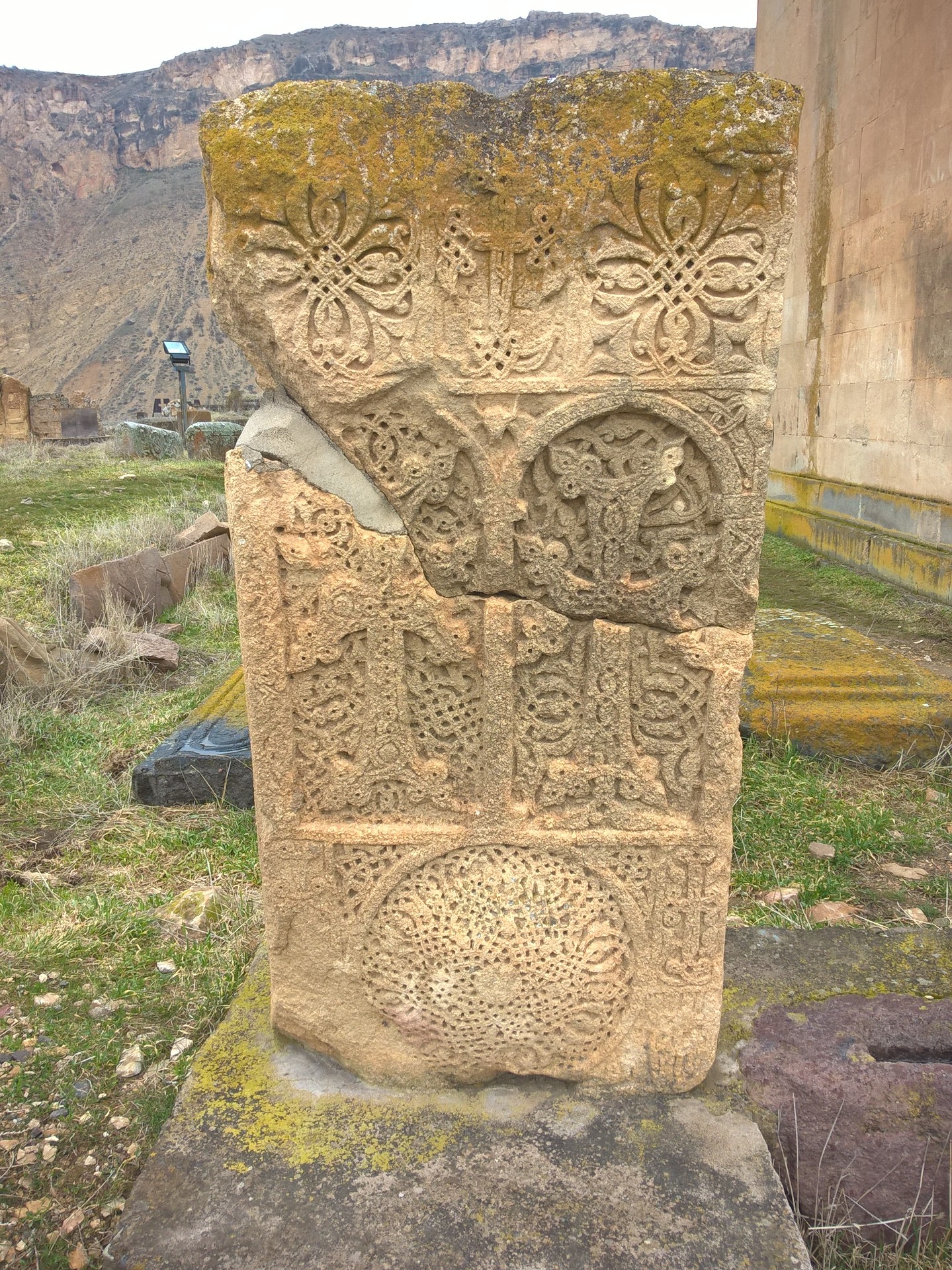
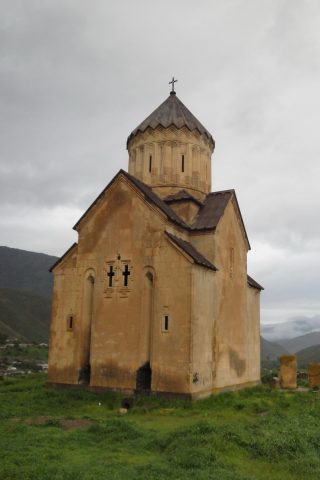
Areni’s Church of the Holy Mother of God, often called Tanahat, sits quietly on a hillside overlooking the village and the winding Arpa River below. Built in the early 14th century, it’s one of those places where time feels both distant and immediate—where the stone walls, worn smooth by centuries, still hold the echoes of medieval life. The church is small, almost modest in scale, but its proportions and details reveal the skill of its builders, who worked with the materials at hand: local tuff, a volcanic rock that gives Armenian architecture its warm, earthy tones.
The structure follows the classic Armenian cruciform plan, with a central dome supported by four massive pillars. Inside, the space is intimate, almost cave-like, with light filtering through narrow windows to illuminate the faded frescoes that once covered the walls. Some fragments remain, hinting at the vibrant scenes they once depicted—saints, biblical figures, and perhaps even local donors who funded the church’s construction. The apse, slightly elevated, draws the eye upward, reinforcing the sense of reverence that has lingered here for centuries.
What makes Tanahat particularly interesting is its connection to the nearby monastic complex of Noravank, one of Armenia’s most celebrated medieval sites. While Noravank dazzles with its intricate carvings and dramatic setting, Tanahat offers something quieter—a sense of continuity. It was part of a network of churches and monasteries that dotted this region during the medieval period, serving not just as places of worship but as centers of learning, art, and even politics. The church’s location, perched on a hillside rather than tucked into a canyon, suggests it was meant to be seen, a landmark for travelers and pilgrims moving through the valley.
The surrounding landscape is just as much a part of the experience as the church itself. The hills roll gently toward the horizon, covered in dry grass and scattered with wildflowers in spring. The Arpa River, visible from the churchyard, cuts through the valley, its waters reflecting the changing seasons. In autumn, the vineyards that stretch across the slopes turn shades of gold and amber, a reminder that this region has been a center of winemaking for millennia. The church stands as a silent witness to all of it—the cycles of nature, the passage of people, the slow accumulation of history.
Unlike some of Armenia’s more famous churches, Tanahat doesn’t draw large crowds. There are no tour buses parked at the base of the hill, no vendors selling souvenirs. Visitors who make the effort to come here often do so for the solitude, the chance to sit on the low stone wall that surrounds the church and take in the view. The air is still, broken only by the occasional call of a bird or the distant sound of a farmer working in the fields below. It’s a place where you can imagine the monks who once lived here, going about their daily routines—praying, copying manuscripts, tending to the land.
The church has survived earthquakes, invasions, and the slow erosion of time, though not entirely unscathed. Some of the exterior carvings have worn away, and the dome, once likely more ornate, now bears the marks of restoration. Yet these imperfections only add to its character. They remind you that this is a living place, not a museum exhibit frozen in time. The local villagers still consider it part of their heritage, and on certain feast days, a small service might be held here, drawing a handful of worshippers who keep the traditions alive.
For those who venture beyond the well-trodden paths of Armenia’s tourist circuit, Tanahat offers a glimpse into the country’s deeper history. It’s a place where the past isn’t just preserved in stone but woven into the landscape itself. The church, the river, the vineyards, the distant mountains—all of it tells a story of resilience, faith, and the quiet beauty of a land that has seen empires rise and fall. Standing here, it’s easy to forget the modern world beyond the valley, to let the weight of centuries settle around you like the dust on the old stones.