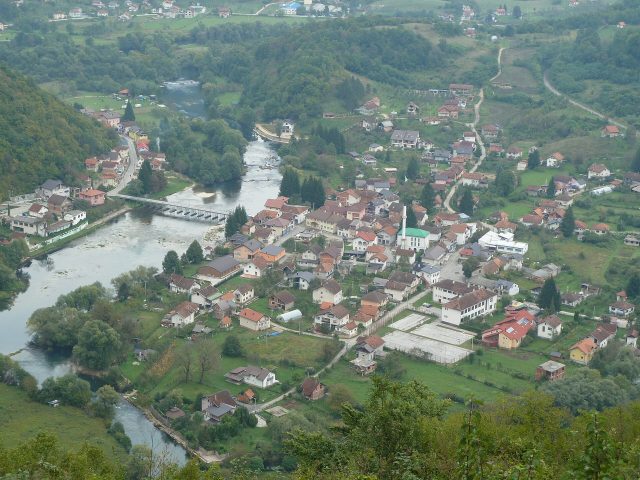
St. Anthony of Padua Church in Bihać is one of those quiet places that doesn’t demand attention but lingers in your memory long after you’ve left. Tucked away on a gentle rise in the heart of the city, it stands surrounded by low-slung houses with terracotta roofs, as if preserving the spirit of a time when Bihać was little more than a sleepy riverside town on the banks of the Una. From the outside, the church is unassuming—whitewashed walls, a simple pediment, a single bell in the tower. There’s no grandeur here, no ornate flourishes, just a quiet authenticity that feels like stepping into the early 1900s.
The church’s history is deeply tied to the Austro-Hungarian era in Bosnia and Herzegovina. Construction began in 1890, when Bihać, like much of the country, was under Habsburg rule. The empire was busy modernizing the region, building roads, schools, and places of worship as part of its efforts to consolidate influence. St. Anthony’s became a symbol of that time—a Catholic church in a city where most people were Muslim or Orthodox. While the design likely came from Viennese architects, local craftsmen adapted it to fit the realities of the Balkans, blending European styles with a distinctly local touch.
Architecturally, the church reflects the neoclassical and neo-Renaissance influences common in late 19th-century Austro-Hungarian religious buildings. The façade is marked by pilasters and a modest portal, topped by a triangular pediment with a cross. Inside, the space was originally designed in light tones, with high windows that bathed the interior in soft, diffused light. The main altar is dedicated to St. Anthony of Padua, the patron saint of the poor and travelers—a fitting choice for a city that has long been a crossroads of cultures and faiths.
The 20th century brought its share of upheavals. During World War II, Bihać found itself in the midst of heavy fighting, and many of the city’s buildings were damaged. The church survived, though its interior suffered. In the postwar years, when Bosnia and Herzegovina became part of Yugoslavia, religious institutions were sidelined, and the small Catholic community in Bihać struggled to maintain the church. It wasn’t until the 1990s, after the breakup of Yugoslavia and the Bosnian War, that restoration efforts began in earnest. Today, the church is active again, though it no longer draws the same number of worshippers as it once did.
For the people of Bihać, St. Anthony’s is more than just a place of worship—it’s a piece of the city’s identity. In a town where the majority of residents are Bosniak Muslims, the Catholic community has always been small but visible. The church stands as a reminder that Bihać has long been a place where different faiths and traditions coexisted. Over the years, it has hosted not only religious services but also community gatherings, cultural events, and even classical music concerts. In recent years, it has started to attract a modest number of visitors, though it remains far less known than Bosnia’s more famous landmarks.
A visit to St. Anthony’s is worth it for the chance to experience the quiet rhythm of old Bihać. The church is surrounded by a small park with towering trees, where locals often sit in the shade on warm days. From here, you can see the Una River winding through the city and the old bridge connecting its banks. In the summer, the air is filled with the rustling of leaves and the distant murmur of water. Inside, the church is dimly lit, the silence broken only by the soft glow of light filtering through the stained glass. The walls still bear faint traces of early 20th-century frescoes, their details softened by time.
This isn’t a place that overwhelms you with its beauty or scale. It doesn’t have the grandeur of Sarajevo’s cathedrals or the fame of Mostar’s landmarks. It doesn’t draw crowds or feature in every travel guide. But that’s precisely what makes it special. St. Anthony’s tells the story of a small city that has long stood at the crossroads of cultures and religions, quietly preserving its own unique character. There’s nothing flashy here, just a sense of authenticity that’s increasingly rare in the modern world. If you find yourself in Bihać, take a few minutes to step inside. You might just feel the weight of history in the stillness—something words can’t quite capture.