Perched on the quiet outskirts of Bomarzo, the Church of Sant’Anselmo doesn’t rush to greet you. The Umbrian hills roll into Lazio’s rugged cliffs, vineyards and olive groves covering the slopes. The church looks like it belongs here—its tuff stone walls the same warm brown as the earth. The facade is plain, with a simple relief above the door and a small circular window. Inside, whitewashed walls and wooden pews frame the altar, where Saint Anselm’s image hangs.
The Orsini family’s mark
The Orsini, one of the Renaissance’s most powerful dynasties, shaped Bomarzo in the 16th century. They built palaces, gardens, and churches, turning the town into a cultural center. Sant’Anselmo was likely part of their private estate, though no one knows exactly when it was constructed. Records suggest the mid-1500s, when Bomarzo was a hub for artists, aristocrats, and papal ambitions. The streets still carry traces of that era—masters like those who defined Italian art once walked them.
Design and atmosphere
The church is built from local tuff, a porous volcanic stone that gives the region its golden-brown buildings. The facade is modest, with a single relief and a small window that lets in soft light. Inside, the space is even simpler: white walls, wooden pews, and an altar with Saint Anselm’s likeness. There are no frescoes, no gilded details—just an empty quiet.
Saint Anselm, the church’s namesake, was a medieval theologian and philosopher. As Archbishop of Canterbury, he shaped scholasticism and wrote proofs of God’s existence. The Orsini family, known for patronizing scholars, may have chosen him to reflect their own intellectual pursuits. His image inside—a fresco or statue—connects Bomarzo to the broader currents of Renaissance thought.
A different kind of landmark
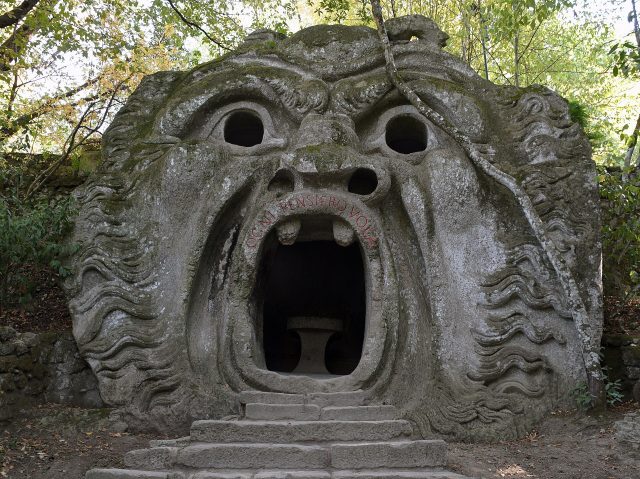
Bomarzo is famous for the Park of the Monsters, Pier Francesco Orsini’s surreal garden from the mid-1500s. The park’s stone sculptures—mythical creatures, grotesque figures, cryptic inscriptions—stand in stark contrast to Sant’Anselmo’s quiet presence. Yet both belong to the same era, when the Orsini family blended devotion with whimsy. The church was part of that vision, though it never sought the spotlight.
Sant’Anselmo doesn’t draw crowds. It’s not in guidebooks, and even locals sometimes forget it’s there. You won’t find queues or souvenir stalls—just an open door, if you’re lucky. Inside, the only sounds are leaves rustling and distant church bells. You can sit on a pew and feel the weight of centuries.
The church isn’t always open. Sometimes the doors are locked, and you’ll have to settle for the facade or the paths around it. But if you find it open, even a few minutes inside feel like a discovery. The silence isn’t empty—it’s full of stone, wood, and light.
Bomarzo offers a quieter side of Italy. No grand cathedrals or lavish palaces, just authenticity. Sant’Anselmo is part of that. It doesn’t try to impress. It simply stands on its hill, watching the valley below.