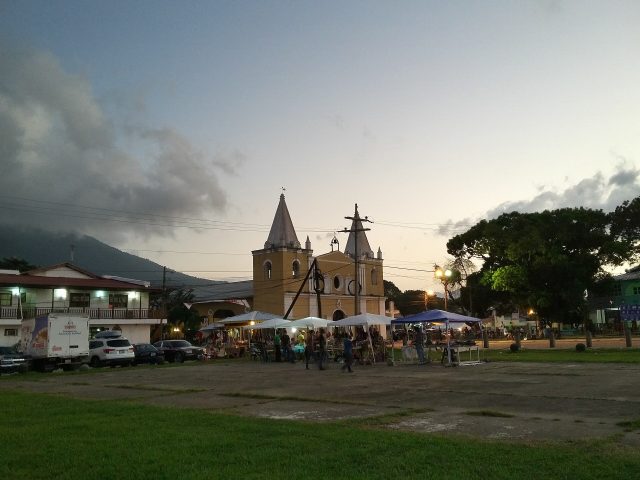
Trujillo’s Church of San Juan de Dios stands on the town’s main square. The past lingers here, in the scent of old wood and salt from the nearby Caribbean. Built during the colonial era, its whitewashed walls have witnessed centuries of change—Spanish settlers, pirates raiding the coast, and the slow march toward independence. Today, it remains part of the town, as natural as the palm trees swaying in the breeze.
The architecture is simple, typical of early colonial design in Central America. Thick walls, a modest bell tower, and heavy wooden doors that creak when opened. Inside, wooden pews are worn smooth by generations of worshippers. Faded frescoes cover the walls, and altars have lost some of their luster but none of their solemnity. The building was made for people, not for show.
Trujillo was one of the first Spanish settlements on the mainland. The church was at the heart of its early life. Royal decrees were read aloud here. Townspeople debated local matters. In times of danger, families took shelter from pirate attacks. It was a symbol of stability in an unpredictable world. People came to mark births, marriages, and deaths, seeking comfort in a land that could be both generous and unforgiving.
Nowadays, the church is still active. On Sundays, the square in front buzzes with activity—locals arrive for mass, children chase each other up the steps, and travelers pause to admire the old clock on the facade. On weekdays, it’s quieter. The doors are usually open, and visitors can wander through the empty nave. The silence feels respectful, as if the building itself is holding its breath.
Trujillo isn’t a place that draws crowds. The streets are lined with low-slung houses topped with red tile roofs, and the sea is never far away. The church fits into this setting, not as a tourist attraction but as part of the town. It doesn’t demand attention; it simply exists.
From the small hill behind the town, where the land slopes down toward the bay, you can see the church from above. Its white bell tower stands out against the green hills and the blue water. From here, it’s easy to imagine how the church has anchored Trujillo through the centuries—surviving hurricanes, raids, and time. There’s something reassuring about its permanence.
For those curious about history, the church is a starting point. Nearby ruins hint at the town’s past. The local museum holds artifacts from pre-Columbian times and relics of the Spanish era. But you don’t need to dive into guidebooks to feel the weight of the place. Sit on a bench in the square, watching people come and go, and you’ll sense the layers of time beneath your feet.
The Church of San Juan de Dios feels lived-in. The stories of the people who have passed through its doors still echo in the corners. There’s no pressure to admire it, no gift shop, no guided tour. Just a quiet space where the past and present overlap. The scent of incense mixes with the salt air. If you listen closely, you might hear the faint murmur of history.