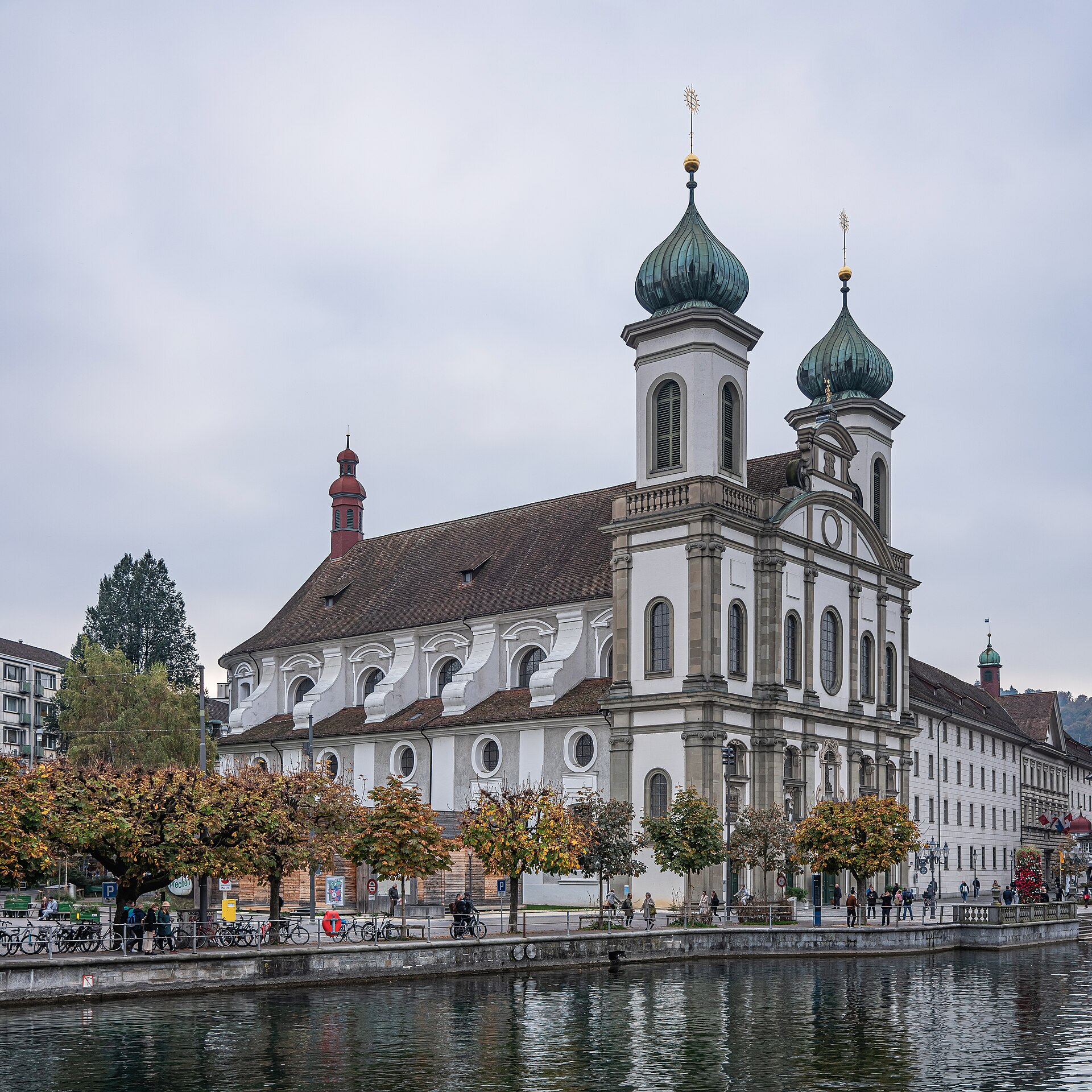
The Jesuit Church in Lucerne is one of those places that doesn’t immediately demand attention, yet lingers in the mind long after you’ve left. Tucked along the banks of the Reuss River, slightly removed from the city’s busier tourist paths, it reveals itself gradually. From the riverside promenade, its facade appears modest, almost blending into the surrounding buildings. But step inside, and the space unfolds in a way that feels entirely different—tall vaulted ceilings, the soft glow of stained glass, and an acoustics that turns even the faintest sound into something resonant, as if every whisper is part of something larger.
The church’s history is deeply tied to the Counter-Reformation, a period when the Catholic Church sought to reclaim its influence across Europe. Lucerne, a stronghold of Catholicism in Switzerland, became a key outpost for the Jesuits, who began constructing their church here in the mid-17th century. The design was entrusted to a Bohemian architect, and though the building took nearly fifty years to complete, the result feels remarkably cohesive. The exterior is restrained, almost austere, but the interior is a masterful play of Baroque light and shadow, where every detail contributes to an atmosphere of quiet grandeur.
The main nave is striking in its height and openness, yet it doesn’t overwhelm. Columns adorned with intricate stucco rise upward, as if supporting an invisible dome, while the dark tones of the altar contrast sharply with the white walls. The way light moves through the space is particularly captivating—morning sun filters through the eastern windows, casting everything in a golden hue, while by evening, the shadows deepen, and the church seems to retreat into itself. The side chapels hold old frescoes and sculptures, each telling its own story of saints, martyrs, and a faith that was once not just tradition, but a way of life.
The church hasn’t always looked as it does today. In the 18th century, after the Jesuits were expelled from Switzerland, the building fell into disrepair, and during the Napoleonic Wars, it was even used as a storage space. It wasn’t until the 19th century, when the order returned, that restoration began, and since then, the church has remained active. Services are still held here, along with organ concerts and weddings, though visitors come just as often. Yet it hasn’t become a museum—it retains a sense of life, evident in small details: the scent of candle wax, the murmur of worshippers, the quiet preparations at the altar.
For Lucerne, the Jesuit Church is more than an architectural landmark; it’s part of the city’s identity. It serves as a reminder of a time when Lucerne was a center of Catholic culture in the region, drawing pilgrims, scholars, and artists. The area around the church once buzzed with activity—debates, schools, and the Jesuits themselves, who acted not only as spiritual guides but as educators. Today, that era feels distant, but its echoes remain in the church’s silence, in its walls, which have witnessed so much change yet preserved their essence.
Visiting the Jesuit Church isn’t so much about ticking off a sight as it is about stepping into a different rhythm. Unlike the crowded Chapel Bridge or the Lion Monument, this place offers a rare stillness. There’s no need to rush—you can stand, look around, and feel time slow down. Sit on one of the pews and watch how the light shifts across the walls, or climb to the choir loft for a view of the entire nave. If you’re lucky, you might hear the organ, its sound filling the space with a depth that feels almost physical.
What makes the Jesuit Church special is its lack of pretension. It doesn’t require visitors to have any particular knowledge or expectations. It’s open to everyone—believers and skeptics, history enthusiasts and casual passersby. You can come with questions or none at all, seeking understanding or simply a moment of quiet away from the city’s bustle. In that sense, its greatest value lies in its unassuming presence, a quiet island of the past in the heart of a modern city. Sometimes, that’s enough.