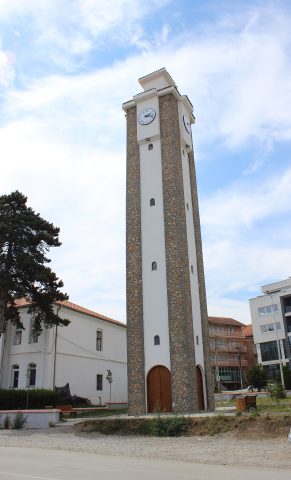
Central Square in Budisalc is where the unhurried pulse of a small Kosovar village makes itself felt. There’s no rush here, no crowds of tourists, no signs pointing you toward something you’re supposed to see. The square is the quiet core of the village, the place where daily life unfolds without pretense. In the mornings, older men gather for games of dominoes, their conversations drifting between the clatter of tiles and the occasional laughter. By midday, children from the nearby school spill onto the pavement, their voices bright against the muted tones of the buildings. As evening falls, the square becomes a meeting point, shaded by old trees where neighbors linger over coffee or simply watch the day wind down. It’s not just an open space—it’s a stage for the small, unscripted moments that make up life in Budisalc.
The architecture around the square is unassuming, built for practicality rather than grandeur. The houses, made from local stone and wood, bear the marks of time—peeling plaster, crooked shutters, the occasional patch of moss creeping up a wall. In the center stands a modest fountain, its basin worn smooth by years of use. It might have once been decorative, but now it serves a simpler purpose, offering a place to pause or fill a bottle of water. Nearby, a few benches line the edges, almost always occupied by someone—a woman knitting, a man reading the paper, a child waiting for a friend. There are no grand monuments here, no towering structures demanding attention. The charm of the square lies in its ordinariness, in the way it feels lived-in rather than designed.
Budisalc’s history is woven into the broader story of Kosovo, and the square is one of the few places where that connection feels tangible. The village sits in the western part of the country, not far from the Albanian border, a location that has seen countless shifts in power over the centuries. In medieval times, these lands were part of Serbian principalities, later falling under Ottoman rule. The 20th century brought more upheaval, from the collapse of Yugoslavia to the conflicts that reshaped the region. The square, like the village itself, has witnessed all of it—periods of peace, times of hardship, moments when the community had to come together to endure. Yet through it all, it has remained a gathering place, a constant in a landscape of change.
Today, Budisalc is a typical Kosovar village, where life moves at its own pace and traditions are passed down through generations. The square plays its part in this rhythm. It’s where festivals are celebrated, where weddings spill out from nearby homes, where mourners gather to pay their respects. On market days, when traders arrive from neighboring villages, the square transforms. Stalls appear, piled with fresh produce—tomatoes still warm from the sun, bundles of herbs, rounds of homemade cheese. The air fills with the scent of baking bread and grilled meat, and the hum of conversation grows louder. For a few hours, the square becomes the heart of not just Budisalc, but the surrounding countryside, a place where people come to trade, gossip, and catch up on the latest news.
To an outsider, the square might seem unremarkable at first glance—just an open space with a few trees and a handful of buildings. But spend enough time there, and the details start to reveal themselves. There’s the old plane tree in the center, its broad branches offering shade to anyone who sits beneath them. Locals say their grandparents used to gather under it, and the tree has become a kind of living monument to the village’s past. Nearby, the minaret of a small mosque rises above the rooftops, its call to prayer drifting across the square at dawn and dusk. And then there’s the absence of tourists, which means the life you see here is unfiltered—no performances, no curated experiences, just the quiet, everyday reality of a village going about its business.
In recent years, Kosovo has begun to attract travelers looking for places untouched by mass tourism, and Budisalc fits that description perfectly. There are no luxury hotels here, no restaurants with menus in five languages, no souvenir shops selling trinkets. What you’ll find instead is a chance to see rural Kosovo as it really is. The square is the best place to start. From here, you can wander the surrounding hills, stopping at a local bakery for a loaf of fresh bread, or simply sit on a bench and watch the village prepare for the evening. The pace is slow, the atmosphere unhurried, and the people are welcoming in a way that feels genuine rather than obligatory.
Budisalc isn’t the kind of place you visit for grand historical sites or dramatic landscapes. There are no ancient fortresses here, no museums filled with artifacts, no famous landmarks to tick off a list. What it offers instead is something quieter, something harder to define. It’s a village where time moves differently, where people live much as their ancestors did, and where the square remains the place where everyone comes together. That sense of continuity, of belonging to something larger than yourself, is what lingers with visitors long after they’ve left. Maybe that’s why some of them return—to sit on a bench under the plane tree, to listen to the murmur of voices, and to feel, just for a little while, like they’re part of this small, unassuming corner of the world.