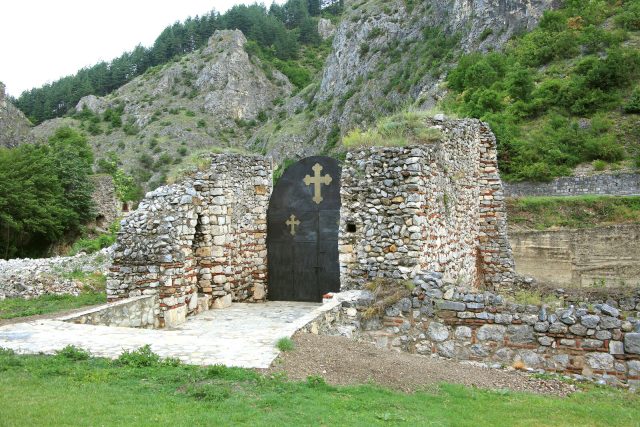
The Cathedral of Saint George in Prizren is one of those places that doesn’t demand attention at first glance but lingers in the mind long after you’ve left. Perched on a gentle rise in the old town, it blends into the labyrinth of narrow streets where houses press close together, their tiled roofs punctuated by the slender minarets of neighboring mosques. Unlike many Orthodox churches across the Balkans, this one doesn’t overwhelm with grandeur or ostentation. Its quiet presence feels organic, as if it grew naturally from the city itself rather than being imposed upon it.
The cathedral’s history is woven into the fabric of Prizren’s past. The first records of a church on this site date back to the 14th century, when the city was a key center of the Serbian Empire. Back then, it was a modest Orthodox temple dedicated to Saint George, the patron saint of soldiers and travelers. Over the centuries, the original structure endured the upheavals of Ottoman conquest, fires, and reconstructions, each leaving its mark. The building that stands today was erected in the 19th century, a time when Prizren was still under Ottoman rule but beginning to stir with the ideas of national revival.
Architecturally, the cathedral is a conversation between eras and cultures. From the outside, it resembles a traditional Balkan Orthodox church—its cross-shaped layout, stone walls, and low dome barely rising above the surrounding rooftops. Yet a closer look reveals the subtle influence of Ottoman design: the arched windows, the decorative touches reminiscent of Islamic architecture, and the absence of the elaborate exterior ornamentation typical of Orthodox churches. Inside, the space is equally unassuming. The 19th-century iconostasis is simple and restrained, while the surviving fragments of frescoes reflect an era when art prioritized meaning over embellishment.
For centuries, the Cathedral of Saint George has been a cornerstone of Prizren’s Serbian community. In the 1800s, when the city became a hub of cultural and religious awakening for Serbs, the cathedral symbolized resistance to assimilation. Intellectuals gathered here to discuss ideas of national unity, and the church served as both a place of worship and a cultural center. After World War II, when Kosovo became part of Yugoslavia, its role shifted. It remained a significant religious site but no longer held the same prominence in public life. Today, amid the complexities of interethnic relations, the cathedral stands more as a historical monument than an active spiritual hub.
Prizren is a city where the stories of different peoples intertwine, and the Cathedral of Saint George is one of the few places where this intersection feels palpable. Just steps away stands the Sinan Pasha Mosque, one of the city’s most beautiful, and a little farther, the Catholic cathedral. These buildings have coexisted for centuries, their proximity unforced and natural, much like the life of Prizren itself—loud, multilingual, occasionally contradictory, but always alive. The cathedral doesn’t compete with its neighbors or assert dominance. It simply endures, as it has for generations, and in that endurance lies its quiet strength.
The best time to visit is on a weekday, when the cathedral is hushed and nearly empty. The air inside carries the scent of wax and aged wood, while sunlight filters through narrow windows, casting soft patterns on the walls. Sometimes, the distant call to prayer drifts in from a nearby mosque, mingling with the sounds of vendors from the bazaar outside. In these moments, it becomes clear that the cathedral is more than just a building—it’s a living part of a larger, intricate world where history resists simple narratives. There are no tour guides reciting rehearsed facts or signs dictating how to behave. There’s only the space itself, waiting to be felt if you take the time to pause and listen.
In recent decades, the Cathedral of Saint George has drawn the attention of historians, restorers, and those simply curious about the Balkans’ layered past. After the 1999 conflict, many Orthodox churches in Kosovo were damaged or destroyed, but this one survived. Perhaps because it was always embedded in the city’s fabric rather than standing apart as a solitary symbol. Today, efforts to preserve it focus not on turning it into a museum piece but on maintaining its place in the living history of Prizren. The restoration of frescoes, the reinforcement of the foundation, and the careful repair of the iconostasis are carried out with patience and respect for what has already endured for centuries.
For travelers, the Cathedral of Saint George isn’t a must-see attraction in the traditional sense. Those who come to Prizren for the fortress of Kalaja or the bridge over the Prizren Bistrica River often overlook the unassuming building on the hill. But if you wander up the narrow street and step inside, you might find something deeper than architectural interest. Time moves differently here—slower, more deliberate, without the rush of modern life. That’s why the cathedral leaves a quiet impression on those who visit. It doesn’t demand admiration or seek to astonish. It simply exists, a witness to the past and a thread in the present, still unfolding.