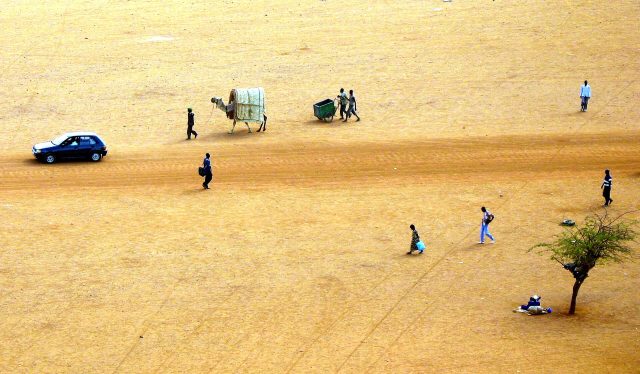
The Grand Market of Niamey is one of those places where the pulse of a city reveals itself in its most unfiltered form. Unlike the polished souks of North Africa or the tourist-friendly bazaars of West African capitals, this market feels like a living organism—breathing, shifting, and adapting with the rhythms of daily life. It sprawls across a vast area near the heart of Niamey, where the Niger River bends lazily under the Sahel sun, and where the city’s history and modernity collide in a whirl of color, scent, and sound.
Stepping into the market is like entering a different world, one where time moves at its own pace. The air is thick with the smell of grilled meat, spices, and dust, mingling with the earthy aroma of fresh produce piled high in wooden crates. Vendors call out to passersby in Hausa, Zarma, and French, their voices rising above the clatter of metal basins, the hum of generators, and the occasional bleat of a goat being led through the crowd. This is not a place for the hurried or the easily overwhelmed; it demands patience, curiosity, and a willingness to get lost in its labyrinthine alleys.
The market’s origins are as old as Niamey itself, though its current form took shape in the mid-20th century as the city grew from a small colonial outpost into the bustling capital of Niger. Back then, it was little more than a cluster of stalls where farmers from nearby villages traded millet, sorghum, and livestock with merchants from the north. Over the decades, it expanded organically, absorbing waves of migrants from rural areas and neighboring countries, each bringing their own goods, traditions, and flavors. Today, it stands as a testament to the city’s role as a crossroads of cultures, where Tuareg silverwork shares space with Nigerian wax prints and Malian leather goods.
Architecturally, the market is a patchwork of makeshift structures and open-air stalls, with corrugated metal roofs providing scant shelter from the midday heat. Some sections are more permanent, with concrete walls and wooden shutters that roll down at dusk, while others are little more than tarpaulins stretched over bamboo frames. The layout is chaotic at first glance, but there’s a logic to it—each section has its own specialty. Near the entrance, women sell pyramids of tomatoes, onions, and okra, their produce arranged with the precision of an artist. A little further in, the air fills with the sharp tang of dried fish and smoked meat, hanging in long strips from hooks. Then come the fabric sellers, their bolts of indigo, gold, and crimson stacked high, waiting to be transformed into boubous or headscarves.
One of the market’s most striking features is its role as a social hub. This is where people come not just to buy and sell, but to catch up on news, negotiate marriages, or settle disputes over a cup of strong, sweet tea. Elders sit on low stools, watching the ebb and flow of the crowd, while children dart between stalls, running errands or hawking small goods. In the late afternoon, when the heat begins to ease, the market takes on a different energy. The light softens, casting long shadows over the dusty ground, and the pace slows. Men gather around makeshift grills, turning skewers of suya—spicy, peanut-coated meat—while women in vibrant pagnes balance trays of fried plantains or steaming bowls of fufu on their heads.
For outsiders, the market can feel overwhelming, even intimidating. The sheer volume of goods, the press of bodies, and the constant negotiation can be exhausting. But those who take the time to linger will find that the chaos has its own rhythm. There’s a certain art to navigating it—knowing when to haggle, when to walk away, and when to simply observe. The best approach is to wander without a fixed destination, letting the market reveal itself in fragments: a stall selling hand-carved wooden masks, a group of musicians tuning their instruments in a quiet corner, a woman weaving a basket with practiced ease.
The market is also a place of contrasts. Here, the old and the new coexist uneasily. Traditional remedies—bundles of dried herbs, powders in recycled plastic bottles—sit alongside cheap Chinese electronics and knockoff designer sunglasses. A man selling hand-forged knives might be texting on a smartphone, while a woman in a handwoven wrap haggles over the price of a mass-produced plastic basin. These juxtapositions are a reminder of Niger’s place in a rapidly changing world, where global trade and local traditions are constantly renegotiating their boundaries.
Beyond its economic and social significance, the Grand Market is a sensory experience unlike any other. The heat, the noise, the smells—all of it combines to create a feeling of immersion that’s hard to replicate elsewhere. It’s not a place for those seeking comfort or predictability, but for those willing to embrace the unpredictability of life in one of West Africa’s most dynamic cities. Whether you come for the fabrics, the food, or simply the chance to witness the daily life of Niamey, the market leaves an impression that lingers long after you’ve left its dusty alleys.
In the end, the Grand Market of Niamey is more than just a place to shop. It’s a microcosm of the city itself—messy, vibrant, and endlessly fascinating. It doesn’t cater to tourists, and it doesn’t apologize for its chaos. Instead, it offers something far more valuable: a glimpse into the soul of a place where history, culture, and commerce intertwine in ways that are as complex as they are compelling. For anyone willing to look beyond the surface, it’s an experience that stays with you.