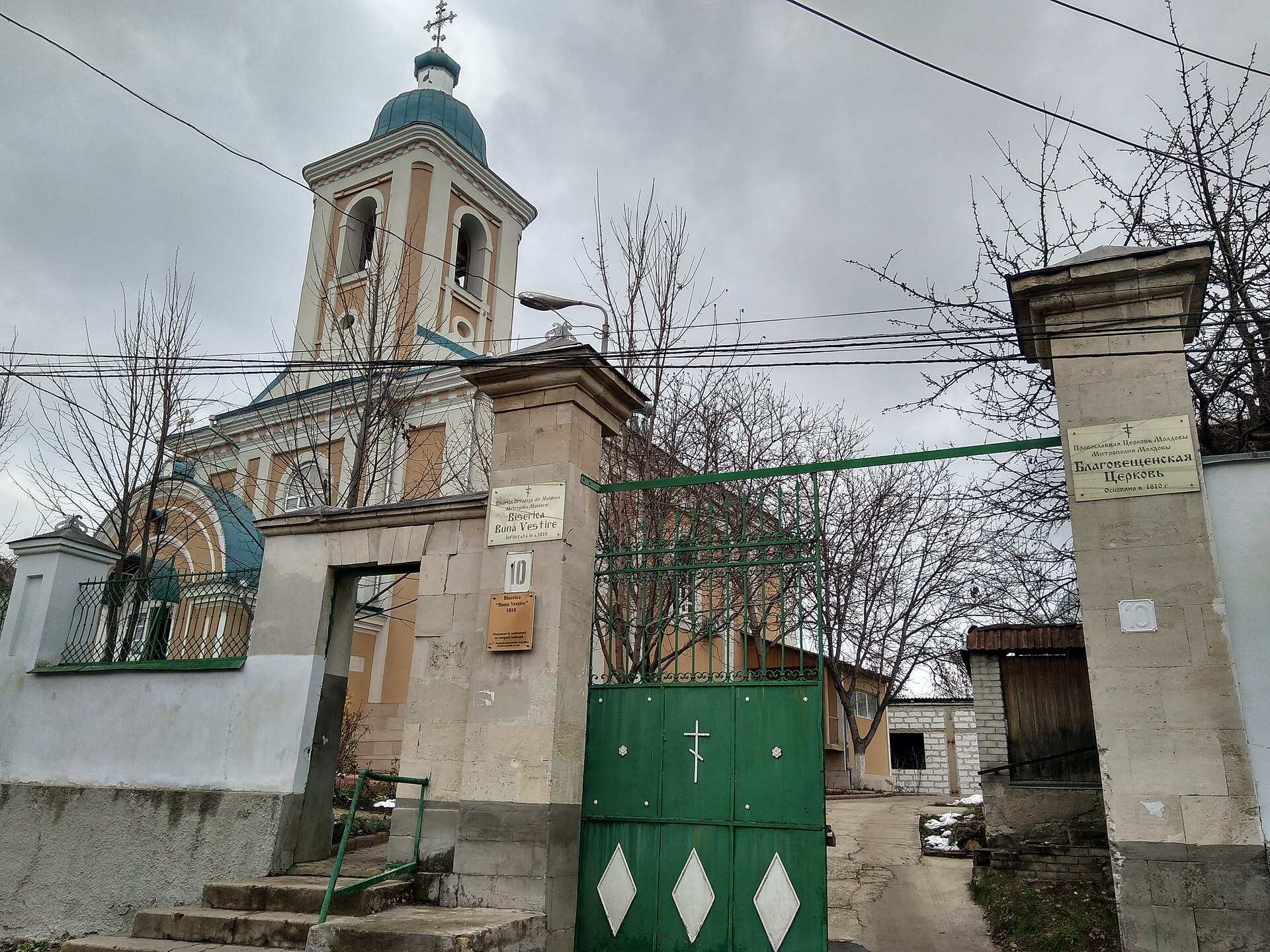
The Annunciation Church in Chișinău is one of those quiet places that doesn’t demand attention but lingers in your memory long after you’ve left. Tucked away in the heart of the city, where the pace of life slows just enough to notice the details, it stands as a subtle yet enduring presence. Unlike many of Moldova’s older Orthodox churches, this one isn’t ancient, but its story is deeply woven into Chișinău’s own—especially during times of change and upheaval.
Built in the mid-19th century, when Chișinău had become the administrative center of Bessarabia, the church reflects the architectural tastes of its time. There’s a quiet elegance to it, blending classical elements with traditional Moldovan design. The whitewashed walls, modest dome, and bell tower with arched openings give it a timeless quality, as if it has always been part of the city’s fabric. Inside, the space feels open and airy, with frescoes and icons painted in soft, muted tones. There’s no overwhelming grandeur here—just a sense of calm, a place where the noise of the outside world fades into the background.
The church has seen its share of hardship. During the Soviet era, when religion was suppressed, it wasn’t demolished like so many others but repurposed as a warehouse. That decision, though pragmatic, stripped it of its original purpose. It wasn’t until the late 1980s, when Moldova began to rediscover its Orthodox heritage, that the church was returned to the faithful. Restoration took years, but today it stands as an active place of worship once again, welcoming both locals and visitors.
For Chișinău, the Annunciation Church is more than just a religious site—it’s a piece of the city’s cultural identity. It sits near other landmarks, like the Central Market and Ștefan cel Mare Park, in a neighborhood where the rhythm of life feels slower, more deliberate. The streets around it shift from the bustle of main avenues to quiet courtyards where time seems to stand still. The church acts as a kind of anchor, a reminder that Chișinău isn’t just a modern city but one with layers of history.
Inside, the atmosphere invites reflection. There’s no crowd, no rush—just the soft light filtering through narrow windows and the scent of incense mingling with the warmth of aged wood. The iconostasis isn’t ornate, but every detail feels intentional, from the placement of the icons to the intricate woodwork. It’s a space designed not to impress but to comfort, to offer a moment of quiet in the midst of daily life.
Services here are understated, without the grandeur of those at the Cathedral. On Sundays, the congregation is mostly made up of locals, many of whom have been coming for years. For them, the church is more than a place of prayer—it’s a tradition, a connection to the past. On weekdays, it’s open to anyone who wants to light a candle, sit in silence, or simply take a break from the city’s pace.
From the outside, the church doesn’t stand out, but if you look closely, you’ll find traces of its history. The old gravestones in the courtyard belong to people who lived in Chișinău in the 19th century—some were prominent figures, others ordinary citizens, but all were part of the city’s story. These markers serve as a quiet reminder that the church has always been more than a place of worship; it’s been a gathering point for the community.
In recent years, the Annunciation Church has started to draw interest from those curious about history and architecture, even if it’s not on the typical tourist route. There’s something about it that resonates with visitors who stumble upon it—perhaps because it doesn’t try to be imposing or dramatic. It simply exists, as much a part of Chișinău as the streets around it.
Chișinău is a city of contrasts, where modern offices stand beside pre-revolutionary mansions and lively cafés share space with quiet courtyards. The Annunciation Church embodies that duality: unassuming yet meaningful, easy to overlook but hard to forget. It doesn’t ask for admiration, but if you find yourself nearby, it’s worth stepping inside—if only to feel the pulse of a city that carries its past into the present.