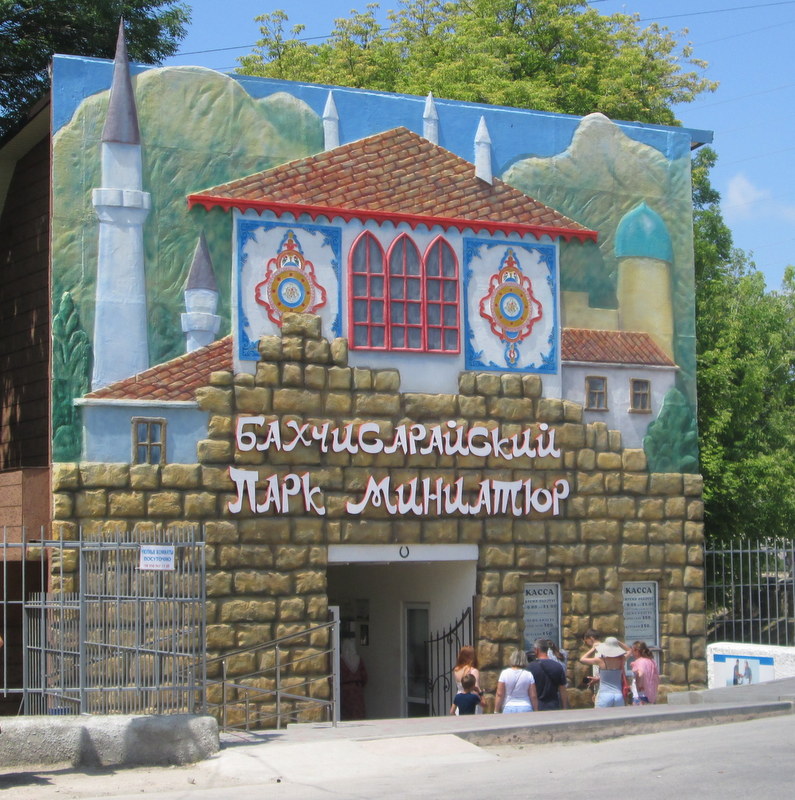
Bakhchisaray’s Miniature Park is one of those rare places where history feels both intimate and vast, compressed into a scale that lets you take it all in at a glance. Tucked away in the heart of this ancient Crimean town, the park doesn’t just shrink landmarks—it distills them, stripping away the noise of modern tourism to reveal the quiet bones of the past. There are no flashy rides or souvenir stalls here, just winding paths and dozens of meticulously crafted models, each one a fragment of Crimea’s layered story.
The idea behind the park makes sense when you consider Bakhchisaray itself—a place where empires, religions, and cultures have collided for centuries. From the medieval khans who ruled here to the Russian tsars who later claimed the land, from cave monasteries carved into cliffs to palaces with marble fountains, the town has always been a crossroads. The miniatures aren’t just replicas; they’re an attempt to stitch together these scattered pieces, showing how places that now feel distant were once part of the same world. You’ll find not only the famous sights but also those lesser-known corners that most visitors overlook, yet which are just as vital to understanding Crimea’s past.
At the center of it all stands the Khan’s Palace, Bakhchisaray’s most iconic landmark, rendered in such detail that its tiny proportions almost slip from view. Nearby, other symbols of the town take shape: the domed roof of Takhtaly-Jami Mosque, the austere walls of Zyndzhyrly Madrasa, and the Fountain of Tears, the very one that once moved Pushkin to write of love and sorrow. But the park doesn’t stop at Bakhchisaray. It stretches across Crimea, bringing together the fortress of Chufut-Kale perched above the valley, the cave cities of Eski-Kermen and Mangup, and even the Livadia Palace, where European history was once decided. Each model is more than a copy—it’s an effort to capture the essence of a place, whether the stark grandeur of a medieval stronghold or the delicate elegance of a palace interior.
What makes the park special is the attention to the small things. The craftsmen didn’t just aim for accuracy in scale; they wanted the models to feel alive. In the Khan’s Palace courtyard, you can spot tiny trees swaying in the breeze, while the fortresses have miniature guards standing watch on their towers. Even the time of day plays a role—when evening falls and the park lights up, the models take on a different quality, as if they’ve stepped out of history and into a stage set. It’s easy to forget you’re looking at miniatures at all.
This isn’t just a place for idle curiosity; it’s a quiet lesson in how Crimea came to be. Walking the paths, you start to see the connections between places that might otherwise seem unrelated. There are no dry lectures here, just visual stories that stick with you. Stand by the model of a cave city, and you can almost imagine the people who once lived there, why they chose those sheer cliffs, how they carved their homes into the rock. Or see how Bakhchisaray transformed under different rulers—from the capital of a khanate to a provincial town in the Russian Empire. The park makes history tangible in a way that guidebooks never could.
For children, the miniatures are often their first real encounter with the past, a way to grasp something vast through something small. For adults, the park offers a chance to see familiar places in a new light, to notice details that might have slipped by before. One of the most striking things is how close together these very different worlds exist—mosques and monasteries, fortresses and palaces, all sharing the same land. It’s a reminder that Crimea has always been a meeting point, a place where cultures overlapped and clashed and shaped one another.
The park’s atmosphere encourages slow exploration. There’s no crowding here, no rush to move on to the next attraction. In summer, the greenery almost swallows the models, making them feel like part of the landscape. In winter, when snow dusts the rooftops, they take on a fairy-tale quality. The quiet isn’t oppressive; it’s the kind of silence that lets you focus, that makes you want to linger over each model, tracing the lines of a building or the curve of a hill.
This isn’t a museum in the traditional sense, nor is it just a tourist attraction. It’s something in between—a place where history, architecture, and nature come together to create something greater than the sum of its parts. There’s no need to follow a set route or keep up with a guide. You can wander, pause where something catches your eye, and let the park reveal Crimea to you in its own way. In the end, that’s what makes it special: it doesn’t just show you a place; it helps you understand why that place matters.