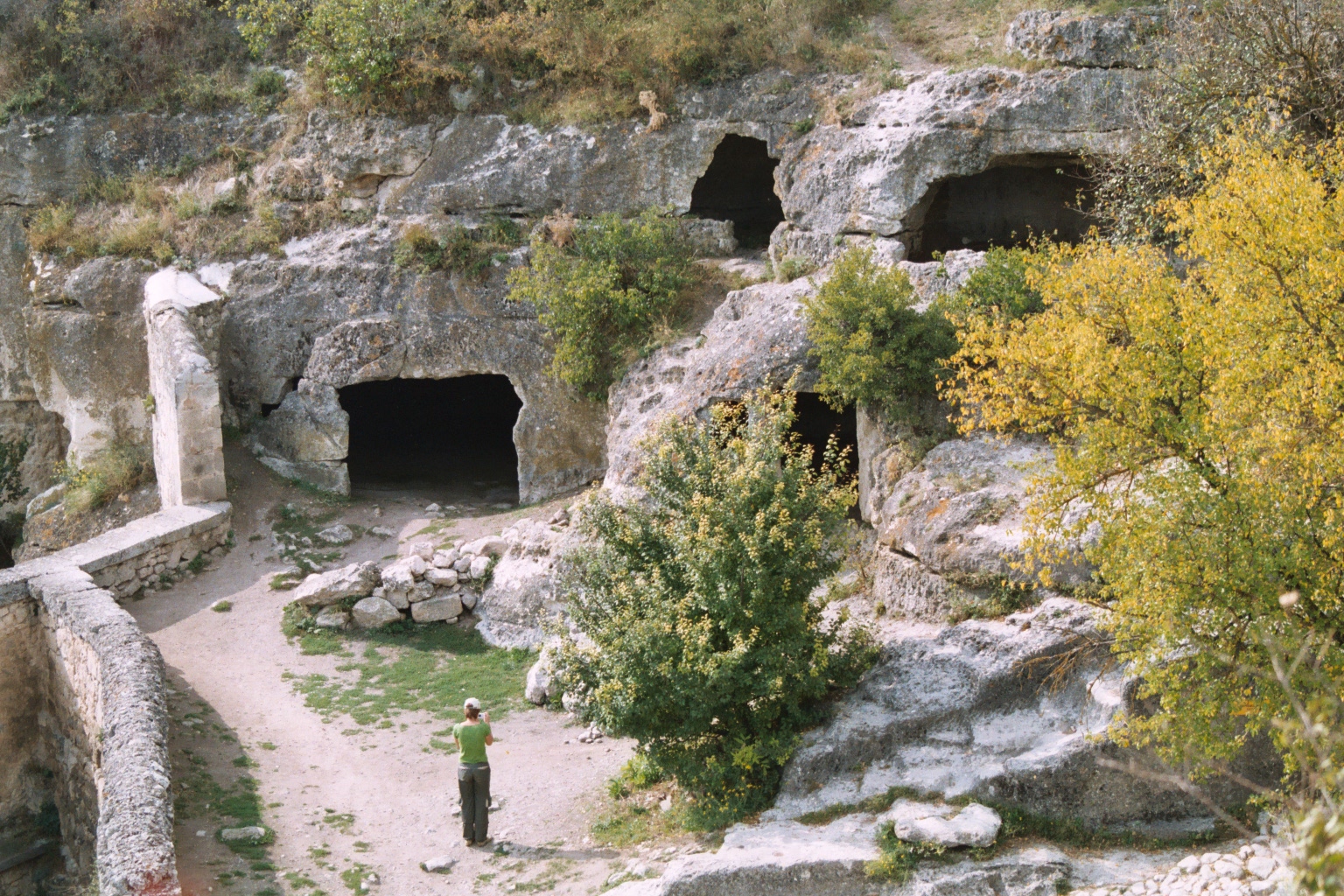
Perched on a rocky plateau above Bakhchisaray, Chufut-Kale feels like a place where time has paused, leaving behind the echoes of centuries. The fortress, carved into the cliffs, overlooks a quiet valley where orchards and vineyards now stretch across land that once hummed with the activity of ancient trade routes. From this height, the past doesn’t feel distant—it’s as if the walls themselves still hold the whispers of the people who lived, traded, and prayed within them. The sheer cliffs and sturdy fortifications made it nearly impregnable, a silent witness to the rise and fall of empires.
The origins of Chufut-Kale trace back to the 6th century, when it began as a Byzantine stronghold. But its true significance emerged later, when it became a key center of the Crimean Khanate. By the 14th and 15th centuries, it had evolved into a thriving settlement under the rule of the Karaim people, a small community with roots in a distinct branch of Judaism. The name Chufut-Kale itself translates to "Jewish Fortress," reflecting its role as a cultural and religious hub for the Karaim. Even after its military importance faded, the fortress remained a spiritual home for them, preserving their traditions in its stone walls.
Walking through Chufut-Kale is like stepping into a living museum of architectural layers. The narrow streets, hewn directly into the rock, wind past the remnants of homes, mosques, and Karaim prayer houses known as kenassas. The massive gates bear inscriptions in ancient Turkic script, while the remains of baths and water cisterns hint at the ingenuity of its former inhabitants. The most striking structure is the Great Kenassa, built in the 18th century. Its intricately carved walls and serene interior still carry the weight of history, offering a glimpse into the spiritual life of the Karaim community.
One of the most enigmatic spots in the fortress is the mausoleum of Janike-Khanym, the daughter of the Golden Horde’s Khan Tokhtamysh. Legend paints her as a ruler of Chufut-Kale who met a tragic end defending the city. The 15th-century mausoleum, though modest in size, is a masterpiece of Crimean Tatar architecture, with its graceful dome and arched windows. Locals still honor her memory, and visitors often linger here, drawn by the romance of the story and the quiet dignity of the place.
Unlike more famous historical sites, Chufut-Kale remains largely untouched by mass tourism. There are no crowds, no souvenir stalls, just the wind sweeping across the plateau and the occasional cry of a bird. On clear days, the view stretches all the way to the sea and the distant mountains, while at sunset, the cliffs glow with warm hues. It’s a place for those who prefer to explore history at their own pace, where every stone seems to hold a story waiting to be discovered.
The fortress may be abandoned, but it doesn’t feel lifeless. The ruins still hum with the energy of the past—imagine merchants haggling in the streets, prayers echoing through the kenassas, and guards scanning the horizon for approaching threats. Chufut-Kale isn’t just a collection of crumbling walls; it’s a bridge to another era, offering a quiet dialogue with history for those willing to listen.
Getting here is part of the experience. The hike from Bakhchisaray takes about an hour, winding through scenic hills before the fortress comes into view. For those who prefer not to walk, a short drive will bring you to the plateau. There are no guided tours or flashy attractions, just the raw beauty of the landscape and the weight of centuries pressing against the cliffs. It’s a stark contrast to the bustling coastal resorts of Crimea, a reminder that the peninsula’s soul lies not just in its beaches but in its ancient heights.
For anyone visiting Bakhchisaray, Chufut-Kale is a must. It’s not the kind of place you rush through—it demands time, curiosity, and a willingness to let the past seep in. The silence here isn’t empty; it’s filled with the voices of those who once called this fortress home. Whether you come for the history, the views, or simply the chance to step away from the modern world, Chufut-Kale offers something rare: a moment of connection with a place that has stood the test of time.