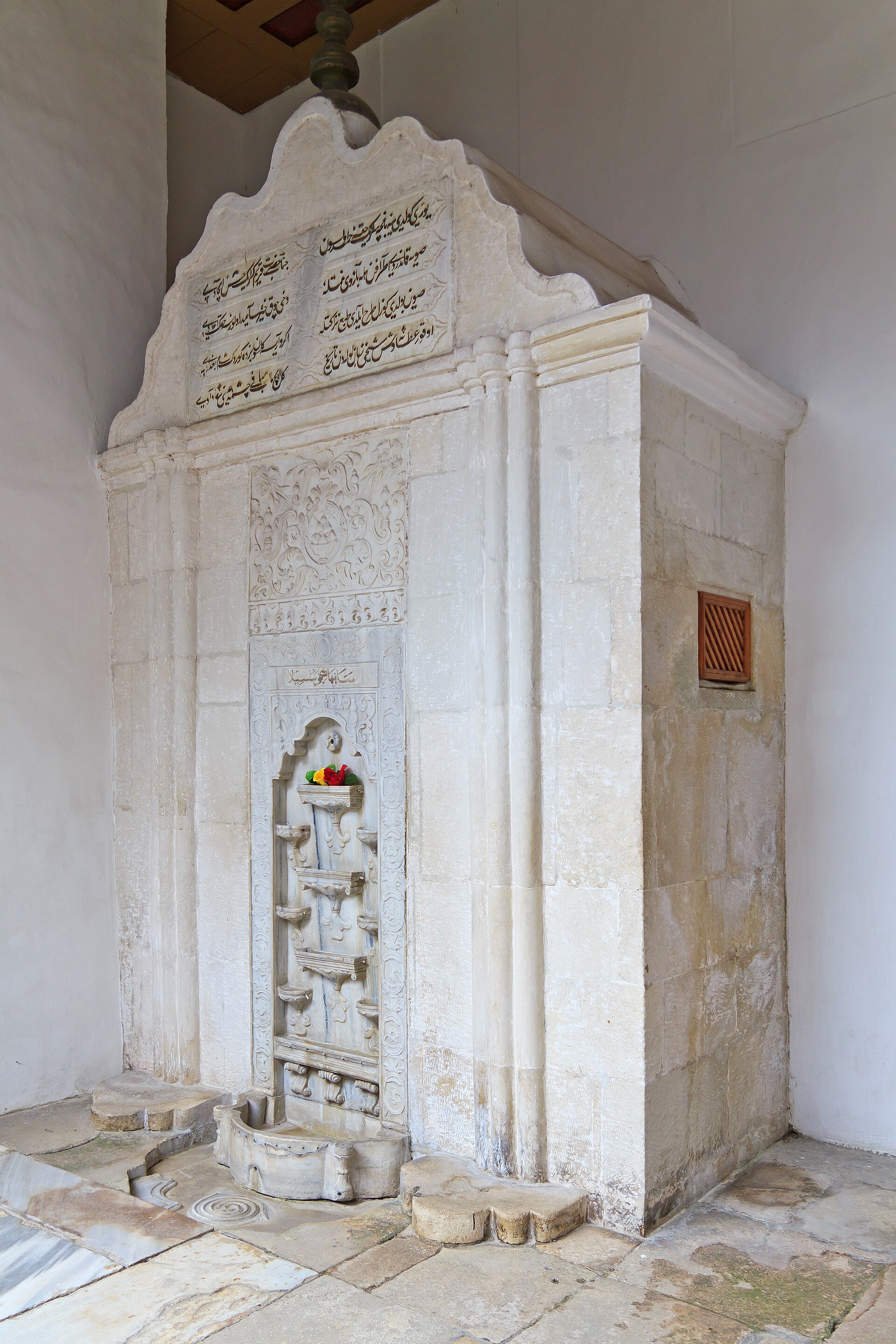
The Fountain of Tears in Bakhchisaray is one of those rare places that feels like a living piece of history. Tucked away in the courtyard of the Khan’s Palace, it stands surrounded by ancient walls that have witnessed centuries of Crimean Tatar rule. Unlike the grand, ornate fountains of European palaces, this one is small and unassuming—a slab of marble with water trickling down its surface, not in a rush, but slowly, deliberately, as if time itself has paused here. There’s no excess in its design, no gilded figures or elaborate carvings. Instead, it carries a quiet dignity, a sense of purpose that goes beyond mere decoration.
The fountain’s story is woven into legend, one that speaks of love and loss. It’s said that Khan Qırım Giray commissioned it in the 18th century after the death of his beloved concubine, Dilara Bikech. The water, dripping steadily like tears, was meant to symbolize his grief, a sorrow so deep it would outlast him. Whether the tale is entirely true or not, the fountain has become a vessel for this narrative, giving the place an almost tangible melancholy. Even without the legend, though, it would still hold its own as a remarkable example of Crimean Tatar craftsmanship, a testament to an era when water was not just an element of beauty but a sacred force.
Architecturally, the Fountain of Tears reflects the understated elegance of the Crimean Khanate. The marble slab is adorned with delicate floral carvings, a nod to the intricate patterns found in Islamic art, while the surrounding latticework serves both as protection and as a frame for the water’s gentle descent. There are no statues, no mythological figures—just the raw simplicity of stone and water. This restraint is characteristic of the period, where symbolism often took precedence over ostentation. The fountain’s design is a quiet dialogue between form and meaning, a reminder that beauty doesn’t always need to shout to be heard.
The fountain is inseparable from the Khan’s Palace, a sprawling complex that evolved over centuries, absorbing influences from the Ottoman Empire, Persia, and even Europe. The palace itself is a patchwork of styles—courtyards with arched galleries, rooms adorned with painted ceilings, and gardens that once bloomed with rare plants. The Fountain of Tears, added in the later years of the palace’s construction, feels like the final brushstroke in a long, intricate painting. It doesn’t dominate the space but rather complements it, adding a layer of emotion to the grandeur around it.
Today, the fountain draws visitors not for its size or splendor, but for the atmosphere it creates. Even on busy days, when tourists fill the palace courtyards, the area around the fountain remains strangely quiet. The water still drips, the marble still gleams under the Crimean sun, and for a moment, it’s easy to forget the modern world outside. There’s no fanfare here, no guided tours rushing through—just the steady rhythm of water, the weight of history, and the sense that some stories are meant to be felt rather than explained.
The fountain’s fame extends far beyond Crimea, thanks in part to Alexander Pushkin. When the Russian poet visited Bakhchisaray in the early 19th century, he was so moved by the place that he immortalized it in his poem *The Fountain of Bakhchisaray*. His verses transformed the fountain into a symbol of eternal sorrow and unrequited love, embedding it in the romantic imagination of generations. Pushkin’s words gave the fountain a second life, one that exists alongside its physical presence. For many, the real fountain and the one in the poem have become intertwined, each lending depth to the other.
What makes the Fountain of Tears so enduring is its authenticity. It doesn’t try to impress with scale or opulence; it simply exists, as it has for centuries. In a world where so much is designed to grab attention, this small marble slab does the opposite—it invites contemplation. The water still falls, the stone still bears the marks of time, and the legend still lingers in the air. It’s a place where history isn’t just remembered; it’s experienced. And perhaps that’s why, after all these years, it continues to draw people in—not with promises of spectacle, but with the quiet assurance that some things are meant to last.