Perched on a hill overlooking the quiet town of Talsi, Valdemār Tower is one of those rare places where the past feels almost tangible. Built in the late 13th century as part of the town’s medieval fortifications, it stands as a silent witness to centuries of change. The tower’s sturdy stone walls, narrow arrow slits, and thick vaulted ceilings speak of a time when defense was a daily concern, and every structure had to serve a purpose beyond mere shelter. Though the castle it once belonged to has long since crumbled into ruins, the tower itself remains remarkably intact, a solitary guardian of Talsi’s history.
The architecture of Valdemār Tower is a textbook example of Livonian military design. Its walls, nearly two meters thick in places, were built to withstand sieges, while the small, high-set windows were designed more for repelling arrows than for letting in light. Inside, the remnants of spiral staircases and upper-level passages hint at the tower’s original layout, where lookouts once scanned the horizon for approaching threats. From the top, the view stretches across the rolling hills and dense forests of the Courland region, a landscape that has changed little since the Middle Ages. It’s easy to imagine the watchmen who once stood here, their eyes trained on the distant roads, waiting for signs of friend or foe.
Talsi’s location has always made it a place of strategic importance. Nestled in the heart of Courland, it sat along key trade routes that connected the Baltic coast with the inland regions. Over the centuries, the town found itself caught in the crosscurrents of power struggles between the Livonian Order, local nobles, and neighboring states. Valdemār Tower likely takes its name from one of the figures tied to these turbulent times, though the exact origins of the name have been lost to history. What remains certain is the tower’s enduring presence—a reminder that Talsi was once more than just a sleepy provincial town, but a fortified stronghold with a role to play in the region’s fate.
Like many medieval structures, the tower’s purpose evolved with the times. By the 19th century, it had been repurposed as a prison, and later, a storage space. Such transformations are common for old buildings; they adapt to the needs of each era while retaining the weight of their past. Today, the tower houses a small exhibition dedicated to Talsi’s history, where visitors can see old maps, photographs, and artifacts that tell the story of the town and its surroundings. The displays are modest but evocative, offering glimpses into the lives of the people who called this place home over the centuries.
Climbing to the top of the tower is like stepping into a different time. Below, Talsi unfolds in a patchwork of red-tiled roofs, tree-lined streets, and the shimmering surfaces of nearby lakes. The view is expansive, especially on clear days, and it’s hard not to feel a connection to the countless others who have stood in this same spot, looking out over the same landscape. Valdemār Tower isn’t just a relic of the past; it’s a living piece of history, one that continues to exist in the present, bridging the gap between then and now.
Talsi itself is a town that moves at its own unhurried pace. Unlike Latvia’s larger cities, it doesn’t draw crowds of tourists or hum with constant activity. Instead, it offers a quieter kind of charm, where narrow cobblestone streets wind past old wooden houses and small squares. Valdemār Tower fits seamlessly into this setting, its weathered stones complementing the town’s understated beauty. In summer, the hill around the tower blooms with wildflowers, while autumn turns the slopes into a sea of gold. Winter lends the scene a stark, almost fairy-tale quality, with the tower standing sentinel over a town blanketed in snow.
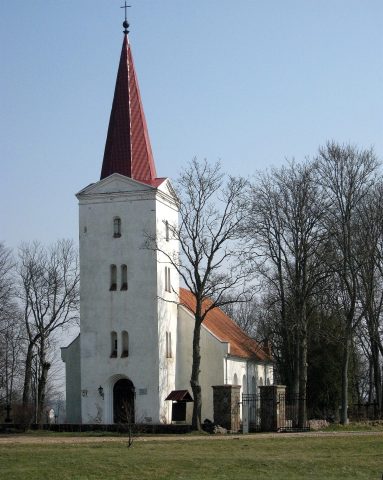
A visit to the tower is also an invitation to explore Talsi more deeply. Nearby, the old cemetery holds the graves of generations of townspeople, each with its own story. A short walk away stands St. John’s Church, a Baroque structure from the 18th century that has watched over the town for centuries. Talsi is full of such places, each with its own quiet significance. Valdemār Tower may be the most striking, but it’s just one piece of a larger tapestry, a town where history is woven into the very fabric of everyday life.
Today, the tower is more than just a museum piece. It’s a venue for exhibitions, concerts, and even weddings, a space where the past and present intersect. Locals take pride in it, not just as a tourist attraction, but as a part of their identity. For visitors, it offers a chance to step back in time, to imagine the clatter of hooves on cobblestones, the distant shouts of merchants, or the quiet murmur of prayers in the nearby church. It’s a place where history isn’t just something you read about—it’s something you can almost touch.
If you find yourself in Talsi, take the time to climb the tower’s steep steps. Pause at the top, let your gaze wander over the town and the surrounding countryside, and try to picture what this place looked like centuries ago. In moments like these, history stops being a distant concept and becomes something real, something alive. Valdemār Tower isn’t just a monument; it’s a storyteller, waiting for those who are willing to listen.