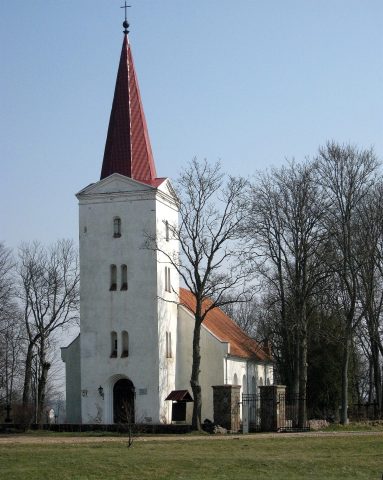
Talsi Lutheran Church stands in the heart of a Latvian town, its presence unassuming yet deeply rooted. Unlike Riga’s grand cathedrals or Western Europe’s ornate churches, this one carries weight shaped by centuries of local life. The building is modest, its neo-Gothic features softened by time. Pointed arches and slender towers rise above the rooftops, but there’s no sense of dominance. The church feels like part of the town, as if it grew from the same soil as the houses and cobblestone streets.
The history of the church begins in the 13th century, when these lands were ruled by the Livonian Order. The first structure here was wooden, later replaced by stone as the town took shape. The building we see today dates to the late 19th century, when Talsi was part of the Courland Governorate under Russian rule. The architecture reflects the era’s tastes—Gothic revival elements blend with the restrained simplicity typical of Baltic Lutheran churches.
Inside, the space is uncluttered. Whitewashed walls, wooden pews, and an altar speak more of devotion than decoration. The organ fills the air with sound that feels timeless, especially during services.
For centuries, the church was more than a place of worship. In medieval times, it served as a gathering point for the community. Under Swedish and Polish rule, it became a stronghold of Lutheran faith in a contested region. By the 19th century, when Talsi had grown into a district town, the church stood at the center of daily life. Baptisms, weddings, and funerals marked the passage of generations. Even during the Soviet era, when religion was suppressed, the church remained open as a concert hall, which may have saved it from neglect.
Today, services are held on Sundays, attended by a small but devoted congregation. The atmosphere inside is warm, and many locals come not just to pray but to sit in silence or listen to the organ. In summer, visitors can climb the narrow steps to the tower for a view of the town and the rolling hills beyond. From this height, Talsi’s nickname—"town of nine hills"—makes sense.
The streets around the church are narrow and winding, lined with early 20th-century houses. Life moves at its own pace: a carpenter’s hammer echoes from a workshop, the scent of fresh bread drifts from a bakery, and the church bells mark the hours.
The church has also become a cultural hub. Organ concerts are held regularly, and in summer, festivals celebrating Kurzeme’s heritage bring musicians and artists. The organ, installed in the mid-20th century, resonates through the vaulted ceiling with surprising power. When the music swells, the space transforms.
To a first-time visitor, Talsi Lutheran Church might seem like just another provincial church. But those who linger notice the details: worn gravestones in the churchyard, faded frescoes on the walls, wooden beams overhead that have sheltered generations. Each element tells a story of ordinary lives lived in this small corner of the world.
The church doesn’t demand attention. It offers itself as a place where past and present coexist, where history is felt in the quiet persistence of everyday faith.
In recent years, Talsi has started to attract travelers seeking something beyond tourist trails. The church serves as a starting point for exploring the town. Summer is an especially lovely time to visit, when linden trees bloom and the air is thick with the scent of grass and wildflowers. As evening falls, the church glows softly in the fading light.
What makes Talsi Lutheran Church special is not its size or grandeur, but its authenticity. It doesn’t try to impress; it simply endures. For those who find their way here, it offers a moment of stillness, a connection to something deeper. Some visitors return, drawn back by the quiet sense of belonging that lingers long after they’ve left.