Where the Tagus River once met its stone foundations, Belém Tower still stands. Built in the early 1500s, it guarded Lisbon’s harbor—not as a true fortress, but as a declaration. Portugal’s power was on display here, where ships returned heavy with spices, gold, and goods from distant lands. The river has since retreated, leaving the tower slightly inland, but the view remains: open water stretching toward the Atlantic.
The architecture mixes late Gothic strength with Manueline detail, a style unique to Portugal. The stonework teems with maritime symbols—ropes, anchors, coral-like patterns. A rhinoceros is carved into the facade, an animal so rare in 16th-century Europe it was a wonder. On the southern side, King Manuel I’s coat of arms marks his reign. Inside, the spaces are tight and shadowed, with vaulted ceilings and spiral staircases leading to chambers that once held gunpowder. The air feels still, as if time has paused.
Combat was never its purpose. The tower was a symbol, a statement of Portugal’s reach. It served as a customs point, where officials checked cargo—pepper from India, Brazilian gold, African ivory. Later, it became a prison, then a warehouse. Its walls adapted, but its legacy was always the same: a threshold between the known and the unknown, where sailors left for uncharted waters and returned with stories of unseen lands.
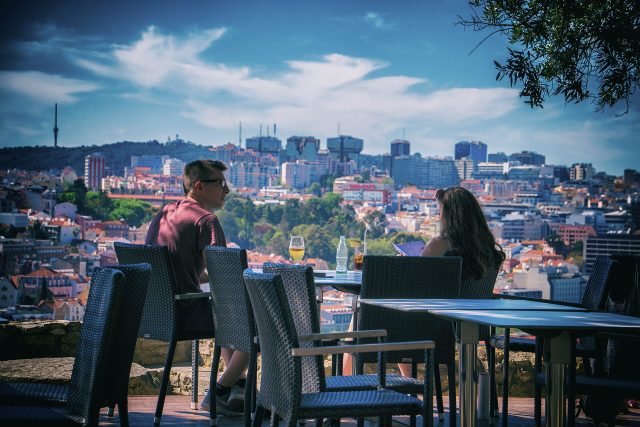
The climb to the top is narrow, the steps smoothed by centuries of feet. From the terrace, Lisbon spreads below—red roofs, the river’s curve, the distant bridge. On clear days, the ocean glints at the horizon. The exhibits inside are simple, but the tower itself is the draw. The stone is rough, the air damp, the river’s murmur a reminder of how much has changed.
The surrounding area is rich with history. The Jerónimos Monastery, another Manueline masterpiece, stands nearby. The Monument to the Discoveries rises a short walk away, honoring the explorers who sailed from these shores. The park around it is a place to pause, to watch the river, to sit.
Evenings bring a different view. The tower is lit from below, its reflection trembling in the water, a ghost of the ships that once passed.
Visiting isn’t about checking a box. The tower doesn’t demand attention; it simply endures. Maybe that’s why it stays with you. It’s not just a monument to Portugal’s past. It’s a quiet question: What would it have been like to stand here when the world was still full of unknowns?