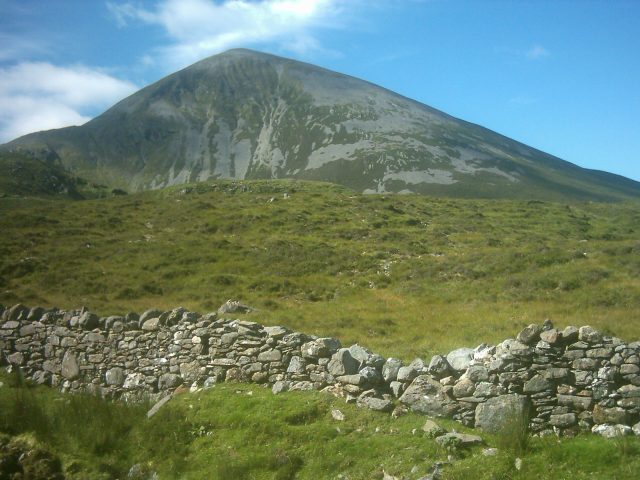
Ballycroy is where Ireland reveals itself in its most untamed and majestic form. Stretching across more than a thousand square kilometers of County Mayo’s wild northwest, this national park encompasses rugged mountains, vast peatlands, still lakes, and windswept moorland. There are no crowds here, no tourist traps—just the ceaseless Atlantic wind carrying the scent of heather and damp earth, the occasional silhouette of a sheep grazing on a hillside, and the quiet persistence of a landscape shaped over millennia. Glaciers once carved these rounded hills and deep valleys, leaving behind a terrain that feels both ancient and alive, as if the land itself is breathing.
The history of Ballycroy is woven into the very ground beneath your feet. Neolithic settlers left their mark here in the form of megalithic tombs and stone circles, silent witnesses to a time when humans first learned to live in harmony with this harsh yet generous land. Centuries later, the O’Malley clan, one of the most powerful families of Ireland’s western coast, ruled these parts. Grace O’Malley, the legendary pirate queen of Connacht, is said to have roamed these hills and shores, her name still evoking the wild, independent spirit of the region. The park feels like a place where history lingers—not in grand monuments, but in the way the land has absorbed the lives of those who once called it home.
At the heart of Ballycroy stands the Nephin Beg mountain range, its highest peak rising nearly eight hundred meters above the surrounding landscape. Climbing Nephin is less a hike and more an experience, one that tests both body and patience. The weather here is famously unpredictable; a clear morning can turn to dense fog in minutes, and a steady drizzle can transform a trail into a slippery challenge. But those who persevere are rewarded with views that stretch to the horizon—rolling hills giving way to the jagged coastline, the vast expanse of the Atlantic, and, on the clearest days, the distant outlines of Achill and Clare Islands. The summit offers a rare sense of solitude, a moment where the world feels both vast and intimately small.
The peatlands of Ballycroy are a world unto themselves, a fragile ecosystem that has thrived since the last ice age. These bogs cover much of the park, their spongy surfaces dotted with rare plants like the insect-eating sundew and the delicate cotton grass, its white tufts swaying in the wind. The peatlands are a haven for birds—curlews, lapwings, and the occasional peregrine falcon—while in spring and autumn, migrating species pause here, turning the park into a temporary avian metropolis. Wooden boardwalks crisscross the bogs, allowing visitors to step into this waterlogged world without disturbing its delicate balance. The stillness here is profound, broken only by the cry of a distant bird or the rustle of wind through the reeds.
The lakes scattered throughout Ballycroy each have their own character, but none more so than Lough Bellawaum, a body of water so clear that on calm days, the rocky bottom is visible several meters down. Local lore speaks of trout so large they became the stuff of legend, drawing fishermen from across the region in search of a prized catch. Today, the lake remains a quiet retreat for those who come not just to fish, but to sit by the water’s edge and listen to the silence. The lakes of Ballycroy are places of reflection, where the only sounds are the lapping of water against the shore and the occasional splash of a leaping fish.
There are few grand architectural features in Ballycroy, but the structures that do exist feel like natural extensions of the land. Stone walls, some dating back to the 18th century, snake across the hillsides, marking boundaries that have stood for generations. These walls were built by farmers who knew every inch of this terrain, their construction a testament to both necessity and craftsmanship. Scattered among the hills are the ruins of old cottages, their roofs long collapsed, their gardens reclaimed by wildflowers. These abandoned homes tell a story of a time when people lived here year-round, enduring harsh winters and lean years, their lives dictated by the rhythms of the land.
Ballycroy is not a place for those seeking the comforts of modern tourism. There are no souvenir shops, no bustling pubs, no guided tours with scripted anecdotes. Instead, there is space—endless, uncluttered space—and the kind of silence that feels rare in the modern world. The few locals you might encounter are reserved but warm, their knowledge of the land passed down through generations. They might share stories of the Great Famine, when entire families left these hills for America, or point out a hidden path that leads to a forgotten viewpoint. Their tales are not the kind you’ll find in guidebooks, but they offer a glimpse into a way of life that has endured, even as the world around it has changed.
What makes Ballycroy special is its ability to make you feel both insignificant and deeply connected. The vastness of the landscape puts things in perspective, reminding you of the smallness of human concerns against the backdrop of mountains and sky. Yet there’s also a sense of belonging here, a feeling that this land has been waiting for you to arrive, to walk its trails, to breathe its air, to simply be present. It’s a place where time slows down, where the rush of daily life fades into the background, and where the only agenda is to observe, to listen, and to let the land reveal itself on its own terms.
If you visit Ballycroy at dawn, when the mist still clings to the hills and the first light of day begins to filter through the clouds, you’ll understand why this place is often called one of Ireland’s most beautiful. There is nothing here but earth, water, sky, and wind—no distractions, no pretenses. The magic of Ballycroy lies in its simplicity, in the way it demands nothing from you except an open mind and a willingness to see the world as it truly is. It’s not a destination for those seeking entertainment, but for those who want to pause, to look around, and to remember what it feels like to be part of something far greater than themselves.