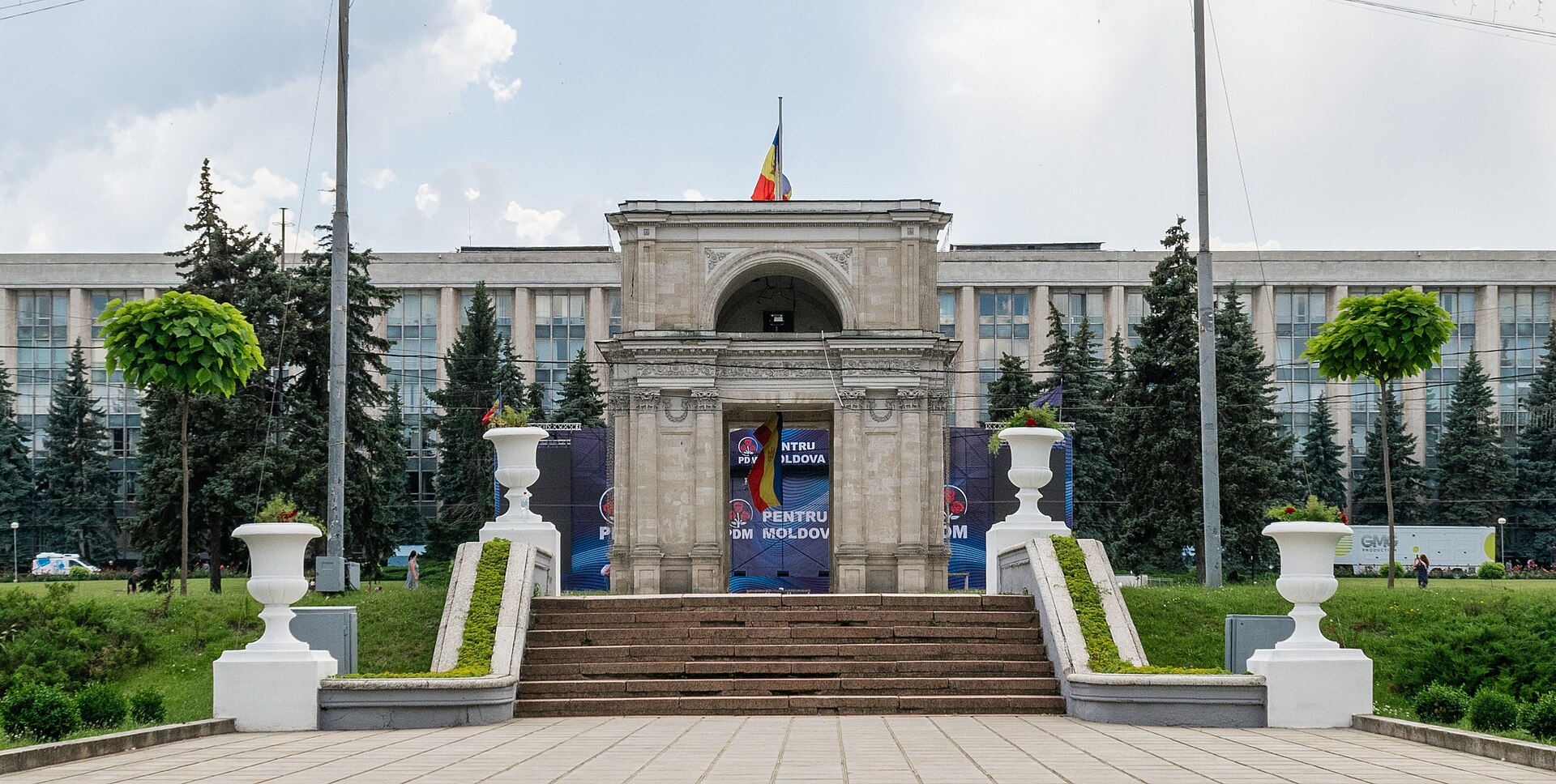
The Victory Arch in Chișinău is one of those landmarks that doesn’t immediately demand attention, yet somehow becomes a quiet symbol of the city. Standing on the Great National Assembly Square, right in front of the Government building, it’s modest in size—nothing like the grand Arc de Triomphe in Paris—but there’s a certain dignity to it. Built in the mid-19th century, it was originally part of a larger ensemble commemorating the Russian Empire’s victory in the Russo-Turkish War. At the time, Moldova was part of Bessarabia, and Chișinău, though still a provincial town, was slowly taking on the features of a European city.
The arch’s design is simple and functional, typical of the neoclassical style of the era. Four columns support the vault, and at the top, a clock still keeps time, its hands moving as they have for well over a century. The clock itself is older than the arch, brought from Odesa where it once adorned another building. There’s something fitting about that—time here feels suspended, as if the past is still present in the details. Inside, the arch once held war trophies, but today it’s empty, visited only by the occasional tourist curious enough to step beneath its vault.
History has left its marks on the arch in subtle ways. During World War II, it survived the bombings that ravaged Chișinău, perhaps because its understated presence didn’t make it a target. After the war, it became part of Soviet Chișinău, its meaning shifting slightly. Where it once celebrated imperial victory, it later stood as a quiet reminder of shared history. Today, many call it the Triumphal Arch, though officially it remains the Victory Arch.
The square around it is always alive with movement. The Great National Assembly Square is one of the busiest spots in the city, hosting protests, festivals, and, in winter, the country’s main Christmas tree. The arch watches over it all, an unchanging fixture in the city’s landscape. Sometimes it feels like it’s seen too much—parades in the 19th century, veterans gathering in Soviet times—but it endures, a silent witness to the passing years.
For locals, the arch isn’t a tourist attraction but a familiar part of daily life. People walk past it on their way to work or school, barely glancing up. Yet if you take a moment to look, you’ll notice how it changes with the light. In the morning, the stone glows golden; by evening, under the streetlights, it takes on a softer, almost mysterious hue. In winter, when snow blankets the square, the arch feels especially solemn, as if it belongs to another era.
Oddly enough, the Victory Arch rarely appears in guidebooks as a must-see. Postcards don’t feature it, and tourists often hurry past on their way to the Cathedral or Ștefan cel Mare Park. But that’s part of its charm. It isn’t a museum piece—it’s a living part of the city, existing for those who call Chișinău home, not for visitors. It doesn’t demand admiration, but it doesn’t let you forget it either.
If you ever find yourself in Chișinău, take a moment to pause here. Listen to the clock’s chime, watch the people rushing by, and you might sense something that can’t quite be put into words—the way history and the present intertwine in this city. The Victory Arch is just one small piece of that, but sometimes the quiet details reveal more than the grandest landmarks.