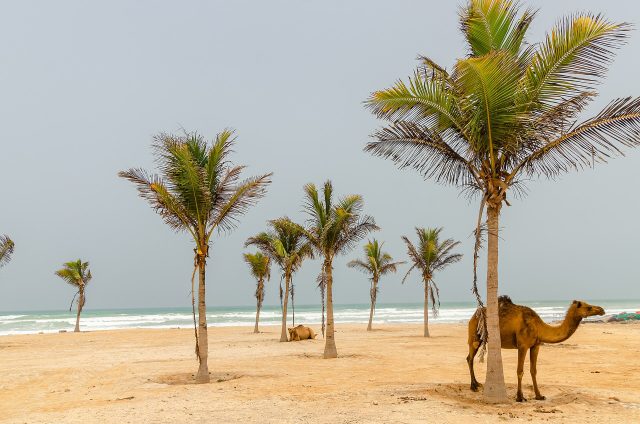
Al-Balad is the old heart of Salalah, a place where the past lingers in every corner. Walking through its narrow, stone-paved streets feels like stepping into another era, when the city thrived as a hub of the frankincense trade and a vital stop on ancient caravan routes. The district has resisted the march of modern development, preserving its authentic character in a way that few places in Oman still can. The buildings here tell stories of a time when life moved at a different pace, shaped by trade, tradition, and the rhythms of the sea.
The architecture of Al-Balad is a testament to practicality and resourcefulness. Homes were built from whatever materials were at hand—clay mixed with straw for walls, palm fronds for roofing, and coral limestone, quarried from nearby shores, to reinforce foundations and corners. Many houses feature intricately carved wooden doors and lattice windows, designed not just for beauty but to shield interiors from the harsh sun. Inside, high ceilings and spacious courtyards reflect a tradition of living that prioritized comfort in the heat, creating cool, airy spaces where families could gather. The craftsmanship is understated but deliberate, a quiet reminder of how people once adapted to their environment.
Centuries ago, Al-Balad was far from the quiet backwater it appears today. It was a bustling commercial district where merchants from across the Arabian Peninsula, Persia, and India converged to trade goods. Frankincense, harvested from the mountains of Dhofar, was the lifeblood of the economy, and Salalah stood as one of its most important centers. The streets would have been alive with the sounds of haggling in multiple languages, the scent of spices and resins hanging in the air, and the sight of camels laden with goods. Though the trade routes have long since shifted, traces of that vibrant past remain. A few old shops still operate, selling spices, handcrafted souvenirs, and traditional textiles, their shelves lined with goods that hint at the district’s former glory.
Dominating the skyline of Al-Balad is Al-Hisn Fort, a structure that has witnessed centuries of change. Built as a defensive stronghold, it later served as a residence for local rulers, its thick walls bearing silent witness to the ebb and flow of power in the region. Today, the fort houses exhibits that offer glimpses into Salalah’s history, from its days as a trading powerhouse to its role in Oman’s modern development. Climbing to the top rewards visitors with sweeping views of the city and the coastline, a perspective that makes it easy to imagine how the fort once commanded the surrounding landscape. It’s not just a monument but a living piece of history, one that continues to evolve alongside the city.
What makes Al-Balad truly special is its sense of continuity. Unlike many historic districts that have been turned into open-air museums, this one remains a living neighborhood. Families still inhabit the old houses, passing them down through generations, and daily life unfolds much as it has for decades. In the mornings, elderly men sit outside their homes sipping coffee, while children play in the shade of palm trees. Small cafés serve traditional Omani fare—strong, spiced coffee with dates, flatbreads baked over open flames—without the polish of tourist-oriented establishments. There’s a simplicity here that feels genuine, a connection to the past that hasn’t been sanitized for visitors.
In recent years, Al-Balad has become a symbol of Oman’s efforts to preserve its cultural heritage. The government has invested in restoring many of the district’s buildings, ensuring they retain their original character while remaining functional. The result is a place that feels both timeless and alive, where history isn’t just preserved but actively celebrated. Festivals, art exhibitions, and concerts of traditional music are now regular occurrences, drawing both locals and visitors. These events have helped reintroduce younger generations to their heritage, bridging the gap between past and present in a way that feels organic rather than forced.
A visit to Al-Balad is more than just a chance to see old buildings; it’s an opportunity to experience the soul of Salalah. There are no crowds here, no neon signs or tourist traps—just the quiet hum of everyday life. The streets are best explored on foot, with time to pause and absorb the details: the texture of the coral-stone walls, the play of light through lattice windows, the occasional laughter of children echoing between the houses. In the late afternoon, as the sun dips toward the horizon, the district is bathed in a warm, golden glow, softening the edges of the old buildings and making the past feel almost tangible.
What sets Al-Balad apart from other historic districts is its refusal to be frozen in time. It’s not a relic but a living, breathing part of the city, one that has adapted without losing its essence. The old and the new coexist here in a way that feels effortless—modern life unfolding against a backdrop of centuries-old architecture. For anyone willing to look beyond the surface, Al-Balad offers a rare glimpse into the layers of history that have shaped Oman, a place where the past isn’t just remembered but still very much alive.