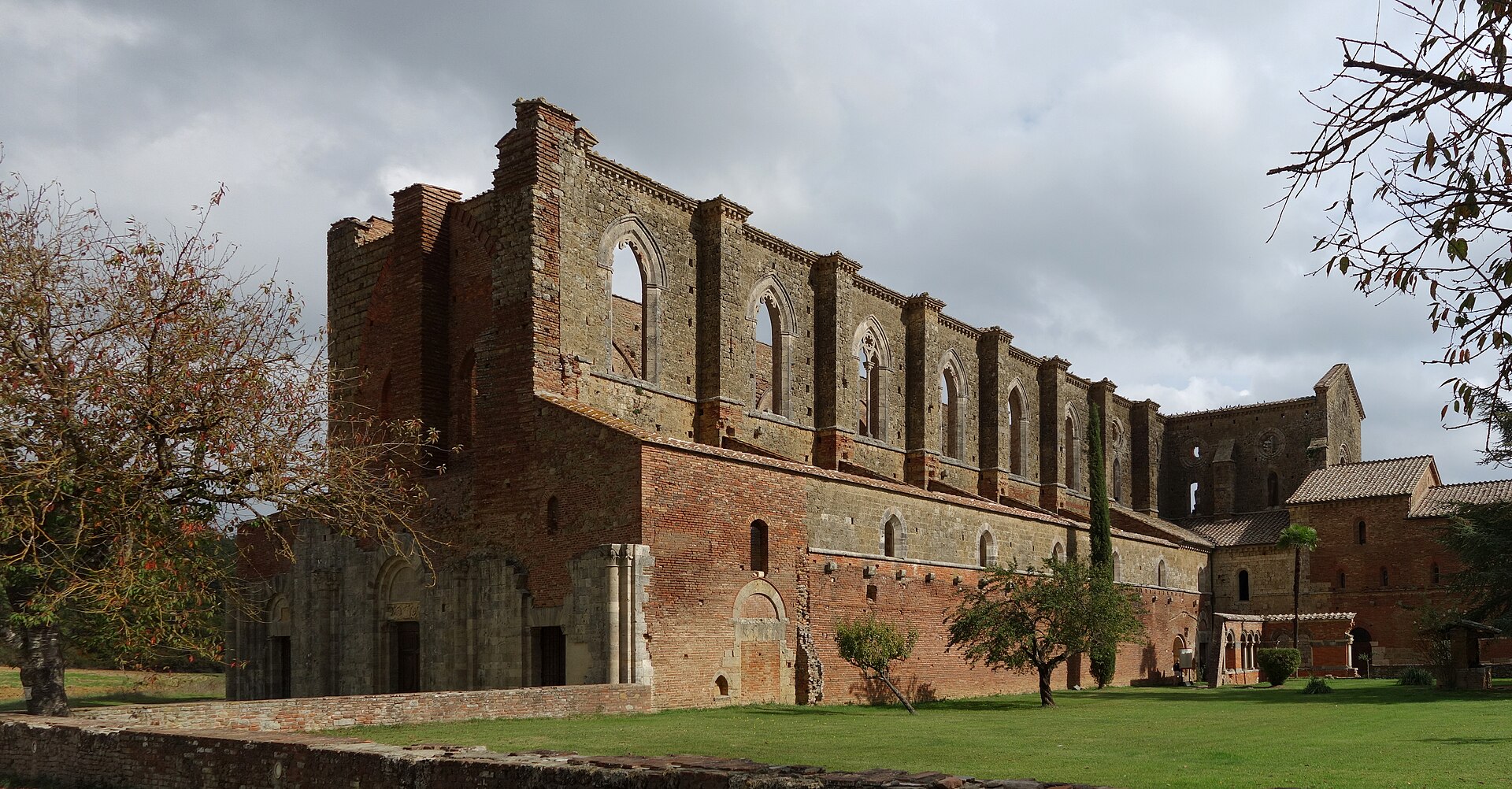
San Galgano Abbey sits in the quiet folds of Tuscany’s Merse Valley, where the land seems to hold its breath. The ruins rise from the earth like the bones of something once vast and living, their roofless walls open to the sky. Grass pushes through cracks in the ancient stone floor, and the only sounds are the wind moving through the empty arches and the occasional call of a bird. There are no crowds here, no guided tours with headsets, no vendors selling trinkets. The place exists as it has for centuries—still, patient, almost forgotten.
The abbey’s story begins in the 12th century, when Cistercian monks chose this remote valley for their monastery. The Cistercians were known for their austerity, building their communities far from cities, in places where the land could sustain them. The Merse Valley was fertile, with the river providing water and power for mills, and the surrounding hills offering timber and stone. But the monks were drawn here by more than practicality. A small chapel already stood nearby, tied to the legend of Saint Galgano, a local hermit whose life had taken on the weight of myth.
Galgano Guidotti was a knight who, according to the story, renounced his sword in 1180 by plunging it into a rock, where it remains to this day. The sword, still embedded in the stone, is kept in the Montesiepi Chapel, a small round building perched on a hill above the abbey. The chapel was built shortly after Galgano’s death, its simple design reflecting the humility of the man it honors. Over time, the chapel became the heart of a growing monastic community, and by the early 13th century, the monks had begun work on the abbey itself.
Construction took decades. The Cistercians built with purpose, favoring function over ornament. Their architecture was Gothic in style but stripped of excess—no soaring spires, no intricate carvings, just clean lines and solid stone. The abbey was meant to be self-sufficient, with workshops, a hospital for pilgrims, and vast agricultural lands. At its height, it controlled vineyards, olive groves, and pastures stretching across the valley. But prosperity was fleeting. By the 14th century, the abbey was already in decline. Economic troubles, plagues, and raids by mercenaries weakened the community, and by the 16th century, the monks had all but vanished. The roof collapsed, the walls cracked, and nature began to reclaim the space.
What remains today is a skeleton of the original structure. The nave, once filled with the murmur of prayers, is now a grassy expanse framed by towering arches. The rose window on the western facade still holds fragments of its tracery, and the outlines of the cloister can be traced in the uneven stones. Inside, patches of frescoes cling to the walls, their colors faded but their presence a quiet testament to the artistry that once filled the space. The abbey doesn’t demand admiration; it simply endures, its beauty lying in its impermanence.
Visitors often describe San Galgano as a place where time feels suspended. The light shifts slowly across the ruins, casting long shadows that stretch and shrink with the sun. There are no signs pointing out historical details, no plaques explaining the significance of each stone. The silence is profound, broken only by the rustle of leaves or the distant lowing of cattle in the fields. It’s easy to imagine the monks moving through these spaces, their footsteps echoing on the flagstones, their voices soft in prayer. The abbey doesn’t offer grand revelations—just the chance to stand in a place where history lingers in the air.
The surrounding landscape adds to the sense of timelessness. Rolling hills stretch in every direction, covered in vineyards and olive groves. Cypress trees stand like sentinels along the horizon, their dark silhouettes a familiar sight in this part of Tuscany. The road leading to the abbey is narrow and winding, lined with wildflowers in spring and golden grasses in autumn. There are no grand entrances here, no fanfare—just the quiet approach of a place that has always been more about presence than spectacle.
San Galgano is often compared to Stonehenge, not for its scale or mystery, but for the way it seems to exist outside of time. The legend of Galgano’s sword adds a layer of intrigue, drawing those who are drawn to stories of faith and miracles. But the abbey’s true power lies in its simplicity. It doesn’t need to be grand or perfectly preserved to leave an impression. The ruins stand as they are, a reminder that decay can be as meaningful as creation.
There are no cafes or gift shops here, no attempts to package the experience for tourists. The abbey asks for nothing but a moment of quiet reflection. It’s a place for those who seek something beyond the usual sights—a pause in the rush of travel, a chance to step into a slower rhythm. In a world that often feels too loud and too fast, San Galgano offers the rare gift of stillness. It doesn’t tell you what to think or how to feel. It simply exists, as it has for centuries, waiting to be seen.