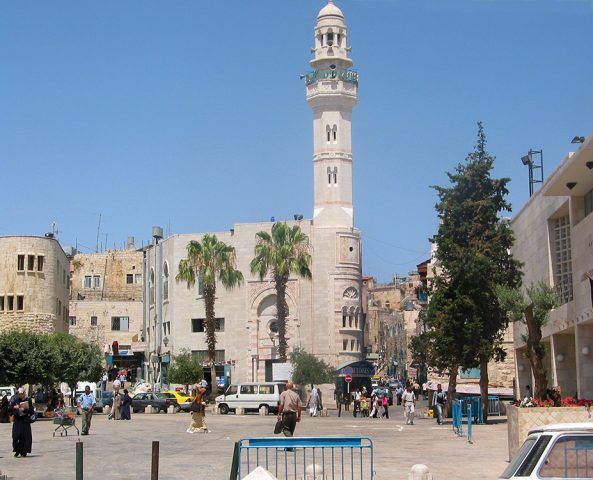
Bethlehem
Palestine · 5 places
Photo: Aurelio de Sandoval, CC BY-SA 3.0
Bethlehem is a place where ancient stories feel alive, not just preserved in scripture or history books. Just six miles south of Jerusalem, it carries a quiet presence that belies its global significance. For centuries, this small city has been a crossroads of faith, culture, and time, where the weight of tradition meets the rhythm of everyday life. It’s not just a destination on a pilgrimage route—it’s a place where the past isn’t just remembered, but still felt in the stones underfoot and the air itself.
At the heart of Bethlehem stands the Church of the Nativity, one of the oldest continuously operating churches in the world. Built in the 4th century under Emperor Constantine, it has drawn Christian pilgrims for generations. Inside, the atmosphere is thick with history—marble columns worn smooth by time, faded mosaics on the walls, and the low, narrow entrance that forces even the tallest visitors to bow their heads. Beneath the altar lies the Grotto of the Nativity, the traditional site of Jesus’ birth. On Christmas Eve, the church overflows with worshippers, and the city hums with a sense of anticipation, as if the miracle of the season might still be unfolding.
Yet Bethlehem is more than its religious landmarks. Beyond the churches and monasteries, life moves at its own pace, blending old customs with modern energy. The narrow streets of the Old City are lined with small shops where artisans sell hand-embroidered fabrics, olive wood carvings, and bottles of locally pressed olive oil. Cafés serve thick Arabic coffee spiced with cardamom, while bakeries tempt passersby with fresh kanafeh and baklava. In recent years, the city has also become a cultural hub, hosting festivals, art exhibitions, and concerts that draw both locals and visitors. The mix of voices—Arabic, English, and others—echoes through the alleys, a reminder that Bethlehem is still very much a living place.
The surrounding hills tell their own story. Olive groves and vineyards stretch across the slopes, tended by families who have worked this land for generations. The olives are harvested by hand, the oil pressed using methods passed down through centuries. Some farms welcome visitors to see the process firsthand, offering tastes of fresh oil or wine made from local grapes. Beyond the fields, the landscape holds other treasures: the ancient Monastery of Mar Saba, carved into the cliffs, and Rachel’s Tomb, a site revered in Judaism, Christianity, and Islam. A walk through these hills offers a quiet escape, with views of the Judean mountains stretching into the distance.
Bethlehem exists in a complex reality, yet it remains a place of openness. Life here moves at a different pace—less hurried than in the world’s great cities, but no less full. The call to prayer mingles with the sounds of children playing in the streets, and the scent of za’atar and fresh bread drifts from open windows. For some, it’s a spiritual journey; for others, a chance to glimpse Palestinian culture and hospitality. But for anyone who visits, Bethlehem becomes more than a dot on a map. It’s a place where time feels both vast and intimate, where the past isn’t just remembered—it’s still being lived.
See & Do
5 places


Places on the map
Marker colour follows the categoryClimate and weather
Detailed weather: Bethlehem- Average temperature
- 17 °C
- Precipitation per year
- 0 mm
Average air temperature
°C
8
9
11
16
20
22
24
25
23
21
15
11
Jan
Feb
Mar
Apr
May
Jun
Jul
Aug
Sep
Oct
Nov
Dec