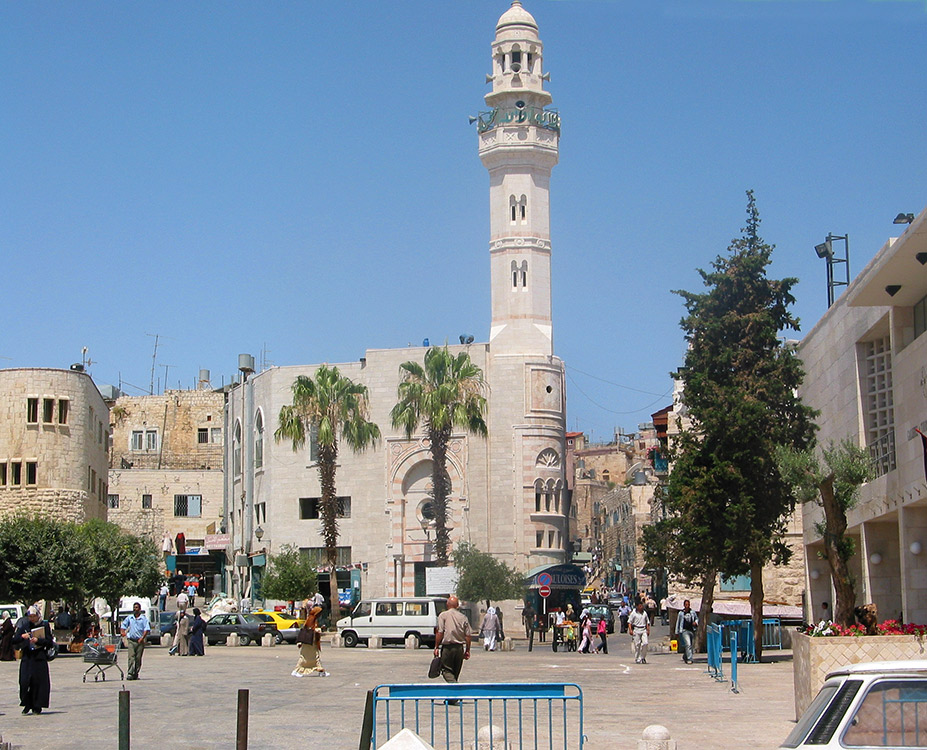
Mosque of Omar: A Quiet Thread in Bethlehem’s Tapestry
Bethlehem’s streets hold stories at every turn. The Mosque of Omar is one of them—a small building with a long memory. It stands near Manger Square, close enough to the Church of the Nativity that you can hear church bells and the call to prayer in the same breath.
The mosque dates to the 7th century. Caliph Umar ibn al-Khattab arrived in Bethlehem after Jerusalem fell to Muslim forces. He was offered a place to pray inside the Church of the Nativity but refused. He prayed outside instead, and later, this mosque was built on that spot. The story is often told as an early act of respect between faiths, though history is rarely as simple as the tales we pass down.
The mosque doesn’t draw attention to itself. Its minaret is a thin stone tower, taller than the buildings around it but not by much. The walls are pale limestone, the same material used in Bethlehem’s oldest structures. Inside, the prayer hall is plain. There are no elaborate decorations, just a space for worship.
For centuries, the mosque has been part of daily life. Local Muslims gather here, as they have for generations, alongside Christian neighbors. The call to prayer mixes with the sounds of the city—conversations, footsteps, the occasional car horn. This coexistence hasn’t always been easy, but it’s shaped Bethlehem in ways that go beyond religion.
Most visitors walk past the mosque on their way to the Church of the Nativity. If you stop, though, you’ll notice things that don’t make it into guidebooks. The courtyard, for example, where men sit on benches, drinking coffee and talking. The stone steps are worn smooth. Light filters through arched windows, softening the edges of time.
The mosque’s location near the Church of the Nativity makes it part of larger conversations. Some see it as a symbol of shared heritage. Others view it as a reminder of the tensions that have marked this land. Both perspectives hold truth, and that tension is part of what makes Bethlehem what it is.
Bethlehem has changed in recent decades. A separation barrier cuts through the landscape. Economic struggles weigh on the city. Yet the Mosque of Omar remains, as do the people who pray there. Life continues in small, steady rhythms—coffee in the courtyard, prayers in the hall, the hum of a city that refuses to stand still.
There’s no grand architecture here, no sweeping views. What you’ll find instead is a place that asks you to slow down. To listen. To notice the way history lingers in the air, in the voices of the people, in the stones underfoot. It’s a reminder that some of the most lasting stories are the ones that unfold quietly, in the spaces between the landmarks everyone already knows.