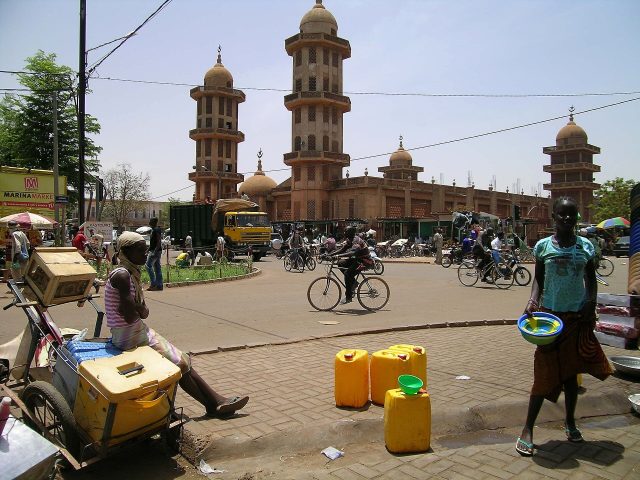
Weather overview
The weather in Уагадугу is shaped by two distinct seasons: a long dry period and a shorter rainy season. From November to March, the city experiences almost no rainfall, with clear skies and abundant sunshine. This is the hottest time of the year, especially in March and April, when daytime temperatures often exceed +40 °C.
The rainy season in Уагадугу begins in June and lasts through September, bringing relief from the heat but also higher humidity. July and August are the wettest months, with frequent downpours that can briefly disrupt travel plans. By October, the rains taper off, and the city transitions back to dry, sunny conditions.
Temperature
Temperatures in Уагадугу remain warm year-round, but the range between day and night can be significant. In the cooler months, such as January and December, nights drop to around +17.5 °C, while daytime highs reach +34 °C. The heat intensifies in March and April, with average highs of +40 °C and lows rarely below +25 °C.
During the rainy season, temperatures in Уагадугу become slightly more moderate. June through September sees highs around +30...+35 °C, with nights cooling to +23...+25 °C. The combination of heat and humidity can feel more oppressive, but the rains also bring a temporary respite from the extreme dryness of the earlier months.
| Month | Minimum | Maximum |
|---|---|---|
| January | 17.5 | 34.2 |
| February | 20.2 | 36.6 |
| March | 25.4 | 40.1 |
| April | 28.3 | 40.7 |
| May | 27.7 | 39 |
| June | 25.4 | 35.8 |
| July | 24.1 | 33 |
| August | 23.2 | 31.5 |
| September | 23.5 | 32.9 |
| October | 24.3 | 35.7 |
| November | 21 | 36.6 |
| December | 17.9 | 34.8 |
Precipitation
Уагадугу is one of the driest capital cities in West Africa, with most of its annual rainfall concentrated in just a few months. From November to February, precipitation is virtually nonexistent, and even in March and April, rain is rare. The first significant showers usually arrive in May, signaling the start of the wet season.
The peak of the rainy season in Уагадугу occurs in July and August, when the city receives over 200 mm of rain each month. These months see frequent, heavy downpours, often in the late afternoon or evening. By October, rainfall decreases sharply, and the dry season returns, bringing back the familiar arid conditions.
| Month | Precipitation |
|---|---|
| January | 0 |
| February | 0 |
| March | 1.8 |
| April | 2.8 |
| May | 50 |
| June | 93.5 |
| July | 224.5 |
| August | 263 |
| September | 155.6 |
| October | 46.3 |
| November | 0 |
| December | 0 |
What to pack
For a trip to Уагадугу during the dry season, lightweight, breathable clothing is essential. In January and February, when nights can be cooler, a light jacket or shawl may be useful. Sunglasses, a wide-brimmed hat, and high-SPF sunscreen are must-haves year-round, as the sun is intense even in the cooler months.
If visiting Уагадугу during the rainy season, pack quick-drying clothes and a compact umbrella or rain jacket. While the rains are usually short-lived, they can be heavy. Waterproof footwear is also a good idea, as streets may flood temporarily. A light scarf or bandana can help with dust during the dry months or humidity during the wet season.
| Month | Wind speed |
|---|---|
| January | 3 |
| February | 3.2 |
| March | 2.7 |
| April | 3.1 |
| May | 3.7 |
| June | 3.6 |
| July | 3.2 |
| August | 2.8 |
| September | 2.4 |
| October | 2.4 |
| November | 2.4 |
| December | 2.8 |