
Toledo
Spain · 10 places
Photo: PMRMaeyaert, CC BY-SA 3.0
Perched on a rocky hill above the Tagus River, Toledo appears before you reach it. The first glimpse is a silhouette—jagged walls, church spires, the cathedral’s dome rising from stone. Closer, the city reveals itself in fragments: narrow streets paved with uneven cobblestones, sudden courtyards where fountains murmur, flashes of valley views through gaps in the buildings. No grand boulevards or open plazas. Toledo is a maze where every turn feels like uncovering something hidden—a blacksmith’s workshop, a quiet square where footsteps echo on ancient stone.
For centuries, this city was a crossroads. Christians, Muslims, and Jews lived here together, leaving layers of history in its streets. In the Middle Ages, Toledo was a center of learning, where scholars translated works on medicine, astronomy, and philosophy from Arabic into Latin. The Jewish Quarter’s alleys and whitewashed houses still hold the shape of its past. Mosques repurposed as churches mark the city’s Islamic history. The Cathedral of Santa María mixes Gothic architecture with Mudéjar patterns, its stones holding the weight of many influences.
Toledo has always been a city of craftsmen.
Generations of workshops have produced blades, jewelry, and ceramics. You can walk into a shop and watch a silversmith engrave a pendant or a potter shape clay into a vessel with traditional motifs. The most famous craft here is damascene work—gold or silver inlaid into steel to form designs. The city’s metalwork dates back to Roman times. Today, knives, swords, and jewelry carry on that tradition, made by hands trained over decades.
The rhythm of Toledo is slow. Even in tourist season, the streets are quiet enough to hear hooves on cobblestones or church bells in the distance. In the evenings, the city glows as the sun sets behind the hills. Locals gather in taverns where the air smells of *carcamusa*, a stew of pork and vegetables, or *marmalade*, a pastry filled with egg yolk and syrup. You can wander for hours, stepping into dimly lit bars or pausing at viewpoints to watch the Tagus reflect the city’s lights.
Toledo doesn’t try to impress. No beaches, no flashy festivals. Instead, it offers something else: time suspended. The city feels permanent, indifferent to trends. History is in the stones, craftsmanship in the workshops, quiet conversations in the plazas. Coming here isn’t just a visit. It’s a step into a story that has unfolded for centuries, one you can return to and still find new corners.
Eat & Drink
1 place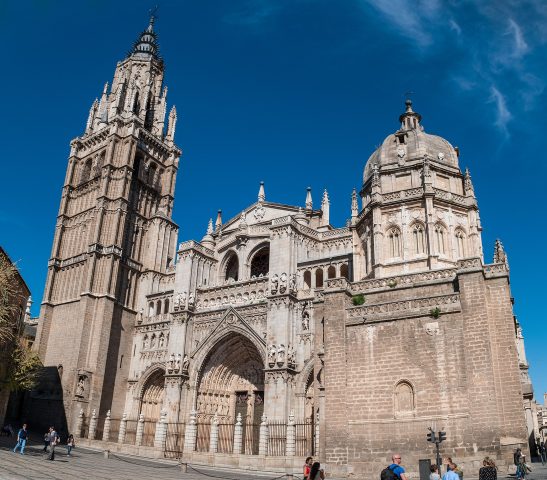
Places on the map
Marker colour follows the categoryClimate and weather
Detailed weather: Toledo- Average temperature
- 17 °C
- Precipitation per year
- 350 mm
- Sunshine hours per day
- 8.4 h
Average air temperature
°C
7
10
12
15
19
25
29
28
23
18
11
8
Jan
Feb
Mar
Apr
May
Jun
Jul
Aug
Sep
Oct
Nov
Dec


