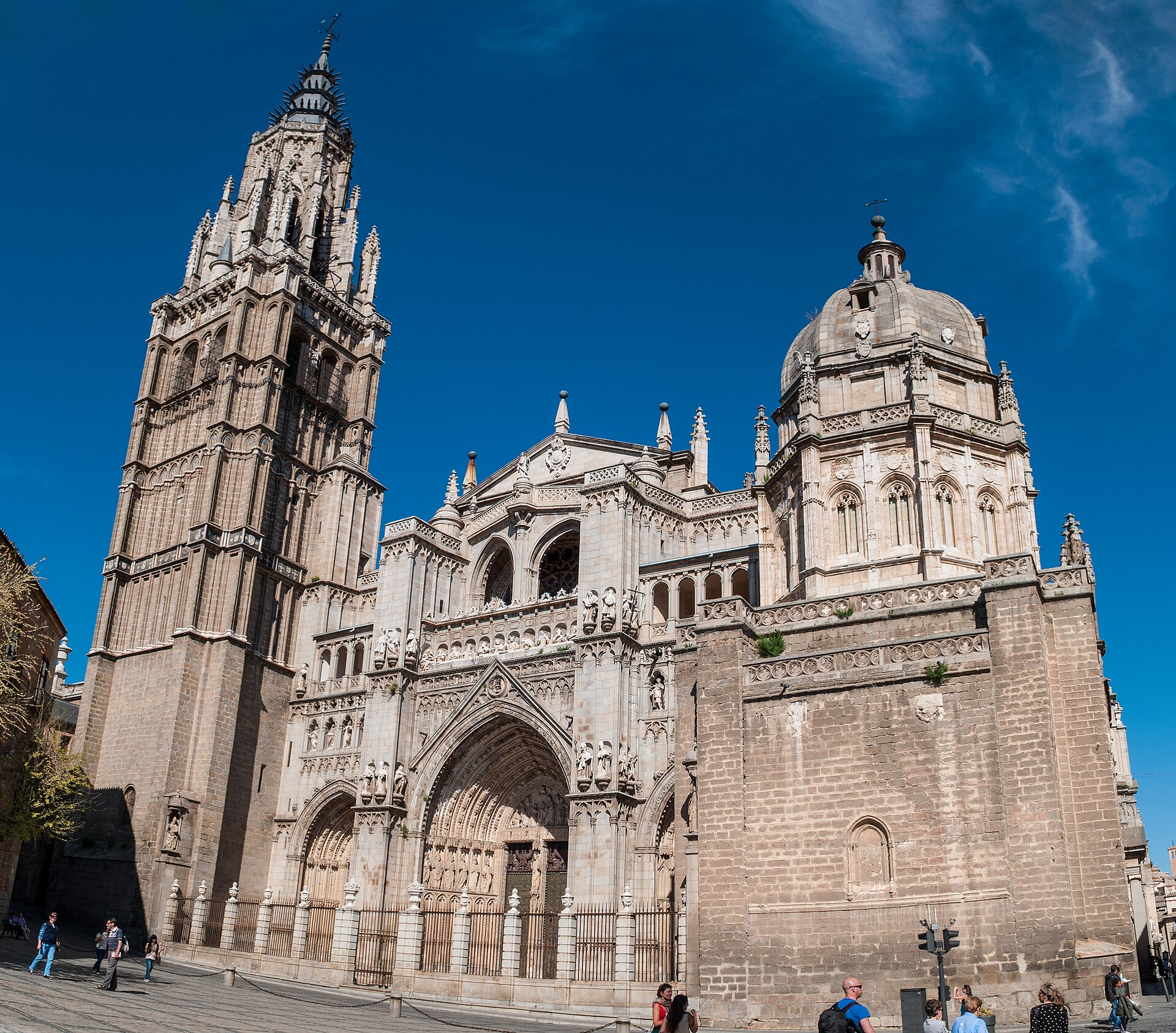
Photo: Michal Osmenda from Brussels, Belgium, CC BY 2.0
Toledo Cathedral
out of 5 0 ratingsToledo’s cathedral isn’t just a building—it’s the city’s pulse, a place where layers of history stack like the stones of its walls. Built on the site of a former mosque, which itself had replaced a Visigothic church, the cathedral carries the weight of centuries in its foundations. Construction began in the 13th century, when Toledo was the capital of Castile, and stretched over generations. Styles shifted, rulers came and went, but the vision remained: to create a monument that would embody the power of both church and kingdom.
The architecture is a conversation between French Gothic grandeur and local sensibilities. Soaring pointed arches, towering buttresses, and stained glass that draws the eye upward are all hallmarks of the style, yet Toledo’s cathedral has its own rhythm. The expansive transept floods the interior with light, while the decoration weaves Christian iconography with Moorish patterns—a nod to the city’s past as a melting pot of Christian, Muslim, and Jewish cultures. The chapels, in particular, are alive with intricate carvings that feel almost like lace in stone, a reminder of the hands that shaped this place over centuries.
The high altar is a masterpiece in its own right, a riot of Plateresque detail that emerged in 16th-century Spain, blending Gothic, Renaissance, and Mudéjar influences. It’s not just the scale that overwhelms but the sheer density of craftsmanship—saints, biblical scenes, and ornate motifs that seem to shift in the light filtering through the stained glass. Nearby, the choir stalls are a quiet marvel, each wooden seat carved with scenes from the life of Christ, portraits of kings, and bishops who once held sway here. The work is so precise it feels almost alive, as if the figures might step out of the wood at any moment.
The stained glass is another defining feature, with each window telling its own story. The oldest, from the 15th century, glows in deep blues and reds, casting an almost mystical light over the interior. Later windows, from the Renaissance, are brighter, their colors dancing across the stone as the sun moves. The rose window above the main entrance is especially striking, a radiant circle that seems to hover over the city, bridging the sacred and the earthly.
The cathedral’s treasury holds relics that draw visitors from around the world. Among them is the monstrance by Enrique de Arfe, a towering work of gold and silver encrusted with gems, weighing over 200 kilograms. It’s one of the most valuable in existence, a testament to the wealth and devotion that flowed through Toledo in its golden age. Alongside it are ancient manuscripts, bishop’s vestments, and other artifacts that whisper of the city’s past as a center of power and faith.
Yet the cathedral is more than its art and relics—it’s a living space. Daily services fill the air with organ music, and during major festivals like Holy Week or Christmas, the building becomes the heart of the city’s celebrations. Processions wind through the streets, incense lingers in the air, and the cathedral feels less like a monument and more like a breathing entity, steeped in tradition.
Toledo itself is a city where history seeps from every cobblestone, but the cathedral stands apart. It doesn’t just dominate the skyline—it anchors the city, its spires visible from nearly every winding alley. Stepping inside, time seems to slow. You could spend hours tracing the details of the carvings, listening to the echo of footsteps, or simply sitting in the quiet. Each visit reveals something new, whether it’s the way the light catches a particular window or the faint scent of old wood and wax.
The cathedral has witnessed coronations, battles, and moments that shaped Spain’s destiny. In the Middle Ages, when Toledo was one of the country’s most important cities, it served as both a spiritual and political symbol, a place where power and faith intersected. Today, its role has shifted, but its significance hasn’t. For visitors, it’s a must-see, a highlight of any trip to Spain. For locals, it’s a place of quiet reflection, a sanctuary from the rush of modern life.
When you leave, it’s worth glancing back. The cathedral changes with the light—ethereal in the morning sun, imposing at dusk when the city’s lights flicker to life. But no matter the hour, it leaves an impression. Not because it’s a box to tick on a tourist checklist, but because it embodies the threads of history, culture, and belief that make Toledo what it is. Here, the past isn’t just remembered—it’s still alive.
Day around this place
Where else to go on the same day
Building the day…
Where it is
39.85736, -4.02364