
Kaunas
Lithuania · 8 places
Photo: Wikimedia Commons, CC BY-SA 3.0
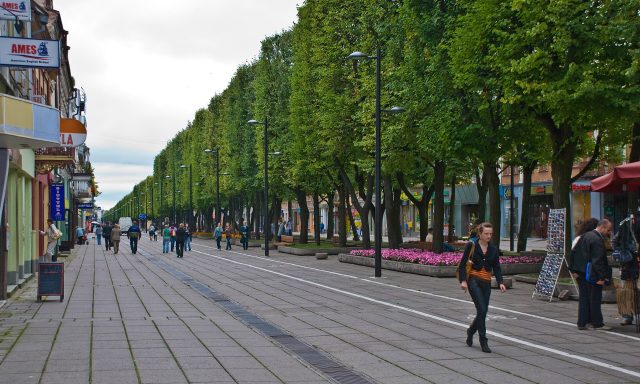
Kaunas doesn’t announce itself with fanfare. It simply exists—unhurried, unpretentious, the kind of place that slips into your memory without demanding attention. While Vilnius draws the crowds and Klaipėda charms with its seaside ease, Kaunas offers something quieter: a city where life unfolds at its own pace. Here, wide boulevards stretch without urgency, and hidden courtyards hum with the kind of everyday rhythm that feels almost forgotten elsewhere. It’s Lithuania without the postcard polish, the kind of place where you might stumble upon a local bakery still using a century-old recipe or a bookshop where the owner remembers your last visit.
The city sits where two rivers, the Nemunas and the Neris, converge, their waters shaping the streets in subtle ways. In summer, the embankments fill with people strolling, cycling, or lingering over coffee at open-air cafés. When winter arrives, the rivers freeze, and the city softens, the usual bustle muffled under a layer of snow. The heart of Kaunas is a patchwork of architectural styles, but it’s the interwar buildings—Art Deco facades, Gothic spires, and the occasional Bauhaus gem—that give the center its character. The town hall, with its soaring tower, is the city’s unofficial emblem, nicknamed the White Swan for its graceful silhouette. Around it, life moves at a leisurely pace: couples pose for photos, old men play chess on benches, and students sprawl on the grass with textbooks and thermoses of tea.
Kaunas has a way of making culture feel approachable. Museums here aren’t just for tourists with guidebooks; they’re woven into the fabric of the city, as natural as stopping for a beer or buying fresh bread. There’s the Devil’s Museum, a quirky collection of figurines and folklore that feels more like a curiosity cabinet than a formal exhibit. History buffs will find plenty to explore in the interwar period displays, when Kaunas served as Lithuania’s temporary capital, its streets buzzing with political and artistic energy. For those who prefer contemporary art, small galleries showcase experimental works by local artists, often tucked into repurposed industrial spaces or quiet courtyards. The best part? You can wander into most of them on a whim, without planning or pretension.
The city’s pulse quickens with its student population. Universities and libraries dot the map, and the side streets are full of affordable cafés where conversations spill into the night. In summer, festivals take over the squares, filling the air with music and the scent of grilled sausages. Winter brings Christmas markets, their wooden stalls glowing under strings of lights. But even in the quieter seasons, there’s a sense of movement—street musicians setting up near the river, pop-up art installations appearing overnight, or a group of friends gathering in a park with guitars and a bottle of local wine. Kaunas doesn’t try to be perfect. It just is, and that’s enough.
If you visit, don’t rush. There’s no need to tick off a checklist of sights. Instead, let the city reveal itself slowly. Wander down a side street and duck into a tiny shop selling honey from nearby forests or cheese aged in underground cellars. Sit by the river and watch the ducks drift past, or find a bench in one of the parks where old men argue over a game of checkers. Kaunas isn’t the kind of place you see—it’s the kind you feel. And if you’re lucky, it might just feel like coming home.
See & Do
8 places


Places on the map
Marker colour follows the categoryClimate and weather
Detailed weather: Kaunas- Average temperature
- 9 °C
- Precipitation per year
- 554 mm
- Sunshine hours per day
- 5.4 h
Average air temperature
°C
-2
-1
3
8
13
18
19
18
14
8
3
0
Jan
Feb
Mar
Apr
May
Jun
Jul
Aug
Sep
Oct
Nov
Dec


