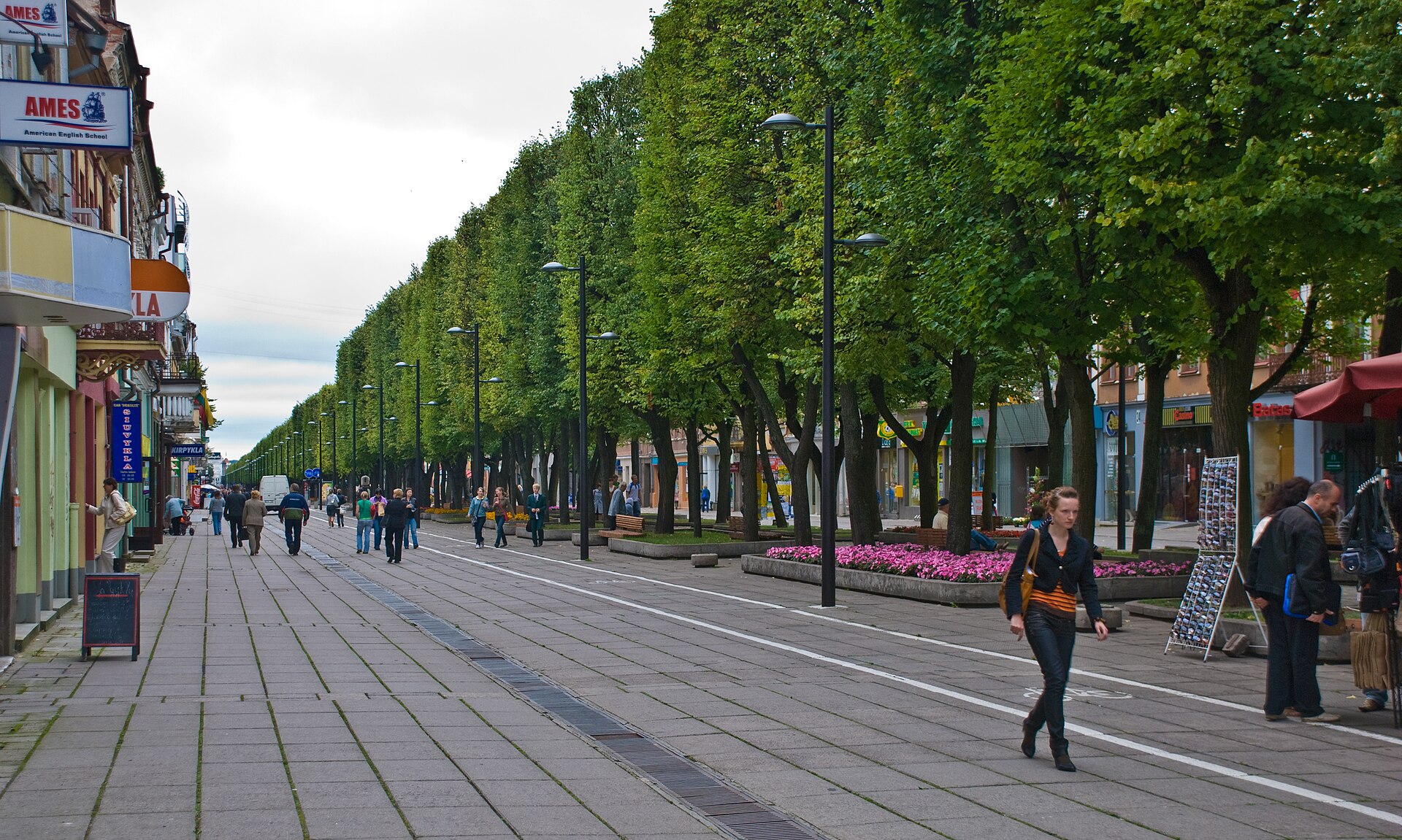
Laisvės Alėja, or Freedom Avenue, is the beating heart of Kaunas, a city that has long stood as Lithuania’s second capital in both spirit and significance. Stretching just over a kilometer from the Town Hall Square to the banks of the Nemunas River, this pedestrian boulevard is more than just a thoroughfare—it’s a living chronicle of the city’s past, a stage for its present, and a canvas for its aspirations. Walking its length, you move through layers of history, from the grand ambitions of the interwar years to the quiet resilience of Soviet times and the vibrant energy of modern Lithuania.
The avenue’s origins trace back to the late 19th century, when Kaunas was a provincial outpost of the Russian Empire. The city’s strategic location between the Nemunas and Neris rivers made it a natural hub, but it wasn’t until the early 20th century that Laisvės Alėja truly came into its own. After Lithuania regained independence in 1918, Kaunas became the temporary capital while Vilnius remained under Polish control. This period, known as the interwar years, was a golden age for the city. Architects, artists, and intellectuals flocked here, transforming Kaunas into a modern European capital almost overnight. Laisvės Alėja became the showcase of this transformation, lined with elegant buildings in the Art Deco and Functionalist styles that still define its character today.
The architecture along the avenue is a study in contrasts and continuity. On one side, you might pass the sleek lines of the former Central Post Office, a Functionalist masterpiece built in the 1930s, its clean geometry a testament to the era’s faith in progress. A few steps away, the ornate façade of the Kaunas State Musical Theatre, with its neoclassical columns and intricate detailing, harks back to an earlier, more decorative age. These buildings weren’t just structures—they were statements. They declared that Lithuania was a nation with its own identity, capable of standing alongside the great cities of Europe. Even today, the avenue retains this sense of purpose, as if every corner café or boutique hotel is still part of that original vision.
For much of the 20th century, Laisvės Alėja was a stage for history’s darker acts as well. During the Soviet occupation, the avenue became a place of controlled spectacle, where May Day parades and state-sanctioned celebrations masked the underlying tensions of life under foreign rule. Yet even then, it remained a space of quiet resistance. Locals would stroll here not just to shop or socialize, but to assert their presence in a city that was still, in many ways, their own. The avenue’s name itself—Freedom Avenue—was a subtle defiance, a reminder of what had been lost and what might one day be reclaimed. When Lithuania finally broke free from Soviet rule in 1990, Laisvės Alėja was where people gathered to celebrate, its pavements echoing with the chants of a nation rediscovering its voice.
Today, the avenue is a place where the past and present coexist with effortless ease. On any given afternoon, you’ll find students lounging on the benches outside the Vytautas Magnus University library, their laughter mingling with the clatter of coffee cups from nearby cafés. Street musicians set up near the intersection with Donelaičio Street, their melodies drifting over the hum of conversation. In the summer, the avenue comes alive with open-air markets, where vendors sell everything from handmade amber jewelry to fresh honey from the Lithuanian countryside. The scent of grilled cepelinai—Lithuania’s beloved potato dumplings—fills the air, drawing both locals and visitors to the small eateries tucked into the side streets.
What makes Laisvės Alėja special isn’t just its beauty or its history, but the way it feels like a shared space. Unlike the grand boulevards of Paris or Vienna, which can sometimes feel like museum pieces, this avenue is unmistakably alive. It’s where a grandmother might push a stroller past a group of teenagers on skateboards, where a businessman in a hurry will pause to chat with an old friend, where a tourist can stop to admire the architecture and end up invited to a local’s table for a cup of strong Lithuanian coffee. The buildings may be grand, but the scale of the avenue is human, designed for people rather than cars or parades.
The avenue’s relationship with the Nemunas River is another layer of its charm. At its eastern end, Laisvės Alėja opens up to a promenade that runs along the riverbank, offering views of the water and the distant hills beyond. This is where Kaunas lets its hair down, where the formality of the avenue gives way to a more relaxed, almost playful atmosphere. In the warmer months, you’ll find people picnicking on the grass, children playing near the water, and couples strolling hand in hand. The river has always been Kaunas’s lifeline, and its presence here is a reminder that the city’s identity is as much shaped by nature as it is by architecture.
For all its grandeur, Laisvės Alėja is also a place of small, everyday pleasures. The side streets branching off the avenue are filled with hidden gems—a tiny bookshop with a curated selection of Lithuanian literature, a vintage record store where the owner will happily spin you a rare vinyl, a bakery where the scent of fresh rye bread is as much a part of the experience as the taste. These places don’t announce themselves; you have to seek them out, and that’s part of the fun. The avenue invites you to slow down, to look beyond the obvious, and to discover the city at your own pace.
In many ways, Laisvės Alėja is a microcosm of Kaunas itself. It’s a city that has known both triumph and hardship, that has been shaped by forces beyond its control yet has always found a way to endure. The avenue reflects this resilience, its buildings standing as silent witnesses to a century of change. But it’s also a place of joy, of connection, of the simple pleasure of being in a city that feels like home—even if you’ve only just arrived. Whether you’re here for a day or a week, Laisvės Alėja will draw you in, not with fanfare, but with the quiet confidence of a place that knows its own worth.