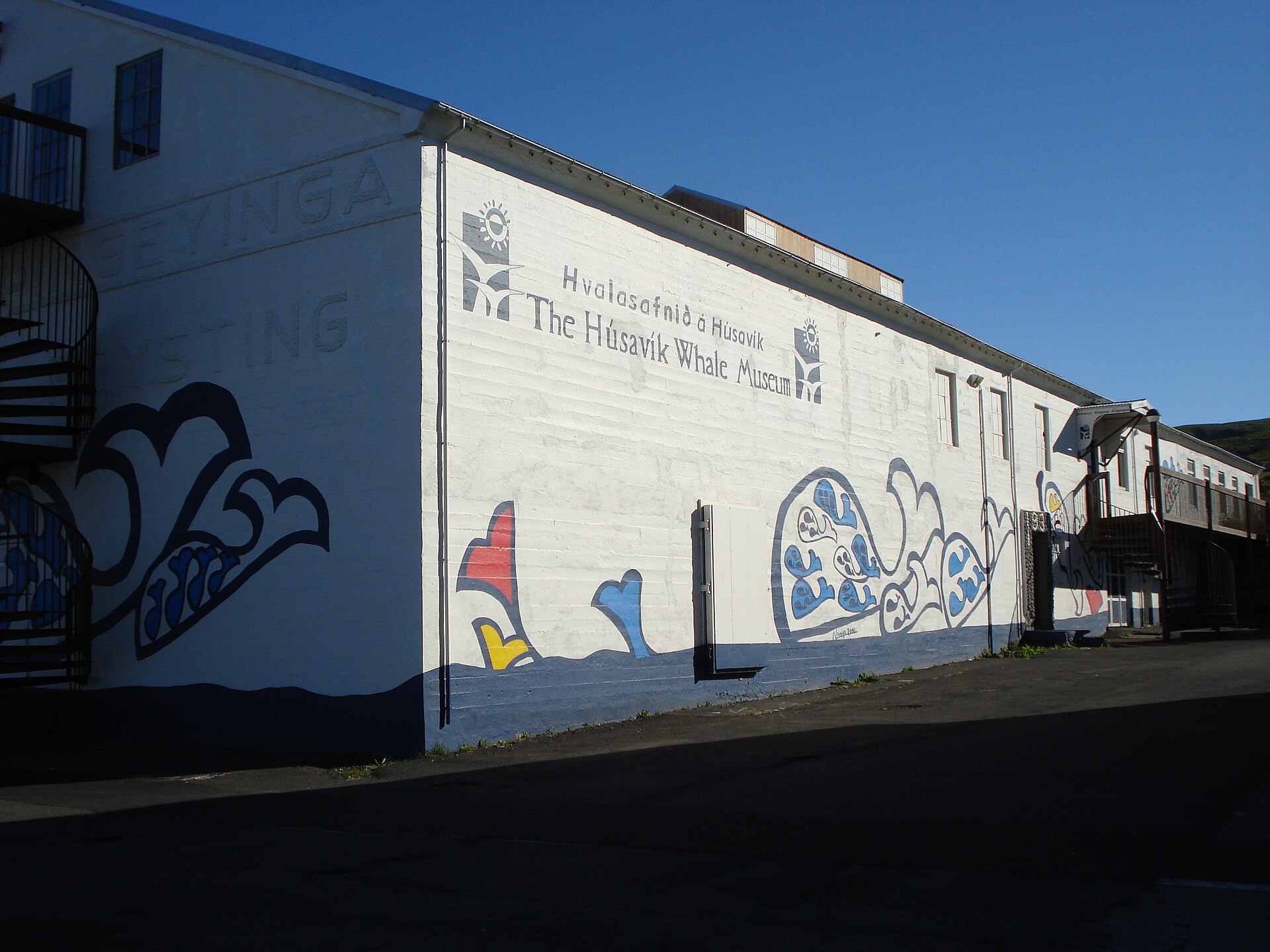
Húsavík has earned its reputation as Iceland’s whale-watching capital, a quiet fishing town on the country’s northern coast where the vast North Atlantic feels closer than anywhere else. But while a boat trip offers a fleeting glimpse of these ocean giants, the Húsavík Whale Museum invites you to step deeper into their world—not just as spectators, but as witnesses to a story that has shaped this place for centuries.
The museum occupies a weathered wooden building along Skjálfandi Bay, its creaking floors and salt-worn beams carrying the weight of history. Built in the early 1900s as a storage shed for fish and whale oil, the structure later served as a shipyard before finding its current purpose. There’s no attempt to soften the past here. The exhibits lay bare how whaling once sustained Iceland’s economy, how entire communities depended on the hunt, and how, over time, the same people who once harpooned these creatures came to protect them. It’s a shift that didn’t happen overnight, and the museum doesn’t shy away from the complexities of that transition.
The most striking exhibits are the skeletons—massive, silent, and impossible to ignore. A full blue whale skeleton hangs suspended from the ceiling, its sheer length forcing visitors to crane their necks. Even lying flat, it would dominate the room. Nearby, the skulls of sperm whales and the vertebrae of humpbacks rest on low platforms, their textures worn smooth by time. The bones aren’t just displayed; they’re presented in a way that lets you trace the curve of a jaw, count the ridges of a spine, or marvel at the sheer scale of something that once lived and breathed in these very waters. It’s one thing to read about a whale’s size; it’s another to stand beneath one and feel the weight of its absence.
A separate section recreates the grim reality of whaling’s heyday. A cramped ship’s cabin, complete with rusted harpoons and tools for flensing blubber, sits beside black-and-white photographs of Icelandic whalers at work. The images are unsettling—not because they’re graphic, but because they’re so ordinary. Men in oilskins haul ropes, their faces set in concentration as they take on animals dozens of times their size. The tools look primitive by today’s standards, yet they were once the height of efficiency. It’s a stark reminder that whaling wasn’t some distant, barbaric practice; it was a way of life, as much a part of Iceland’s identity as fishing or farming.
But the museum isn’t stuck in the past. Modern exhibits explore the science of whale conservation, explaining how researchers track migrations, study communication, and fight to protect dwindling populations. Interactive screens let visitors listen to the eerie songs of humpbacks or test their ability to identify species from underwater footage. The waters around Húsavík are particularly rich in marine life, thanks to nutrient-dense currents that attract everything from blue whales to orcas. The museum makes it clear why this stretch of ocean is so vital—not just for the whales, but for the people who now rely on them in a different way.
For those who want to linger, a small screening room plays short documentaries filmed in local waters. The footage is often breathtaking: a humpback breaching, its body arcing out of the sea before crashing back down; a pod of orcas corralling herring into tight bait balls. These aren’t just nature clips; they’re a bridge between the museum’s exhibits and the real thing. After watching, it’s hard not to feel the pull of the bay outside, where the same creatures might be swimming just beyond the harbor.
The museum is compact, but every detail feels intentional. There’s no clutter, no overwhelming barrage of information—just a series of carefully curated spaces that guide you from history to science to conservation. Even if museums aren’t usually your thing, this one is worth the visit. It doesn’t preach or romanticize; it simply presents the facts and lets you draw your own conclusions. What emerges is a portrait of a town that has had to reconcile its past with its present, and in doing so, has become a place where people come not just to see whales, but to understand them.
Afterward, Húsavík itself feels different. The town is small—colorful houses clustered around a quiet harbor, fishing boats bobbing beside whale-watching vessels. But now the details stand out: the old photographs of whalers in the café, the whale-themed souvenirs in the gift shops, the street names that hint at a maritime history. The museum doesn’t just teach you about whales; it changes how you see the town, turning a simple visit into something richer. The past here isn’t buried; it’s alive in the bones of the building, in the stories of the people, and in the very water that still draws these magnificent creatures to shore.