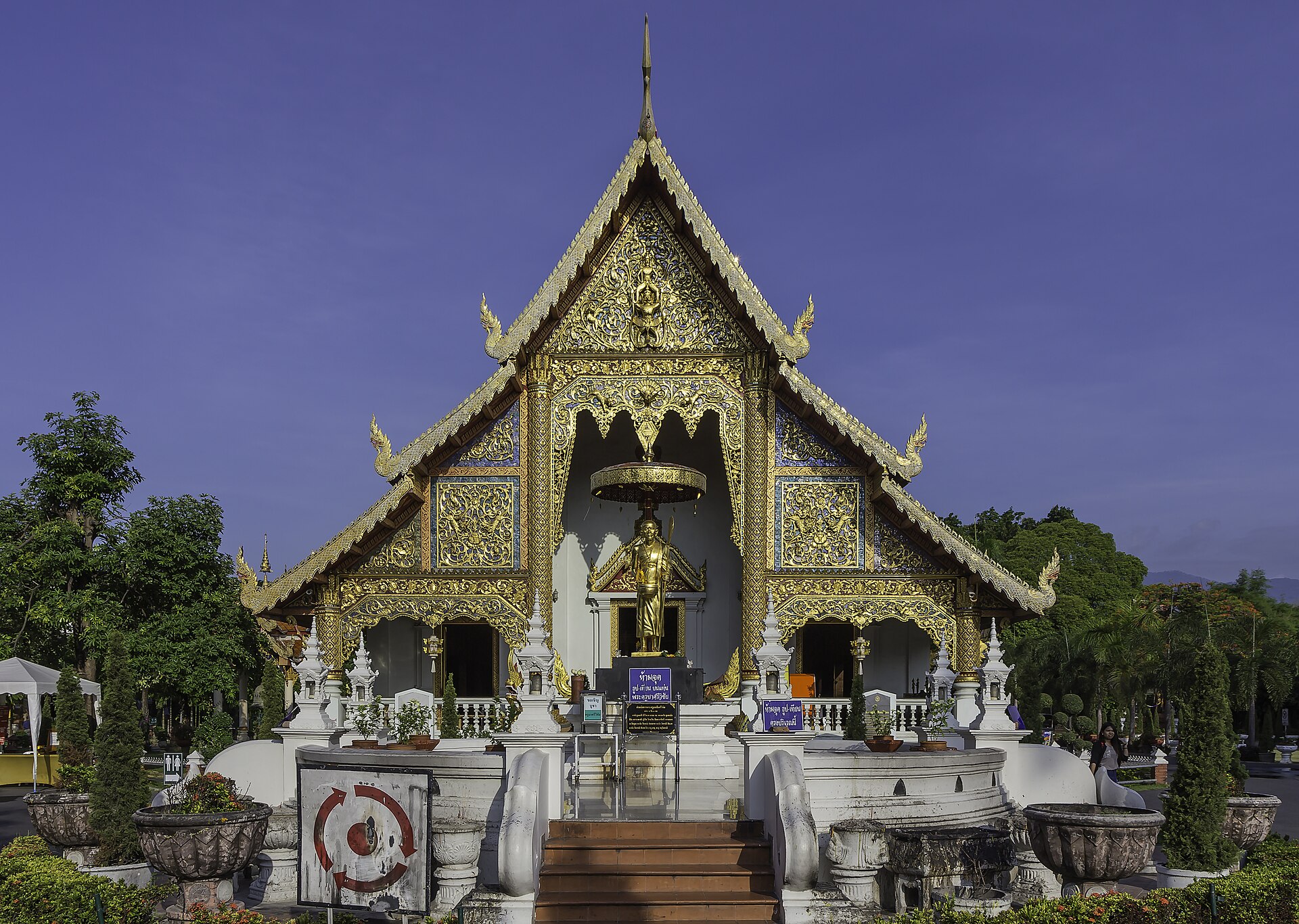
Wat Phra Singh is one of those rare places in Chiang Mai where the city’s spiritual heart still beats in rhythm with its centuries-old past. Tucked away in the old quarter, just west of the Ping River, it feels like a quiet witness to the days when Chiang Mai was the capital of the independent Lanna kingdom. The temple isn’t just a relic of history—it’s a living part of the city, where monks chant, locals pray, and rituals unfold not for show, but because they always have.
The centerpiece of Wat Phra Singh is the Viharn Luang, or Great Vihara, built in the 14th century. Its wooden pillars, intricately carved with floral and geometric patterns, rise to support high ceilings, while the walls are covered in murals depicting scenes from the Buddha’s life. The most revered object here is the Phra Singh Buddha, a bronze statue in the Bhumisparsha mudra, believed to be one of the most sacred in Northern Thailand. Legends say it was brought from Sri Lanka, though historians suggest it was likely cast locally in the 15th century. Either way, for devotees, it remains a powerful symbol, a focal point for prayers and offerings.
The temple’s architecture reflects the understated elegance of Lanna style—less about grandeur, more about harmony. The multi-tiered roofs of the viharas and chedis curve gently, like lotus petals, while golden spires catch the sunlight. Stone lions guard the entrance, and the overall effect is one of balance, not ostentation. Unlike the more ornate temples of Bangkok, Wat Phra Singh feels grounded, its beauty lying in its simplicity and the way it blends with the surrounding trees and shadows.
Beyond its religious significance, the temple has long been tied to the political life of the region. In the 16th century, it was the coronation site for Lanna rulers, and even after Chiang Mai became part of Siam, it remained a center for Buddhist scholarship. Today, a monastic school still operates here, where young monks study Pali scriptures, meditation, and ancient texts. During the rainy season, when monks spend more time in the monastery, the temple hums with activity—chanting, the rustle of pages, the soft footsteps of bare feet on stone.
One of the most moving traditions at Wat Phra Singh takes place during Songkran, the Thai New Year in April. As temperatures soar, the Phra Singh Buddha is paraded through the streets on a chariot, and crowds gather to sprinkle it with water—a gesture of purification and blessing. This isn’t a spectacle for tourists; it’s a deeply personal ritual, where families come together, offering jasmine flowers and prayers. The air fills with laughter, the scent of incense, and the sound of traditional music, turning the temple into a place of shared joy.
The temple complex holds other treasures, too. The Viharn Lai Kham, or Small Vihara, is adorned with 18th-century murals that offer a glimpse into everyday life in old Lanna. The paintings depict farmers in rice fields, market vendors haggling, and monks receiving alms—scenes that feel intimate and human. These murals aren’t just art; they’re a record of a time when Chiang Mai was a self-sufficient city-state, its culture distinct from the rest of Thailand.
Nearby stands the Tripitaka Library, home to ancient Buddhist texts inscribed on palm leaves. These fragile manuscripts are rare, carefully preserved over centuries. While the library isn’t usually open to the public, monks sometimes allow visitors a peek inside, revealing the delicate script and the quiet reverence with which these texts are kept. The building itself is a fine example of traditional Lanna architecture, with carved wooden doors and windows that filter the light softly.
What makes Wat Phra Singh special isn’t just its history or its art—it’s the atmosphere. The temple grounds are shaded by old trees, offering a quiet retreat from the bustle of the city. There are no hawkers here, no crowds jostling for photos. Instead, there’s a sense of timelessness, where the sound of a bell or the rustle of leaves feels like part of something larger. For those who come seeking more than a quick visit, the temple reveals itself slowly, not as a tourist attraction, but as a place where the past and present coexist in stillness.