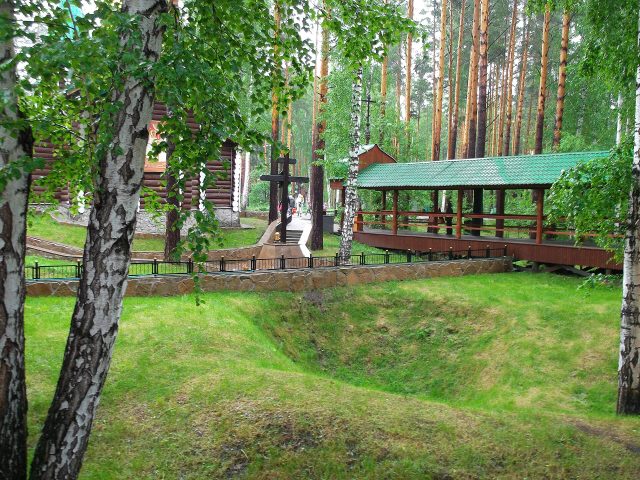
The Church on Blood in Yekaterinburg stands where history isn’t just remembered—it lingers in the very air, heavy with the weight of what once unfolded here. This is the site where, in July 1918, the last Russian imperial family—Tsar Nicholas II, his wife Alexandra, and their five children—were executed. The violence of that night didn’t just end a dynasty; it altered the course of a nation. The church built here doesn’t erase the past but transforms it into something solemn, a place where grief and reverence coexist.
Construction began in 2000, when the Russian Orthodox Church decided to honor the Romanovs with a memorial that would do more than mark a tragedy. Architects approached the project with deliberate care, designing a structure that would blend into Yekaterinburg’s urban fabric while carrying deep symbolic meaning. The church was completed in just three years, an impressive feat for such a grand undertaking. Consecrated in 2003, it quickly became one of the city’s most significant landmarks, drawing visitors not just for its beauty but for the stories embedded in its walls.
The architecture balances traditional Orthodox elements with details that reflect the church’s unique purpose. White stone walls and golden domes give it the familiar silhouette of Russian churches, yet there are subtle differences. The lower chapel, dedicated to the New Martyrs of Russia, mirrors the layout of the Ipatiev House basement where the execution took place. Fragments of the original walls are preserved here, and the granite floor evokes both sorrow and permanence. It’s a space that doesn’t just commemorate but physically recreates the past, forcing visitors to confront the reality of what happened.
Upstairs, the upper church—consecrated to All Saints Who Have Shone Forth in the Russian Land—feels brighter, more expansive. Mosaics and frescoes depict saints, martyrs, and scenes from Russian history, their colors soft against the white stone. The iconostasis, while classical in style, includes nods to the Romanov era, its details carefully chosen to evoke the time without overwhelming the space. There’s no excess here, just a quiet grandeur that invites reflection on the fleeting nature of power and the enduring strength of faith.
Beyond its role as a memorial, the Church on Blood remains an active parish, where daily services, prayers, and quiet moments of contemplation take place. Pilgrims light candles, tourists wander the grounds, and locals stop by to sit in silence. In summer, the church is surrounded by visitors; in winter, its golden domes gleam against the snow, a striking contrast to the bustle of the city below. The building doesn’t just stand apart from Yekaterinburg—it feels like a natural part of it, a place where the past and present coexist.
Adjacent to the church, a small museum offers a deeper look into the events that led to the Romanovs’ execution. The exhibits include documents, photographs, and personal items recovered during excavations, all arranged to provide context without imposing a single narrative. The collection is modest but powerful, piecing together fragments of a story that still resonates today. It doesn’t claim to have all the answers but instead lets visitors draw their own conclusions.
For many in Yekaterinburg, the Church on Blood is more than a tourist site—it’s a part of the city’s identity. Memorial events are held here each year on the anniversary of the execution, and during major Orthodox holidays, the church becomes a gathering place for worshippers from across the region. Yet it doesn’t feel out of place in a modern city. Its architecture complements the mix of old and new that defines Yekaterinburg, where historic buildings stand alongside contemporary structures.
Visiting the church leaves an indelible impression, a mix of sorrow and peace. The weight of history is impossible to ignore, yet the building itself—its light walls, golden domes, and serene atmosphere—offers a sense of continuity. It doesn’t just remember the past; it suggests that memory can be a bridge rather than a divide. That tension between grief and hope is what makes the Church on Blood so compelling. It doesn’t provide easy answers, but it asks the right questions, leaving visitors to grapple with them long after they’ve left.