Lungshan Temple in Taipei is one of those rare places where time seems to slow down, not in the way of a museum exhibit frozen behind glass, but as if the very air carries the weight of centuries without hurry. Built in the mid-1700s, it wasn’t just preserved through the years—it was lived in, prayed in, and relied upon, surviving earthquakes, wars, and the relentless march of modernity while remaining exactly what it was always meant to be: a sanctuary for those who need it. The temple has witnessed the transformation of Taipei from a quiet settlement into a sprawling metropolis, yet it stands unchanged in its purpose, a quiet anchor in the middle of the city’s constant motion.
The architecture is striking even to those unfamiliar with traditional Chinese design. The sweeping, upturned eaves of the roof, layered with green tiles, give the building a sense of movement, as if the structure itself is rising toward the sky. Every detail carries meaning—dragons coiled around pillars, phoenixes perched on beams, and intricate carvings of deities that were never just decoration but symbols of protection, prosperity, and divine favor. The stone lions guarding the entrance are more than ornamental; they’re a testament to the skill of craftsmen who shaped them centuries ago, their expressions fierce yet somehow welcoming. Inside, the temple is divided into halls, each dedicated to different gods, but the central shrine belongs to Guanyin, the goddess of mercy, whose presence draws the most devotion.
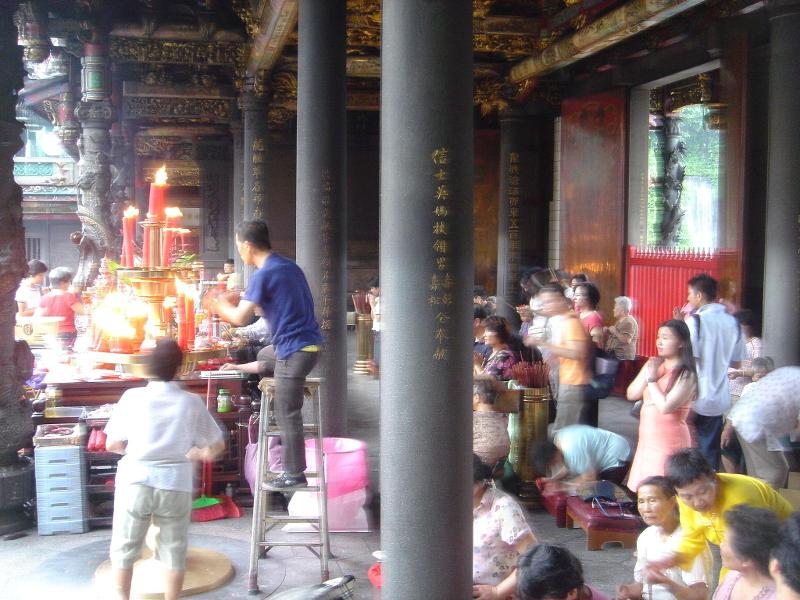
This is no relic of the past. The moment you step inside, you realize Lungshan Temple is very much alive. The scent of incense is thick in the air, curling upward in slow, deliberate spirals before dissipating into the rafters. Worshippers light candles, arrange offerings of fruit and flowers, or simply sit on the wooden benches, watching the steady rhythm of temple life. On ordinary days, it’s a place of quiet reflection, but during festivals—like Lunar New Year or Guanyin’s birthday—the temple becomes a sea of people, the air humming with prayers and the murmur of shared faith. It’s not a spectacle for tourists; it’s a living tradition, unfolding as it always has.
The temple’s history is intertwined with that of Taiwan itself. It was founded by settlers from Fujian Province in mainland China, who brought not just their gods but their way of life. In its early years, Lungshan Temple wasn’t just a place of worship—it was the heart of the community, where disputes were settled, business was conducted, and festivals were celebrated with opera performances and feasts. During the Japanese colonial period, it narrowly escaped destruction, and in World War II, its roof was damaged by bombing raids. Yet each time, the temple was repaired, not as a monument to the past, but as a necessity for the present. Today, it stands as both an architectural treasure and a symbol of resilience, a place that has weathered every storm without losing its essence.
For many visitors, Lungshan Temple offers the first real glimpse into Taiwan’s spiritual traditions. There’s no scripted experience here, no guided tour explaining what you’re supposed to feel. Instead, you watch as locals press their palms together in prayer, bow before the altars, or leave offerings with quiet reverence. The rituals aren’t performed for an audience; they’re part of daily life, as natural as breathing. Unlike so many tourist sites that feel staged, Lungshan Temple exists on its own terms, and if you’re lucky, you might find yourself slipping into its rhythm, even if just for a moment.
The surrounding neighborhood of Wanhua is one of Taipei’s oldest, a place where the city’s past lingers in the narrow alleys and low-slung buildings. The streets here are lined with small shops selling everything from incense and paper money for offerings to handmade wooden combs and ceramic bowls. It’s easy to imagine what Taipei must have looked like before skyscrapers and neon signs took over—less polished, perhaps, but full of character. Nearby, the Huaxi Night Market offers a taste of local life, with stalls serving up steaming bowls of oyster omelet, crispy fried tofu, and sweet potato balls. The market isn’t just a place to eat; it’s where the neighborhood gathers, where old friends catch up over bowls of noodles and children dart between the crowds.
What makes Lungshan Temple special isn’t just its age or its beauty, but the way it refuses to be anything other than itself. It doesn’t try to impress or entertain; it simply endures, a quiet constant in a city that’s always changing. For some, it’s a place of pilgrimage. For others, it’s a historical landmark. And for many, it’s just a peaceful corner in the middle of the chaos, a place to light a stick of incense and pause for a moment. But no matter why you come, it’s impossible to leave without feeling that you’ve touched something timeless—a piece of Taiwan’s soul that hasn’t faded, no matter how much the world around it has.