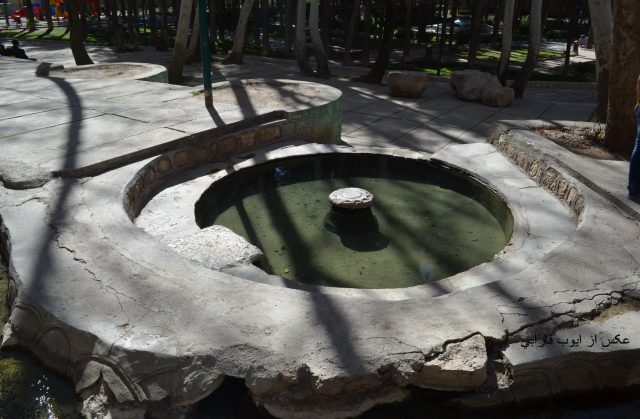
On the edge of Khersin, a quiet town in Iran’s Zagros foothills, the Temple of Anahita sits undisturbed. This isn’t a place you’ll find on most tourist maps. The dry slopes and scattered villages here hold a different kind of history—one where water was sacred, and gods shaped daily life.
The temple honors Anahita, the Zoroastrian goddess of water, fertility, and purity. Her worship once stretched from Anatolia to Central Asia, but few traces of her cult remain. This site is one of them. Massive stone blocks, fitted without mortar, form a square enclosure with an open courtyard. At its center, the faint outline of a pool marks where sacred waters once flowed, carrying the goddess’s blessings.
Scholars place its construction in the Achaemenid period, around the 4th or 3rd century BCE. Some tie it to Artaxerxes II, who promoted Anahita’s cult to unify his empire. Others argue for later Parthian modifications. The temple’s design reflects the era’s cultural exchanges—Persian, Mesopotamian, and Hellenistic influences merging in its stones.
The landscape tells its own story.
Khersin lies in Kermanshah Province, where arid plains give way to lush valleys. Ancient paths, still used by shepherds, crisscross the land. Nearby, rock reliefs and ruined settlements hint at a long history before empires rose. The temple isn’t alone here—it’s part of the earth itself.
What stands out most is the quiet. No crowds, no vendors, no signs. The wind rustles through the stones, or a farmer’s voice carries from the fields. On hot days, the air shimmers above the warm rock. The stillness makes it easy to picture the temple as it once was—a place of pilgrimage, where people came to pray, to seek favor, to connect with something beyond themselves.
For visitors, the temple offers more than old stones. It’s a reminder of how people once saw their place in the world. Water, in this dry land, was never taken for granted. Anahita embodied that reverence—a goddess who controlled rains and rivers. Today, when water flows from taps, the temple quietly asks us to remember its fragility.
The temple has stood for over two thousand years. Empires rose and fell. Religions changed. Yet these weathered stones remain, modest but enduring. There’s no grand restoration here, no attempt to recreate the past. The temple simply exists, as it has for centuries.
This isn’t a museum. No plaques explain every detail. No tours guide you through its history. Instead, it invites you to wander, to sit on the sun-warmed stones, to listen. It doesn’t demand attention but rewards those who pause. In a world where everything is curated, the temple offers something rare: the chance to feel history, not just learn it.
Standing in its courtyard, you can almost hear the echoes of those who came before—people who looked up at the same sky, who believed in the power of water and the gods who governed it. The stones, the silence, the horizon—all of it makes the past feel close.