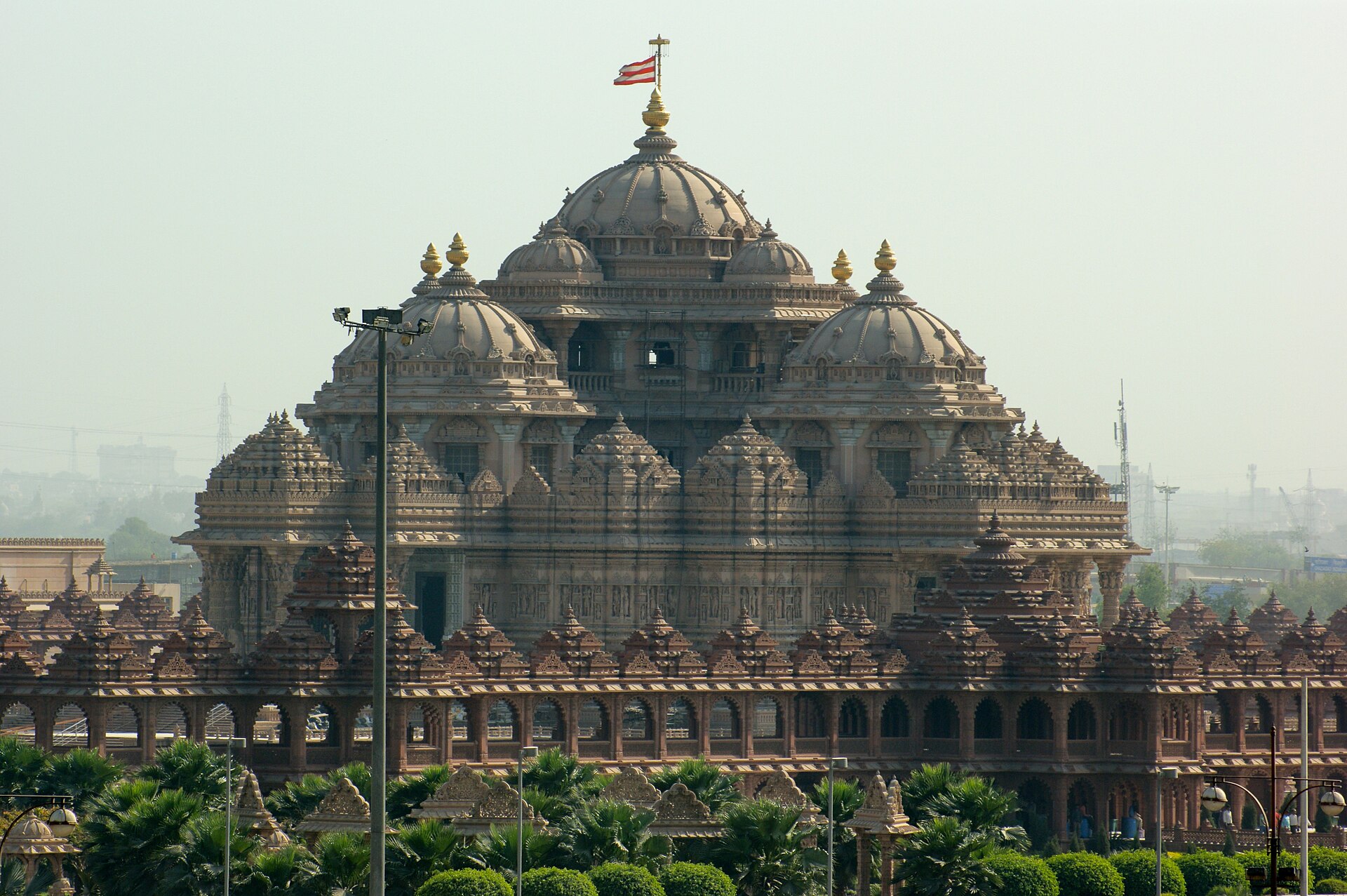
Akshardham Temple in Delhi is a place where contemporary design meets age-old traditions, and grand scale coexists with quiet spirituality. Completed in the early 21st century, it stands as one of India’s most striking religious complexes, though it doesn’t claim the ancient heritage of older sanctuaries. Its creation is tied to the Swaminarayan movement, which emerged in the 19th century and now has millions of followers worldwide. More than just a place of worship, Akshardham is an attempt to capture the essence of Indian culture—where art, philosophy, and faith intertwine.
The architecture of Akshardham is breathtaking in its detail and ambition. The main structure is built from pink sandstone and white marble, materials deeply rooted in India’s architectural history. The central dome rises nearly forty meters, its surface adorned with thousands of hand-carved figures—deities, saints, animals, and mythical beings. Every element was crafted by hand, without modern machinery, a testament to the artisans’ dedication to traditional methods. Surrounding the temple, gardens with fountains, bridges, and artificial lakes create a sense of harmony between human craftsmanship and nature.
Inside the complex, a sense of tranquility prevails. The main hall, or mandir, is dedicated to Bhagwan Swaminarayan, the movement’s founder. Unlike many Hindu temples, it doesn’t feature multiple altars to different gods. Instead, a towering statue of Swaminarayan takes center stage, surrounded by figures of his disciples. The walls are lined with intricate reliefs depicting his life and the movement’s history. Light filters through high windows, casting a soft glow that enhances the space’s airy, uplifting atmosphere.
One of the most compelling parts of Akshardham is its exhibition on Indian history and culture. Spread across several halls, it explores themes from the ancient Indus Valley civilization to India’s scientific and artistic achievements. Visitors can see replicas of archaeological finds, models of famous temples and cities, and interactive displays explaining the basics of Indian philosophy. While not an academic deep dive, the exhibition offers a broad yet engaging introduction to India’s cultural richness.
The evening musical fountain show is a highlight for many. Set to classical Indian music, water jets create mesmerizing patterns in the air, accompanied by light effects and a narrative about timeless values like love, compassion, and devotion. For many, this spectacle becomes the emotional peak of their visit—a moment where architecture, art, and nature merge into something unforgettable.
Akshardham isn’t a traditional pilgrimage site. There are no ancient relics or centuries-old scriptures here. Instead, it presents a modern interpretation of spirituality, where faith feels accessible and integrated into everyday life. People of all backgrounds visit—not just for worship, but to find peace, admire the craftsmanship, or simply escape the city’s chaos for a while.
What’s remarkable is how quickly the temple was built. The entire complex took just five years to complete, an astonishing feat for a project of this scale. Thousands of artisans from across India worked on it, many passing down skills through generations. Even more striking is that the temple wasn’t funded by the government or corporations—it was made possible entirely through donations from Swaminarayan followers. This makes Akshardham not just an architectural marvel but a social one, showing how collective faith and effort can bring something extraordinary to life.
Today, Akshardham is one of Delhi’s most visited sites, though it’s not as iconic as the Red Fort or Jama Masjid. Perhaps that’s because it doesn’t dwell on the past but instead invites reflection on the present. There’s no weight of centuries here, just a sense of time moving slowly, deliberately. Some visitors leave with a new perspective, others simply with admiration for its beauty—but few walk away unmoved.