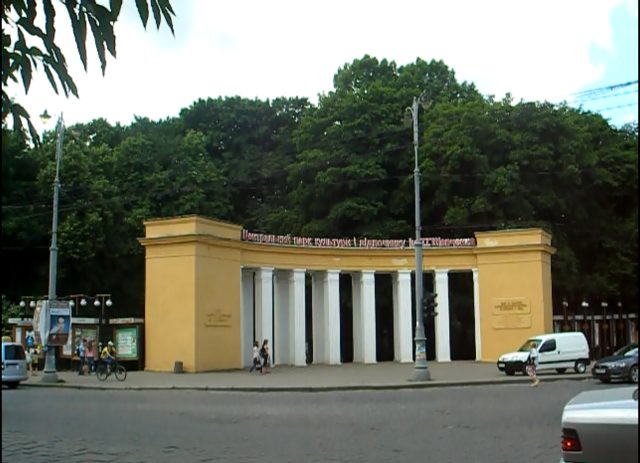
The town hall in Khotyn was built in the late 19th century as the seat of local government. Now it stands on the Dniester’s banks, its walls holding stories of the city’s past.
Its design mixes late historicism with neo-Gothic touches. A tall tower rises above the two-story structure, capped by a weather vane. Pointed arches, decorative cornices, and small turrets give the facade the look of a fortress. Inside, high ceilings and spacious halls once housed city officials. Today, they occasionally host exhibitions and cultural events.
The building sits in Khotyn’s old quarter, where other historic structures surround it. The square in front has long been the city’s gathering place—markets, celebrations, and public meetings all took place here. Nearby, remnants of ancient fortifications hint at Khotyn’s turbulent history. The town hall itself has survived sieges, reconstructions, and shifting rulers, each leaving traces behind.
Khotyn’s history mirrors the region’s. Over centuries, it has been part of the Moldavian Principality, the Ottoman Empire, the Polish-Lithuanian Commonwealth, and the Russian Empire. The town hall, built during the Russian imperial period, reflects a shift toward European-style governance while retaining echoes of earlier eras. It was a statement of progress, a blend of modernity and tradition.
The square around the town hall is always alive. Vendors set up stalls, locals chat over coffee, and visitors wander the cobblestone streets. Nearby cafes serve Bukovinian dishes, adding to the city’s atmosphere.
If you’re exploring Khotyn, the town hall is a good place to start. From here, you can walk through the old streets, visit the local history museum, or simply soak in the quiet charm of the city. The Dniester’s beauty and centuries of human stories shape its character.
History isn’t just in grand capitals. In Khotyn, the town hall carries the weight of time—every stone, every arch tells a story. Though it no longer serves its original purpose, it remains a symbol of the city’s identity. Visiting it isn’t just about seeing an old building; it’s about feeling the pulse of a place where the past is still present.