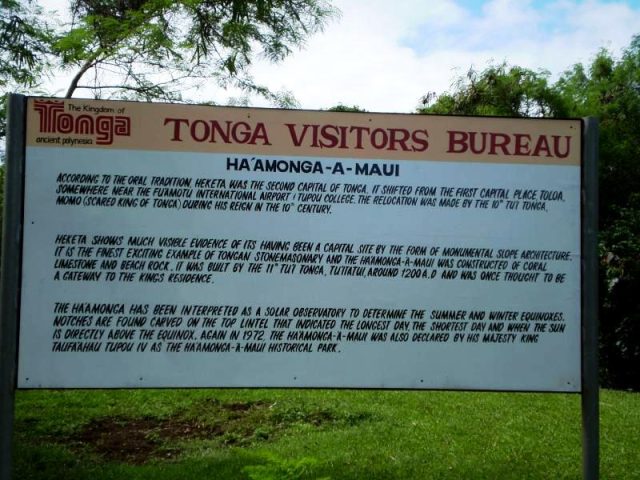
Haʻamonga ʻa Maui is one of those rare ancient sites that quietly demands attention, not with grand spectacle, but with the weight of centuries. Standing in the village of Niutoua on the northern edge of Tongatapu, this trilithon is often called Tonga’s Stonehenge, though the comparison is more poetic than precise. Three massive limestone slabs form its structure—two upright, one resting across the top like a lintel—rising nearly five meters high. Each stone weighs several tons, and their precise origins remain unclear, though they were likely quarried elsewhere on the island. Most scholars agree the structure dates to the early 13th century, built during the reign of King Tuʻitātui, a period when Tonga’s influence stretched across much of Polynesia.
Theories about its purpose are as varied as the legends surrounding it. Some stories credit the demigod Maui, a figure woven into Polynesian mythology, with lifting the stones from the ocean floor as a display of strength. Others suggest the trilithon served as a gateway to a royal compound or even an astronomical marker, aligning with solstices or equinoxes. Archaeologists, however, remain cautious. While the structure may have been part of a larger ceremonial complex, its exact function is still debated. What is certain is that its construction required extraordinary effort—moving and positioning such massive stones without wheels or metal tools would have demanded coordinated labor on a scale rarely seen in pre-modern Polynesia.
The logistics of building Haʻamonga ʻa Maui are staggering to consider. The limestone blocks were transported from elsewhere on Tongatapu, possibly using wooden rollers, ropes made from plant fibers, and earthen ramps to hoist the horizontal slab into place. The precision of the fit suggests careful planning, and the sheer physical challenge speaks to the organizational power of Tonga’s early society. It’s a reminder that even in an era without written records, complex engineering was possible when driven by necessity or ambition.
Today, the site is modestly maintained, surrounded by a low fence and a well-kept lawn. There are no souvenir stalls or guided tours here—just the quiet presence of the stones themselves. Visitors often linger, not for the sake of photographs, but to absorb the stillness. The air carries the sound of rustling palms and the distant murmur of the ocean, a backdrop that makes it easy to imagine the site as it might have been centuries ago: a place of gathering, where chiefs and priests convened under the watch of the king.
A short walk away stands Esi Maka Faʻakinanga, a stone throne carved from a single block of coral limestone. Like the trilithon, it’s attributed to the time of Tuʻitātui, and local tradition holds that the king used it during ceremonies, surveying his people from its elevated position. The throne faces the surrounding landscape, reinforcing its role as a seat of authority. While visitors are welcome to sit here, the site retains a sense of reverence, a quiet acknowledgment of its past significance.
Haʻamonga ʻa Maui is more than an archaeological curiosity; it’s a symbol of Tonga’s historical legacy. Long before European explorers arrived, the kingdom was a dominant force in the Pacific, and this structure stands as a testament to that era. Even in the 19th century, when outsiders first documented the trilithon, it was already ancient, yet it remained a living part of Tongan culture. Today, its image appears on the national coat of arms, and the site is protected as a national treasure, a rare surviving link to a time when Tonga’s rulers shaped the destiny of the region.
Reaching the site is straightforward. From Nukuʻalofa, the drive takes about half an hour, and while public buses run irregularly, they’re a reliable option for those without a car. The best times to visit are early morning or late afternoon, when the light softens the contours of the stones and the heat is less intense. There are no cafes or shops nearby, so bringing water and a snack is a good idea. Locals are usually happy to share stories about the site if asked, offering a glimpse into how it’s perceived today—not just as a relic, but as a living piece of history.
What makes Haʻamonga ʻa Maui special isn’t its fame or the crowds it draws, but its unassuming authenticity. There’s no pressure here, no scripted experience, just the quiet dialogue between past and present. For those who take the time to visit, it offers something rare: a moment of connection to a world that existed long before ours, yet still feels strangely close. In a place where time moves differently, the stones stand as silent witnesses to the ingenuity and ambition of those who came before.